Founding of the Empire of Murmurin
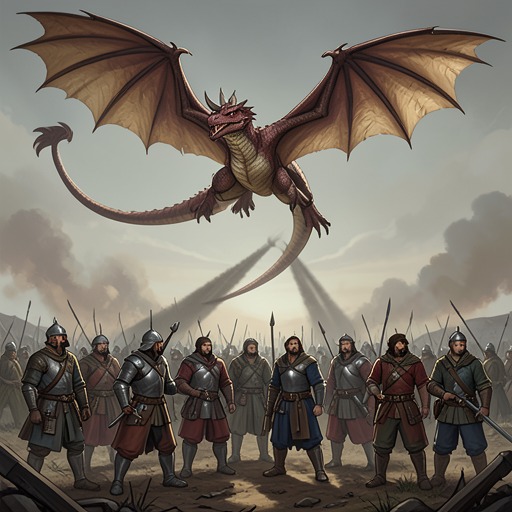
Vainqueur the DragonThe Founding of the Empire of Murmurin marks the moment when Vainqueur Knightsbane’s personal dominion becomes an announced political order. Victory over Furibon gives him a claim to the surrounding lands, while his enormous power, monster following, and talent for treating every achievement as proof of royal greatness allow him to elevate himself from king to emperor. The new empire is simultaneously a territorial state, an adventurer organization, a monster military, and an extension of Vainqueur’s hoard: its institutions promise collective order, but its first principle is the protection of one dragon’s wealth.
Causes and Territorial Claim
After Furibon’s defeat, the political opportunity is unusually clear. Victor Dalton explains that Gardemagne had promised the victor the surrounding lands, a territory called a barony. He has already sent Savoureuse’s message by homing pigeon so that Vainqueur can be officially named Baron of Murmurin once the Adventurer Guild is notified. Victor also argues that distance from Gardemagne, the density of monsters, and proximity to Maure’s territory make Murmurin effectively impossible to dislodge, even if the guild refuses to recognize the claim. The arrangement therefore rests on both delegated legitimacy and practical possession: Gardemagne has offered the territory, but Vainqueur’s control depends just as much on remoteness and force. Vainqueur initially tries to solve the problem through naming. He proposes a title combining his kingship of the Albain Mountains with his barony of Murmurin, but finds the resulting formulations inelegant. Victor supplies the decisive political vocabulary by suggesting that Emperor stands above King because an empire is larger than a kingdom. The suggestion changes Vainqueur’s self-understanding: he realizes that he had called himself king only because he did not know a higher title existed. The founding thus begins not with a constitutional procedure but with a linguistic discovery that lets Vainqueur enlarge his identity and then impose that enlarged identity on the territory.
Proclamation and Imperial Authority
Vainqueur adopts the full style of “His Majesty Vainqueur Knightsbane, First of his Name, Great Calamity of this Age, and Emperor of Murmurin and the Albain Mountains.” The title joins inherited dragon pride, remembered destruction, geographical sovereignty, and theatrical self-praise. It is not merely ceremonial. The Class System confirms that Vainqueur has established “imperial authority” over the Murmurin region and possesses power worthy of the title, rewarding his self-promotion with a level in Noble and transforming the Noble Class into the Emperor Class. That recognition also gives the empire a conditional structure. The system warns that Vainqueur will lose the Emperor Class benefits if he cannot defend his title against challengers and doubters, recovering them only after defeating the naysayers. Imperial legitimacy is therefore represented as something that must continually be performed and defended. A declaration can create the title, but only continued power can preserve its rewards. The game-like rule turns political authority into a measurable cycle of claim, challenge, and reaffirmation. The new class grants Vainqueur additional health, stamina, agility, intelligence, charisma, and luck. More importantly, it rewrites three of his existing perks. Old Money becomes Born in the Purple, tripling his chances of gaining treasures after killing monsters. Snobbery becomes For the Emperor, giving soldiers and vassals a stat and morale bonus proportional to his Charisma when he leads them in battle. Aristoradar becomes Dynasty, allowing him to grant one Noble level to another person, after which that individual must advance independently. The system consequently translates imperial power into three concrete mechanisms: increased treasure acquisition, charismatic military command, and the ability to reproduce nobility among followers.
Government, Ritual, and Law
Vainqueur marks the founding with Vainqueur Day, an annual celebration of Furibon’s defeat. The holiday is designed as a public performance of imperial memory: monsters are to feast on cattle, burn a wooden puppet of Furibon before an adoring crowd, and cheer the emperor. Vainqueur also orders the construction of a statue of himself in the werewolf village, larger than the statues of the gods in human temples. The holiday and monument make conquest repetitive and visible. Each year, the empire will return to the same victory, the same enemy, and the same glorified ruler, turning a military episode into civic ritual. The first imperial commandment is “no taxes, ever.” Vainqueur reaches this decision after reflecting on his own experience and on the cruelty of Victor Dalton’s manling king. He identifies the separation of a dragon from hard-won treasure as the greatest possible crime and presents tax abolition as an act of magnanimity. The law is therefore both popular policy and self-portrait: it protects inhabitants from extraction, but its stated moral foundation is still the dragon’s fear of losing his hoard. The empire’s first law makes its founding contradiction explicit, pairing a potentially attractive anti-tax principle with a ruler whose political imagination remains centered on possession.
Administration, Military, and Economy
The empire does not emerge from an empty wilderness. Vainqueur has already turned Victor Dalton into his chief of staff and living signature, assigning him responsibility for paperwork and administrative management. Victor is also ordered to create a profitable use for discarded monster parts, junk, and corpses rather than allowing them to be left for animals. This converts waste into commerce and gives the emerging state an economic function, while placing the practical burden of administration on a human subordinate who privately expects no payment. The military base of the new order is similarly expansive. Vainqueur observes a line of applicants, mostly kobolds, seeking to join the campaign against Furibon. Victor counts one hundred kobold applicants and reports that Croissant has also been asked to send inhabitants with class levels above twenty, including a troll, a dryad, and a golem. Vainqueur presents this recruitment as universal rather than discriminatory, claiming that every creature is equally inferior to him and should have the right to become his emergency food. The joke reveals the empire’s coercive hierarchy even as the recruitment policy broadens its membership across species. The Kobold Rangers are integrated into this structure as workers and soldiers, while Vainqueur loans them weapons from his hoard. He dislikes spreading his treasures beyond his sight, so he asks Barnabas to produce weapons for the minions and treats the existing equipment as temporary incentives. Victor alone is considered fully trustworthy to wield the dragon’s sacred treasures in battle. The policy makes material access a reward and a mechanism of control: the empire’s soldiers may fight for Vainqueur, but the most valuable instruments remain personal extensions of the emperor’s hoard. The same organizational logic later supports Nethermart. Under Malfy’s direction, bug fiends construct a six-floor, ivory-draped building in northern Murmurin, the tallest structure near Vainqueur’s statue. Its opening is announced as the first fiendish magic-item shop in Outremonde, serving monsters and mortals alike and accepting souls as collateral when customers cannot pay in coins. Weapons are offered at a thirty percent discount in anticipation of war with Maure. Nethermart shows the empire developing beyond conquest: its military needs, commercial institutions, supernatural labor, and imperial image begin to reinforce one another.
Consequences and Political Meaning
The founding gives Murmurin a recognizable political identity without making Vainqueur’s rule conventional. It has a claimed territory, a ruler with a system-recognized class, a chief administrator, a recruited army, public works, a recurring holiday, a monument, a commercial center, and a first law. Yet every institution bears the mark of its creator. Bureaucracy is delegated to Victor Dalton, weapons remain tied to hoard ownership, public architecture magnifies the emperor’s image, and the central law is defined through a dragon’s relationship to treasure. The empire’s later public life preserves this mixture of celebration and destruction. After a Bragging Day, Vainqueur finds the surrounding area resembling the aftermath of a volcanic disaster, with no house left unturned and no sheep alive. He then calls the Kobold Rangers, gnolls, mimics, and other servants to end the party. The scene places imperial spectacle beside its material cost: the state can gather minions under a common ceremony, but its ruler’s festivities leave devastation for those same servants to manage. The Class System’s rewards clarify the deeper significance of the event. Vainqueur’s title is not only a social fiction, because the system converts authority into abilities that increase treasure, strengthen armies, and reproduce noble status. At the same time, the level ceiling later stops further advancement until a Crest is used, demonstrating that even an emperor’s ascent is bounded by an external rule. The founding therefore fuses satire and institutional force. Vainqueur’s empire begins as vanity made official, but once territory, followers, rituals, commerce, and executable class rules gather around that vanity, the joke becomes a durable political structure.