Furibon's Scythe
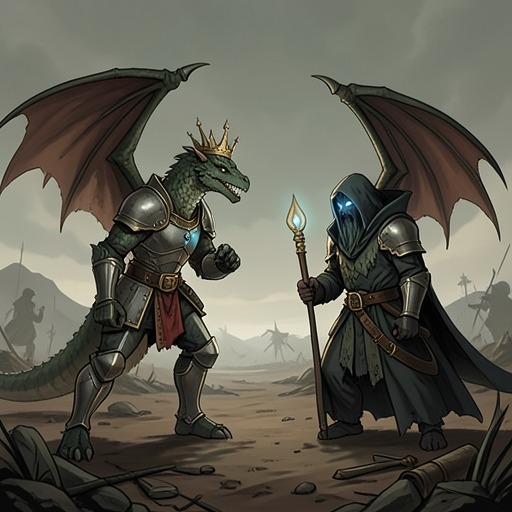
Vainqueur the DragonFuribon's Scythe is a magical item whose importance extends beyond its function as a weapon. It belongs to the great hoard of Vainqueur Knightsbane and carries the presence of Furibon, whose identity remains attached to the object even when the scythe is being handled by someone else. Its recovery and misuse turn a symbol of fealty into a comic object of material inconvenience.
Return to the Great Hoard
After the battle, Vainqueur Knightsbane's surviving minions gathered the treasure beside his statue. The hoard was substantial, though it fell short of the perfect golden marvel sacrificed to a greedy goddess, and the crystallized princesses preserved some of its prestige. In this setting, the return of magical possessions becomes a ritual of restored order: Vainqueur Knightsbane's flying Grand Vizier throws Furibon's Scythe, along with every magical item in his possession, onto the pile as a token of fealty. The other minions follow by returning their own magical items, completing what the narration describes as the cycle of life.
The gesture gives Furibon's Scythe a political meaning. It is not merely surrendered property but part of the collective treasure through which the minions acknowledge Vainqueur Knightsbane's authority. The scythe's place on the hoard therefore confirms the reassembly of the master's resources after the battle, while also placing individual magical equipment beneath the larger identity of the hoard.
A Missing Item and an Unreliable Custodian
The restoration is immediately complicated when Vainqueur Knightsbane notices that several items he had lent out are missing. His question about the absent equipment exposes a gap between formal fealty and practical accountability: the minions have returned what they possess, but not everything that once belonged to their master has survived its circulation among them. Furibon's Scythe is specifically named among the items thrown back onto the hoard, yet the surrounding exchange establishes that the recovery is incomplete.
Victor Dalton admits that he has, in his words, "kinda lost them." His embarrassed gesture of scratching the back of his head makes the loss feel less like a grave betrayal than a revealing failure of stewardship. The scythe thus participates in a recurring tension between Vainqueur Knightsbane's hoard-centered values and Victor Dalton's improvised, careless relationship with magical objects. To Vainqueur Knightsbane, an item is part of status and accumulated power; to Victor Dalton, it can become something temporarily handled and then inexplicably misplaced.
From Weapon to Back Scratcher
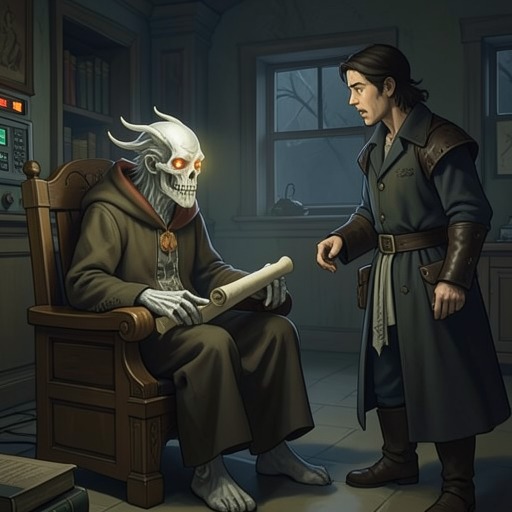
Furibon's Scythe later appears in a markedly different context. In a bedside scene, Charlene is recovering from drinking heavily, while Croissant lies fully clothed on the ground, snoring with a bottle in one hand and Victor Dalton's scythe in the other. The weapon is no longer displayed as treasure or wielded in combat. It has become an accessory to drunken disorder.
Furibon complains that Croissant used him to scratch Croissant's back, repeating the complaint in disbelief: "He used me to scratch his back," followed by "To scratch his back..." The wording preserves Furibon's humiliation through the weapon itself. The scythe's material function has eclipsed its symbolic and martial identity, and the object exposes the indignity of being useful in a way wholly opposed to its apparent purpose.
Victor Dalton's reaction completes the comic reversal. He blinks at the sight, looks from Croissant to Charlene and back again, and finally remarks, "That's awkward." The scene makes the scythe conspicuous precisely because it has been displaced from its expected role. Once an instrument associated with Furibon and the hoard, it becomes an embarrassing household object whose presence reveals the disorder of the room and the casual misuse of magical possessions.
Materiality and Comic Significance
Furibon's Scythe moves between systems of value without losing its identity. In the hoard, it is a magical possession returned during a ceremony of allegiance; in Victor Dalton's admission, it belongs to a chain of loans and losses; beside the bed, it is an uncomfortable physical object grasped by a sleeping drunk. Each transition strips away some of the grandeur attached to it while making its material presence more visible.
That movement produces the scythe's central irony. A weapon can serve as a token of loyalty, yet it can also be treated as disposable equipment; an object tied to Furibon's dignity can be reduced to a back-scratching tool; and a recovered treasure can remain entangled in the careless circulation that caused magical items to go missing. Furibon's Scythe therefore links the grand economy of Vainqueur Knightsbane's hoard to the intimate absurdity of the bedside scene, showing how authority and prestige are repeatedly unsettled when enchanted things enter ordinary, inept, or drunken use.