Gardemagne–Ishfania Mutual Protection Pact
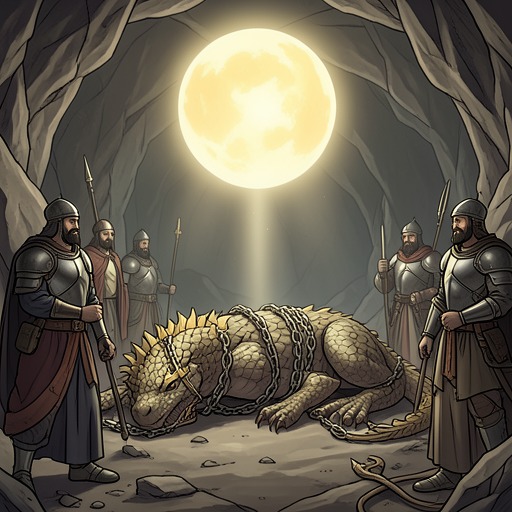
Vainqueur the DragonThe Gardemagne–Ishfania Mutual Protection Pact is the treaty through which Gardemagne recognizes Vainqueur Knightsbane as Emperor of Ishfania after the destruction of Brandon Maure’s army and the collapse of Ishfania as an independent nation. It transforms military possession into a legally acknowledged adventurer state, preserves Vainqueur’s political standing and Emperor class, and establishes a mutual pledge against war between the two powers and against outside threats.
Causes and Political Background
The pact arises from a regional power vacuum rather than from a simple gesture of friendship. King Roland explains that Brandon Maure is dead, his army has been destroyed, and Ishfania no longer exists as a nation, even though its demon-infested desert still contains enough resources to attract competing claims from the Eversun Empire, Barin, and Prydain. Gardemagne therefore seeks to occupy the diplomatic vacuum before a new Century War begins. The treaty is presented as preventive statecraft: recognition of Vainqueur’s rule is intended to keep rival powers from turning Ishfania into another battlefield.
Vainqueur’s claim rests on conquest and protection of treasure. He protests that he defeated the moth-like threat and saved the great hoard from Brandon Maure. King Roland recasts that boast as a basis for sovereignty, offering to recognize the territory Vainqueur already treats as his own rather than demanding that Gardemagne contest it. The arrangement thus joins two incompatible political languages: Gardemagne speaks in terms of borders, recognition, and international stability, while Vainqueur understands dominion through personal power, hoard protection, and victory over an enemy.
Terms and Operation
Under the pact, Gardemagne recognizes Vainqueur as Emperor of Ishfania and treats the territory as an official adventurer state. Vainqueur retains the benefits of the Adventurer Guild while ruling his territory as he wishes. The agreement therefore does not erase his unusual constitutional status; it places a monster emperor and his domain within a framework that Gardemagne can officially acknowledge without requiring him to govern according to the ordinary model of a human kingdom.
The central obligation is a solemn promise that Gardemagne and Vainqueur’s country will never take up arms against one another. The two sides also agree to fight together against outside threats, making the treaty a mutual protection pact rather than merely a declaration of territorial recognition. Its security clause converts the former possibility of conflict between Gardemagne and Vainqueur into a formal alliance, while the external-threat clause gives both parties a reason to preserve cooperation beyond the immediate settlement.
The treaty also has a direct mechanical consequence for Vainqueur. He realizes that official recognition means he will never lose access to his Emperor class, and he accepts the arrangement as a tribute. His response reveals how completely political legitimacy is filtered through the Class System: diplomatic recognition matters to him not only as authority over Ishfania but also as protection of the status and power attached to his imperial class.
Borders and Territorial Order
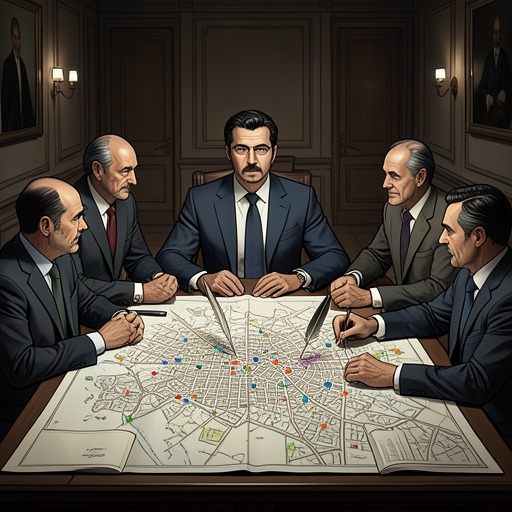
The pact is accompanied by a concrete frontier. King Roland asks Nostredame for a map of the continent and a pen, then draws the Albain Mountains as the boundary between Gardemagne and Vainqueur’s dominion. The agreement therefore produces more than a verbal promise. It maps the new political order onto the landscape, giving a formerly unstable region a recognized edge between Gardemagne’s kingdom and the newly acknowledged Ishfanian domain.
That border is especially significant because Ishfania has been described as the result of an earlier imperial catastrophe. The Sablaris, a dark elf empire that ruled much of the southern continent, Ishfania, and Barin, became associated with the cult of Sablar the destroyer; its followers caused a magical cataclysm that turned the empire into a red desert in pursuit of universal entropy. Brandon Maure later took over the ruins of Ishfania with summoned monsters. The pact thus overlays a new legal boundary on territory already marked by collapse, desertification, conquest, and monster rule.
Relation to Vainqueur’s Rule
The treaty formalizes a pattern already visible in Vainqueur’s government at Murmurin. He declares that no taxes will ever be imposed because separating a dragon from a hard-won hoard is, in his view, the greatest crime. He also promises protection to minions and hoarders who send their treasures to him for safekeeping, presenting himself as a defender against future Furibons. The pact extends this personal protection logic from individual treasures and local subjects to an entire state: Vainqueur’s authority becomes territorially organized without ceasing to be centered on his appetite, hoard, and coercive power.
His rule combines generosity, extraction, and violence. He loans valuable weapons to trusted servants such as Victor Dalton, charges for or controls access to wealth, and rewards labor through payments that can be disputed even when the dragon considers them generous. He accepts gnoll workers who had served Furibon after condemning and forgiving them, yet he also eats twenty troublemakers before they obey. The mutual protection pact belongs to this same political world. It presents sovereignty as protection, but protection remains inseparable from the ruler’s power to decide who belongs, who is forgiven, and who is subject to force.
Significance and Consequences
The Gardemagne–Ishfania Mutual Protection Pact marks a transition from adventuring violence to recognized state formation. Vainqueur’s victory over Brandon Maure does not remain merely a personal triumph or the seizure of a hoard; through King Roland’s proposal, it becomes the foundation of an official political entity. The treaty also protects Gardemagne from an immediate rival while discouraging other powers from exploiting Ishfania’s resources, making Vainqueur’s empire useful to human diplomacy even though its ruler is a dragon.
Its legal structure reflects the book’s plural political order. Religious contracts can authorize the transformation of corpses into necromantic labor, monster rulers can declare their own commandments, the Adventurer Guild can grant institutional benefits, and a human king can recognize a conquered desert as an adventurer state. The pact does not replace these competing systems with one universal law. Instead, it links them: Vainqueur’s personal conquest is translated into territorial sovereignty, his imperial class is preserved through diplomatic recognition, and his protection of a hoard is enlarged into a promise of interstate defense.
The treaty’s final irony lies in the contrast between its solemn language and Vainqueur’s interpretation. King Roland proposes a carefully balanced commitment to nonaggression and collective defense; Vainqueur hears confirmation that his title and Emperor class will remain secure and accepts the arrangement as tribute. Even so, the pact succeeds in imposing a durable political consequence on his otherwise erratic rule: the dragon’s dominion receives a border, a diplomatic identity, and a powerful neighboring ally.