Gardemagne–Vainqueur Treaty
Vainqueur the DragonThe Gardemagne–Vainqueur Treaty is the decisive act that converts Vainqueur Knightsbane from a feared dragon overlord into a ruler whose territorial claim is acknowledged by Gardemagne. Its importance lies in the collision between two kinds of authority: Vainqueur's conquest, appetite, and personal intimidation on one side, and King Roland's diplomacy, maps, treaties, and statecraft on the other. The settlement does not erase the violence that produced Vainqueur's empire, but it translates that violence into a legal and diplomatic arrangement.
Causes and Political Background
The treaty emerges after Ishfania has been fatally destabilized. King Roland explains that Ishfania's army has been destroyed and Maure is dead, leaving the region as a demon-infested desert with valuable resources. He fears that the Eversun Empire, Barin, or Prydain might seize the vacuum and provoke another Century War. The treaty is therefore presented not as a reward for Vainqueur's character, but as a preventative measure: Gardemagne would rather recognize and manage the new power than allow competing states to fight over the abandoned territory.
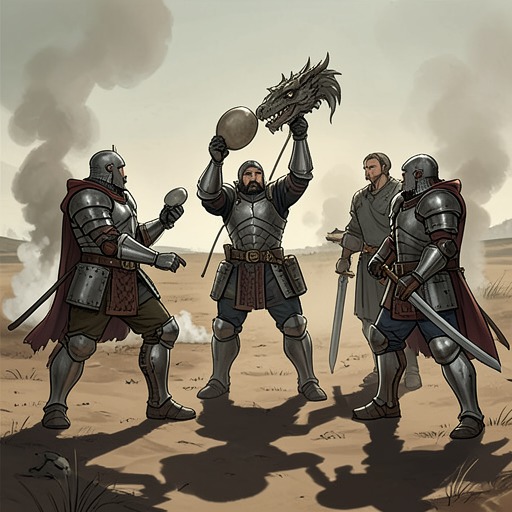
Vainqueur understands the situation through the language of possession. He insists that he defeated Maure and saved the great hoard from him, treating the political aftermath as confirmation that the treasure now belongs under his protection. Roland turns that claim into a usable diplomatic premise. Instead of challenging Vainqueur's self-proclaimed empire directly, he offers recognition of Vainqueur as Emperor of Ishfania and defines the territory as an official adventurer state. This allows Vainqueur to retain the prestige and practical benefits of the Adventurer Guild while ruling his territory according to his own wishes.
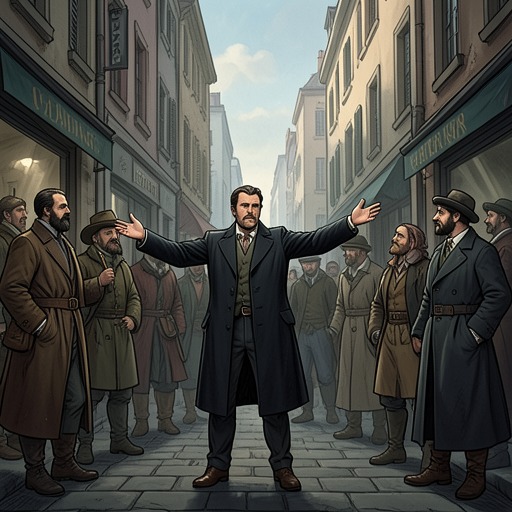
The negotiations take place in a setting where friendship, ransom, taxation, and sovereignty are inseparable. King Roland arrives as a supposed friend rather than as a bounty hunter, but his immediate condition is that Vainqueur return his niece. Vainqueur distinguishes sharply between ordinary manlings and Manling Victor, declaring that only Victor has earned the title of friend. The exchange establishes the treaty's tone: personal loyalty remains the dragon's private standard, while public order is assembled through bargains between rulers.
Terms and Territorial Settlement
The central exchange is a mutual protection pact. Gardemagne will recognize Vainqueur's imperial claim, and the two countries will promise never to take arms against one another and to fight together against outside threats. Vainqueur accepts immediately when he realizes that the agreement also preserves his Emperor class. His sovereignty is thus tied not only to land and military force, but to the continuation of a class-based status that the treaty helps make politically durable.
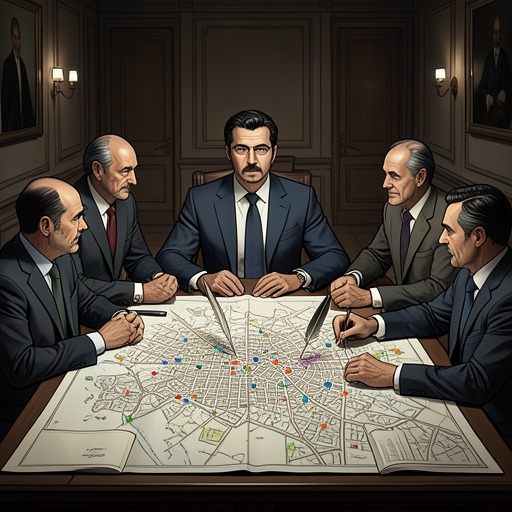
The frontier is fixed through a physical map. At King Roland's request, Nostredame conjures a map of the continent and a pen, and Roland traces the Albain Mountains as the boundary between Gardemagne and Vainqueur's dominion. Vainqueur attempts to claim the mountains as well, expanding his title to include Murmurin, Ishfania, and the Albain Mountains. Roland concedes a broad swath of territory, but preserves Gardemagne's ownership of the powerstone mines that it has already opened. The final arrangement therefore combines imperial expansion with a negotiated limit on resource claims.
Vainqueur accepts the territorial concession while performing magnanimity in the language of wealth. He declares himself too rich to lower himself by claiming Gardemagne's hoards, and Roland responds by circling the enlarged territory on the map. The resulting title is grandiose even by Vainqueur's standards: Vainqueur Knightsbane, First of His Name, Great Calamity of the Age, Defender of the Hoard, and Emperor of Murmurin, Ishfania, and the Albain Mountains. The treaty gives bureaucratic and geographic shape to a title that previously existed mainly as boast and threat.
Institutional Consequences
The agreement follows a broader transformation in which Vainqueur's hoard-centered impulses become institutions. Earlier, he ordered Victor Dalton to turn discarded monster parts and corpses into a profitable shop, forcing his chief of staff to manage commerce alongside class progression and Kobold training. Victor subsequently signed a long contract with the Church of Camilla surrendering corpses to necromantic transformation, an arrangement that exposes how legal contracts, religious authority, and postmortem labor coexist within the emerging order.
Vainqueur's administration also develops military and bureaucratic structures. He promotes Victor to military advisor during the war against Furibon and orders him to collect intelligence on dungeon traps, defenders, barriers, the restoration of the hoard, and methods for surpassing Furibon's magical strength. Recruitment expands beyond the Kobold Rangers: one hundred kobold applicants are joined by high-level creatures including a troll, a dryad, and a golem. The treaty therefore arrives after the dragon's personal following has begun to resemble an army and an administrative apparatus rather than a loose band of minions.
The same process appears in public law. After Furibon's defeat, Vainqueur proclaims Vainqueur Day, demands a feast and a public burning of a wood puppet representing Furibon, and orders a statue of himself larger than the gods' statues in local temples. When Victor asks about actual laws, Vainqueur declares that there is no greater crime than separating a dragon from a hard-won hoard and makes his first commandment "no taxes, ever." The treaty internationalizes this principle. Vainqueur demands that his quests be exempt from guild fees and taxes, and King Roland agrees that V&V will be permanently exempt from fees normally imposed on adventurer companies, with the Kingdom funding the local chapter instead.
Protection becomes the treaty's constructive counterpart to exemption. After Furibon's torture and the labor required to defeat him, Vainqueur agrees that minions and hoarders may send their treasures to him for safekeeping, promising that no hoard in his empire will remain defenseless against the Furibons of the world. This unusual concession earns him a level in Kaiser for displaying a measure of genuine nobility and placing his minions' well-being first. The treaty consequently confirms a ruler whose legitimacy is comic and self-serving but not wholly empty: domination is paired with protection, and treasure is made the basis of a public obligation.
Sovereignty, Borders, and Contradictions
The treaty illustrates how Vainqueur's rule moves from personal exception to recognized sovereignty. His authority begins in declarations, raids, recruitment, and the ability to impose his will on monsters and manlings. His administration includes commercial exploitation, necromantic labor contracts, military intelligence, surveillance through creatures capable of transforming into objects, and the public staging of imperial memory. Yet the agreement with Gardemagne supplies something conquest alone cannot: an external recognition that his dominion is a state-like entity.
That recognition remains deeply contradictory. Vainqueur claims equality only in the sense that all creatures are equally inferior to him and that every creature may become emergency food. His empire is founded on a hierarchy centered on the dragon, while its political language borrows from treaties, laws, public works, guild exemptions, and mutual defense. The treaty does not democratize his rule; it stabilizes it. Gardemagne's diplomacy accepts the dragon's exceptional status because doing so may prevent a wider war and contain the struggle over Ishfania's resources.
The border at the Albain Mountains makes this compromise visible. Vainqueur wants an unlimited extension of his hoard, while Roland insists on retaining already-developed powerstone mines. The final line is neither purely imperial nor purely national. It is a negotiated frontier in which land, mineral rights, military security, adventurer privileges, and personal prestige are exchanged in one package. The treaty thus turns the unstable geography of conquest into a divided but mutually acknowledged political space.
Narrative Function and Aftermath
The treaty is framed by a larger comic history of repeated crisis. The War of the Hoard is presented as a chronicle whose final chapter is titled "Furibon must die," while Vainqueur's subsequent administration treats the victory as the founding myth of a new empire. The treaty supplies the diplomatic chapter after the military one: the dragon's war against Furibon produces not merely treasure and celebration, but borders, titles, exemptions, and an alliance.
Its aftermath is marked by the continuing theatricality of Vainqueur's regime. V&V becomes a protected organization, Vainqueur's imperial titles expand, and his rule is celebrated through Vainqueur Day and monumental statuary. Commerce also broadens through Nethermart, a six-floor, ivory-draped building constructed by bug fiends under Malfy's direction and opened as the first fiendish magic-item shop in Outremonde. The shop welcomes monsters and mortals, accepts souls as collateral when customers cannot pay in coins, and advertises discounted weapons for the coming war with Maure. These developments show the treaty's world: sovereignty is not only mapped and sworn, but sold, branded, ritualized, and defended.
The settlement therefore functions as both endpoint and escalation. It closes the immediate struggle over Ishfania by recognizing Vainqueur's claim, yet it also creates a larger dominion with new borders, resources, obligations, and enemies. Even the celebrations leave the land devastated: after Bragging Day, houses are overturned, sheep are dead, and Vainqueur must order the Kobold Rangers, gnolls, mimics, and other servants to end the party. The treaty's central irony is that order is born from a ruler whose triumphs repeatedly resemble catastrophe. Gardemagne does not make Vainqueur gentle; it makes his power legible, contractual, and internationally consequential.