Ghouls
Vainqueur the DragonGhouls are among the book’s most important forms of undead life, functioning simultaneously as frightening corpses, religious agents, prospective workers, and participants in a broader monster society. Their appearances repeatedly turn death from a private terror into a public system: ghouls sell or seek corpses, serve divine institutions, join imperial projects, and occupy ordinary settlements alongside other humanoid-looking monsters.
Appearance and First Associations
A ghoul is first identified through physical and sensory signs rather than biography. One hooded figure wears heavy crimson robes, has corpselike white hands, and carries the familiar smell of rot beneath the hood. The creature’s approach is immediately unsettling, but its opening question is commercial rather than predatory: it asks whether fresh corpses are available for sale. The scene therefore establishes the ghoul through a double image, combining bodily decay with practical business activity.
The ghoul’s clothing also reveals an institutional identity. A mosquito crest on the robes marks the figure as a worshiper of Camilla, the Marquise of Blood and goddess of death, pestilence, and darkness. Victor Dalton learns that Camilla belongs to the Dread Three, alongside Deathjester and Veran, a group of former evil adventurers who became gods together. The ghoul consequently stands at the intersection of the undead and a tolerated but feared religious network: its corpse-like body signals death, while its insignia places that death within organized worship.
Ghouls in Monster Civilization
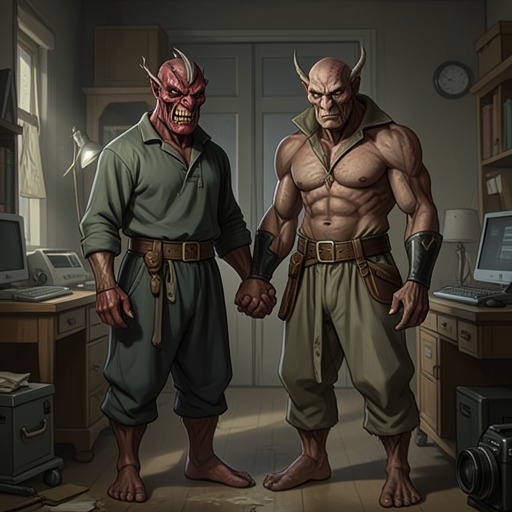
Ghouls are not confined to isolated encounters or dungeon imagery. In a settlement populated by humanoid-looking monsters, half of the residents appear human enough while Monster Insight identifies many as werewolves or shapeshifters. The other inhabitants are openly monstrous, including a large family of pallid ghouls, a squid-human hybrid, and a rusty steel golem. The village is thus presented as a community rather than a lair, and the ghouls form one visible household within a mixed population.
This communal appearance broadens the meaning of the species. Ghouls are shown living among other creatures, participating in a society where disguise, mutual recognition, and the acceptance of monstrous bodies are ordinary matters. The settlement’s population challenges the assumption that a ghoul exists only as an enemy to be destroyed. Its pallor and undead nature remain conspicuous, but they do not prevent domestic or civic belonging.
The broader political order also treats ghouls as potential members of an organized undead economy. Jules Rapace, a corpseling and necromancer, expresses gratitude after joining Emperor Vainqueur’s expanding realm. He is attracted by an empire lacking Gardemagne’s heavy taxation on undead labor and open to mass zombification. His ambition is an approaching corpse boom and an undeathstrial revolution. Although Jules is specifically a corpseling rather than a ghoul, his program clarifies the economic environment in which ghouls and other undead can be understood: undeath is not merely a supernatural state but a labor category subject to taxation, recruitment, and industrial development.
Religion, Commerce, and the Dead
The ghoul worshiper of Camilla makes religious affiliation inseparable from exchange. Elsewhere, Victor Dalton seeks a miracle that might return him to Earth, while the religious marketplace assigns monetary prices to divine intervention. Camilla’s institutions belong to that same competitive field, but their association with death gives the market a darker register. The ghoul’s offer to buy fresh corpses suggests that bodies can circulate as commodities just as miracles circulate as paid services.
This commercial logic returns when Victor faces competing claims on his soul. Dice and the Moon Man already have claims, but Camilla submits a third afterlife proposal in recognition of Victor’s exemplary service to the undeathstrial revolution and continued friendliness toward her church. The offer reveals that Camilla’s interest is not limited to the dead as passive remains. She evaluates service, loyalty, and institutional usefulness, while Victor’s relationship with undead society becomes a factor in determining his postmortem destination. Ghouls therefore belong to a religious economy in which death creates new obligations, opportunities, and forms of patronage.
Violence, Vulnerability, and Reversal
The book also places ghoul-like undead within scenes of extreme violence. During a confrontation with a powerful lich, Victor Dalton warns Vainqueur Knightsbane that powerful undead are immune to critical hits and urges him to use his breath. Vainqueur answers with a quick fireball that vaporizes the lich at once, only to regret the act immediately because the dragon’s crown has been endangered. The incident does not identify the lich as a ghoul, but it demonstrates the hostile environment shared by undead creatures: supernatural durability can make them formidable opponents, yet even a powerful undead body may be erased instantly by superior force.
That scene contrasts sharply with the ghoul family in the monster settlement. In combat, undead bodies become targets, resistances, and tactical problems; in the village, ghoul bodies become signs of kinship and residence. The contrast is central to the species’ narrative function. Ghouls can be read through horror, but the story repeatedly redirects attention toward their social position, their affiliations, and the material systems that decide whether the dead are enemies, customers, laborers, worshipers, or citizens.
Narrative Significance
Ghouls help expose the instability of the book’s boundaries between life and death, person and resource, and monster and neighbor. The hooded ghoul’s rotting appearance produces immediate horror, yet its first recognizable activity is trade. The pallid ghoul family makes the same category domestic and communal. Camilla’s church transforms death into an institution, while the undeathstrial revolution transforms it into an economic future.
Their recurrence also reinforces the procedural logic of the world. Characters gain classes and perks through relationships with monsters, lead monsters to victory, and eventually encounter a level ceiling that requires a Crest for further advancement. Against that system of measurable growth, ghouls represent a condition that is simultaneously biological, spiritual, administrative, and economic. Their bodies mark them as dead, but the institutions around them continue to classify, employ, worship, purchase from, and bargain over them. In this way, Ghouls are not merely another undead enemy type; they are evidence that the story’s monster civilization can absorb death into everyday social life without making it any less strange or morally unsettling.