Icefang
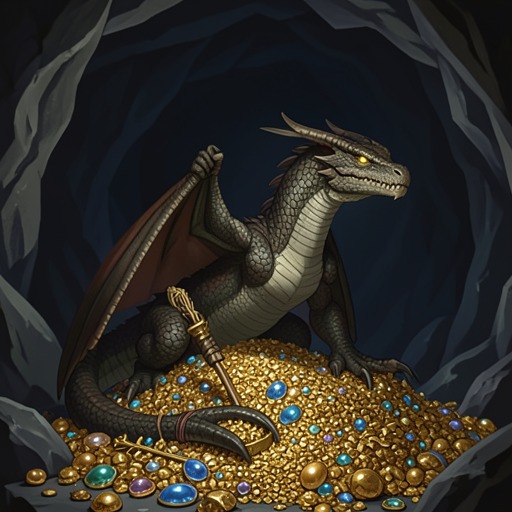
Vainqueur the DragonIcefang is a frost dragon whose defining importance lies in his rivalry with Vainqueur Knightsbane. He measures worth through hoards, princesses, minions, titles, and public superiority, making him both a personal antagonist and a comic standard against which Vainqueur’s claims are tested. Their conflict is not merely a quarrel between two dragons: it is a recurring contest over wealth, status, legitimacy, and the right to define what counts as greatness.
Identity and Temperament
Icefang is identified by the icicle spikes growing from his back and by his smug blue eyes. When he appears at Vainqueur’s gathering, he is already almost as large as the great red dragon, and he carries himself with conspicuous self-importance. Rather than land conventionally, he flies above the castle in what the narration describes as a foppish maneuver, using physical display to announce that he considers himself above ordinary ceremony.
His chosen title is Great King Icefang. The title is not presented as a quiet constitutional fact but as another instrument in the rivalry: he introduces it while challenging Vainqueur and expects the title itself to command recognition. His pride is paired with a sharp instinct for contradiction. Icefang does not simply boast about his own achievements; he searches for weaknesses in Vainqueur’s presentation and attacks them before the audience can settle into admiration.
Rivalry with Vainqueur Knightsbane
The antagonism between Icefang and Vainqueur is longstanding and structural. The two belong to opposed dragon traditions, with the narrative emphasizing the natural rivalry between red and frost dragons and presenting red dragons as obviously larger and wealthier. Icefang has nevertheless made competition with Vainqueur his life’s purpose. While awake, he gathers a larger hoard, more beautiful princesses, and finer minions, attempting to construct an unquestionable claim to supremacy.
The effort repeatedly fails. Icefang’s ambition is therefore sustained by defeat rather than resolved by victory, and his fifty-year nap has only deepened his bitterness. His rivalry is not an occasional irritation but a continuing program of accumulation and comparison. Vainqueur understands the pattern and treats Icefang’s arrival as a challenge to be answered with an even more spectacular demonstration of wealth.
Their verbal exchanges make the competition concrete. Icefang greets Vainqueur by asking whether he is still poor, then announces that he is now Great King Icefang. When Vainqueur insists that he was never poor, Icefang answers that Vainqueur is poor compared with him. Vainqueur counters that Icefang’s hoard is made of silver and therefore does not shine enough to count as true wealth. Icefang responds that wealth knows no limits and promises to count every coin in Vainqueur’s hoard; Vainqueur answers that the counting will last until the end of time. Each insult converts material possession into a public argument about rank.
The Bragging Day Contest
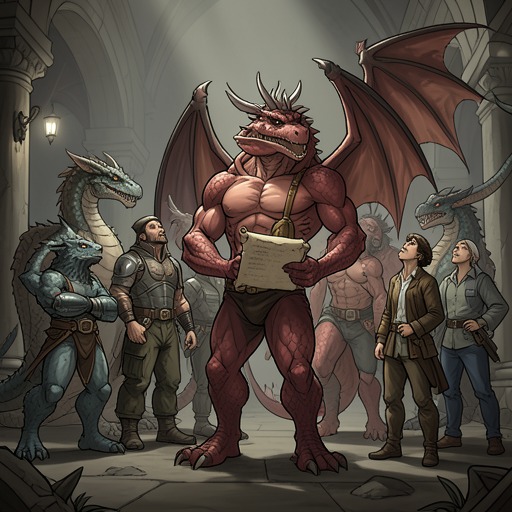
Icefang’s presence threatens to pull attention away from Vainqueur during the emperor’s great gathering. Vainqueur reacts by offering a preview of his magnificent hoard, turning the occasion into an immediate contest rather than waiting for the formal Bragging Day. Icefang mocks the possibility that Vainqueur cannot even bathe in his own treasure, but the sight of the hoard produces the reaction Vainqueur wants: Icefang’s eyes widen in stunned disbelief.
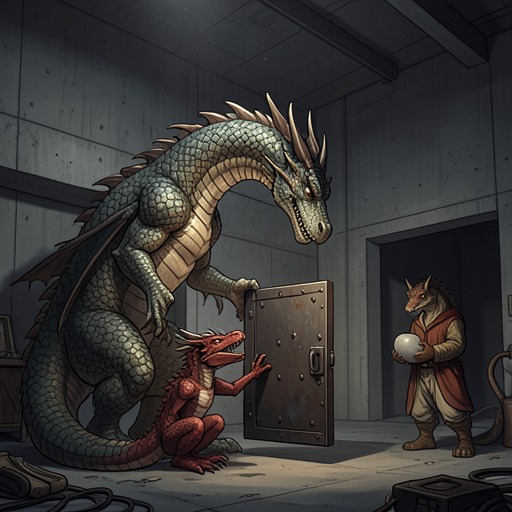
The hoard impresses other dragons as well. Jolie walks across it, amazed by its depth, warmth, texture, and shininess, while Vainqueur permits his family to touch the treasure as a kingly gesture. The scene establishes that Icefang’s rivalry is governed by physical evidence. He can dismiss claims, titles, and ceremony, but the scale of the hoard forces an involuntary response before he can resume his criticism.
The later presentation is less secure. Vainqueur boasts of his wealth, his domain, and his three princesses, but Icefang immediately observes that the princesses are not dancing and assigns the display a low rating. Genialissime gives a higher assessment because Vainqueur has two spare princesses, while Blightswamp argues that three princesses gathered together magnify their princessness and support a theory that princessness is contagious. Icefang remains unimpressed. He insists that the princesses are not triplets and declares that the food is the only genuinely bragworthy feature, while dismissing Vainqueur’s hoard as paltry.
The criticism wounds Vainqueur’s intended spectacle because the audience is made up of dragons whose standards are defined by excess. Icefang’s role is consequently double-edged: he is the enemy who refuses to applaud, but his refusal gives the celebration its dramatic test. Vainqueur’s greatness must survive an adversary who is prepared to inspect every claim for an exploitable deficiency.
Skepticism Toward the Class System
Icefang also challenges Vainqueur’s account of his power. Vainqueur rejects the suggestion that he has become a banker and instead names himself the Defender of the Hoard. He attributes his authority to killing Furibon during the First War of the Hoard, defeating the Moth King during the Second War of the Hoard, and uncovering the ancient Class System, which gave him the power to protect the dragon way of life from those who would reduce it to lead.
Icefang calls the explanation ridiculous. In his view, a system that grants power and money should be accessible to him as well; since he cannot simply see or use it, he concludes that it does not exist and announces that he will prove the point. His skepticism is consistent with his competitive nature. He does not merely doubt Vainqueur in private. He challenges the claim before the gathered dragons, forcing Vainqueur’s extraordinary account to become a public demonstration.
The challenge backfires. After the system appears and the guests begin declaring themselves sorcerers, knights, and nobles, Icefang’s eyes widen as he recognizes that the display is real. His response changes the balance of the gathering: the dragon who had treated Vainqueur’s system as a convenient fiction becomes one of its witnesses. He then turns to Roland Gardemagne and orders him to hand over a plate, framing compliance as a great honor because a dragon of Icefang’s caliber has deigned to answer the human species’ requests, while still demanding gold and silver in return.
Narrative Role and Significance
Icefang functions as a rival, heckler, and unwitting verifier of Vainqueur’s ascent. His contempt gives Vainqueur’s achievements an external measure, because praise from loyal minions could be dismissed as obedience while Icefang’s approval is difficult to obtain. The frost dragon’s attacks also expose the fragility of imperial performance: three princesses, a vast hoard, a grand feast, and a new system can all be reduced to shortcomings when placed before someone determined to outshine them.
At the same time, Icefang is more than a one-note obstacle. His consistent obsession with gathering superior treasures, princesses, and minions makes him recognizable as a character built around rivalry, but his astonishment at Vainqueur’s hoard and his eventual admission that the Class System is real provide moments of involuntary revision. He remains proud and abrasive, yet evidence can force him to change his position. That limited flexibility gives his rivalry its comic energy: Icefang wants to deny Vainqueur’s greatness, but he is too attentive to wealth and power not to recognize them when they become undeniable.
His final significance is therefore paradoxical. Icefang seeks to be the greatest of all dragons by making every other dragon’s achievement seem insufficient, but his repeated challenges help stage Vainqueur’s public victories. The rival who intends to diminish Vainqueur instead supplies the resistance through which Vainqueur’s hoard, imperial identity, and Class System acquire dramatic credibility.