Ishfania
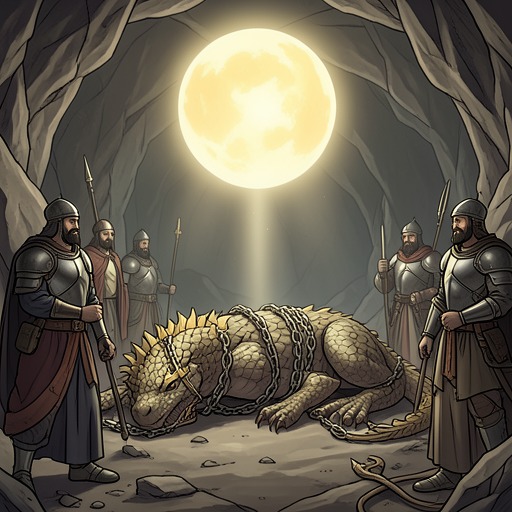
Vainqueur the DragonIshfania is both a ruined landscape and the central prize around which the later political order of the story is arranged. Once part of the great Sablaris Empire, it was seized by Brandon Maure after a magical cataclysm turned the region into a red desert; after Maure’s defeat, the territory became the basis of Vainqueur Knightsbane’s claim to imperial sovereignty and a test of whether monster rule could be converted into a recognized state.
Historical Formation and Ruin
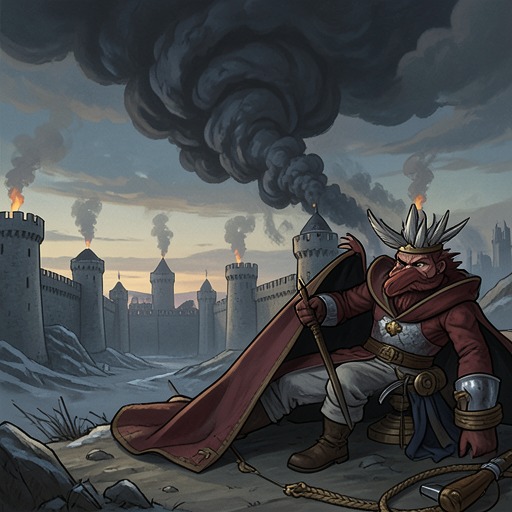
Ishfania’s devastation began under the Sablaris, a dark elf empire that ruled much of the southern continent, including Ishfania and Barin. Cultists of Sablar the destroyer eventually captured the empire and sought to accelerate their patron’s project of universal entropy. Their answer was a magical cataclysm that transformed the entire imperial realm into a red desert. The landscape surrounding the Castle of Murmurin preserves that history materially: the countryside is composed of brown soil, badlands, and arroyos, with sparse flowers and plants and an immense red sand desert visible beneath the southern horizon. The region is therefore not merely politically defeated; it has been ecologically marked by the violence of its former rulers.
Brandon Maure, described as the offspring of a demon lord and a dark elf, later took control of the ruins of Ishfania with summoned monsters. His position was connected to the wider conflict involving Gardemagne and the fomors. According to Furibon, Maure supported the fomors led by King Balaur in their war against Gardemagne, hoping to seize southern territories. That side lost, leaving Gardemagne with adventurers and crusaders but no immediate enemy to fight. Ishfania consequently became vulnerable: Prydain and the Dark Forest remained too dangerous for Gardemagne to threaten, whereas Ishfania, weakened by the conflict, could not withstand the full strength of its neighbors.
Fortresses, Armies, and the Century War
Ishfania’s military history is concentrated in fortified sites rather than in a stable civic center. The Castle of Murmurin had once served as an officer-training facility for the continent’s elite and as the headquarters of the Ishfanian Inquisition. At the beginning of the Century War, Maure sent his general, the lich Furibon, to seize it. Furibon turned the castle into a haven for fiends and awakened the volcano beneath the fortress, while the Ishfanian Inquisition tried unsuccessfully to drive out the demons.
The territory also became a field of proxy warfare. François Vilmain explained that he, Gustave La Muraille, and Ogron the Ogre had originally fought for Gardemagne during most of the Century War, operating under royal writs that permitted adventurers and mercenaries to raid enemy towns in the king’s name. When the war ended, their sanctioned violence lost its political legitimacy. Maure then offered them retirement money and asylum in exchange for burning the countryside of Euskal and keeping the crusaders occupied while he retook Rochefronde. That plan included Haudemer, making the destruction of Ishfanian territory part of a larger attempt to recover Maure’s fortress and resist the pressure of Gardemagne.
The plan faltered because a dragon guarded Haudemer. Maure’s forces repeatedly sent men to investigate and lost more men each time, while the royal army closed in. The episode reveals Ishfania as a territory whose strategic value remained high even after its institutions had collapsed: Maure could not simply abandon Haudemer, yet every attempt to secure it deepened his military and financial crisis.
Monster Territory and Vainqueur’s Claim
After Vainqueur defeated Furibon, the region’s surviving monster communities became attached to the new power centered on Murmurin. Gnoll tribes had lived in encampments south of the castle, under Furibon’s rule. The lich had permitted them to remain and keep their gold as long as they obeyed him, but most fled when Vainqueur fought him. Those who stayed later came to Murmurin seeking work. Vainqueur condemned them for having served a cruel undead ruler, then forgave them and accepted them into his service.
Their incorporation was not peaceful or idealized. The gnolls were less disciplined than the zealous Kobold Rangers: they stopped working when Vainqueur was absent and picked fights with other minions. Vainqueur responded by eating twenty troublemakers before the rest began to behave. The incident shows how his sovereignty operates at the frontier, combining recruitment, conditional pardon, labor extraction, and direct predation. Ishfania’s inhabitants are not presented as a unified population waiting for liberation; they are scattered survivors whose relationship to the new regime is negotiated through fear, employment, and access to protection.
The territory also contains hidden communities that challenge the boundary between human and monster. Croissant explained that shapeshifting monsters disguised themselves as humans to avoid inquisitors and adventurers who otherwise tried to exterminate them. Such communities included a school where mimics and other shapeshifters learned to blend into human society. This concealment reflects the political conditions of Ishfania and its neighboring lands: survival requires adopting the appearance of the dominant population, while the threat of violence encourages monsters to strike first.
From Conquest to Recognized State
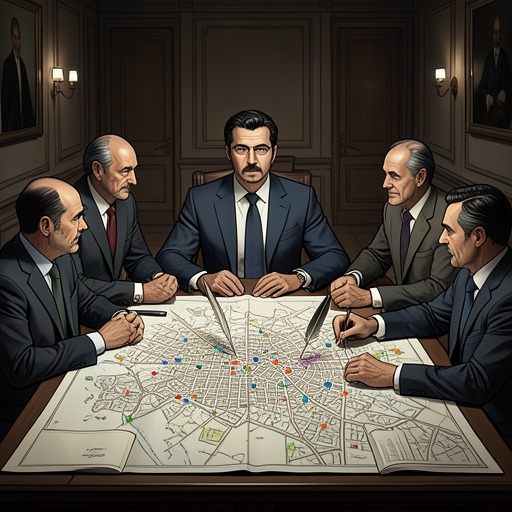
Vainqueur’s seizure of Ishfania initially looked like another episode in the succession of military occupations that had defined the region. His destruction of Maure’s army, however, created a vacuum that other powers might exploit. King Roland of Gardemagne observed that, with Maure dead and his army destroyed, Ishfania no longer existed as a nation in the conventional sense. It remained a demon-infested desert with enough resources to attract the Eversun Empire, Barin, or Prydain, and Roland feared that competing claims could begin a new Century War.
Gardemagne’s response was to recognize Vainqueur as Emperor of Ishfania and to treat his domain as an official adventurer state. The arrangement allowed Vainqueur to retain the benefits of the Adventurer Guild while ruling the territory according to his own wishes. In return, he promised that Gardemagne and his countries would never take arms against one another and would fight together against outside threats. The agreement converted conquest into diplomatic legitimacy and made Ishfania a buffer against renewed imperial competition.
This recognition also mattered to Vainqueur personally because it protected his Emperor class. His acceptance of the treaty was therefore simultaneously political, material, and absurdly self-interested: a continental settlement became, in his mind, a guarantee that the Class System would continue to acknowledge his title. Yet the treaty has consequences beyond his vanity. It gives Ishfania a recognized external protector, places its monsters under a new sovereign framework, and prevents the territory from becoming an unclaimed prize in a second regional war.
Legacy and Narrative Significance
The fall of Ishfania is repeatedly narrated through competing legal and historical forms. Maure used summoned monsters and military force to rule the ruins; Furibon enforced obedience through terror and control of treasure; Vainqueur offered protection to hoarders and minions while proclaiming that there should be no taxes. His proposed policy promised that no hoard would remain defenseless and that inhabitants could send their treasures to him for protection from figures like Furibon. The policy exposes the contradiction at the center of the new empire: Vainqueur’s rule is founded on possession, but he presents possession as a public service.
The territory’s meaning changes again after Maure’s death. Vainqueur’s guests, including monsters who had gathered around his court, follow his example and decide to become adventurers. Lucie Lavere later reports that Vainqueur has claimed Ishfania with Gardemagne’s support and that the destruction of Maure’s army has left the old order in ruins. Her report makes clear that the transfer of power is not simply a private victory over one demon ruler. It has redirected the political identities of many creatures and opened a new relationship between monster communities, adventuring institutions, and human states.
Ishfania thus functions as a frontier made from accumulated catastrophes. The Sablaris turned an empire into a desert; Maure converted the ruins into a monster dominion; Furibon imposed obedience on displaced tribes; and Vainqueur transformed the same devastated space into the foundation of an officially recognized empire. When Vainqueur’s family finally flies away and his party ends, his claim over Ishfania has been publicly secured. The land remains damaged, militarized, and inhabited by dangerous monsters, but it is no longer merely a vacancy left by collapse: it has become the testing ground for a new form of monster sovereignty.