Ishfania’s Greed-Law Principle
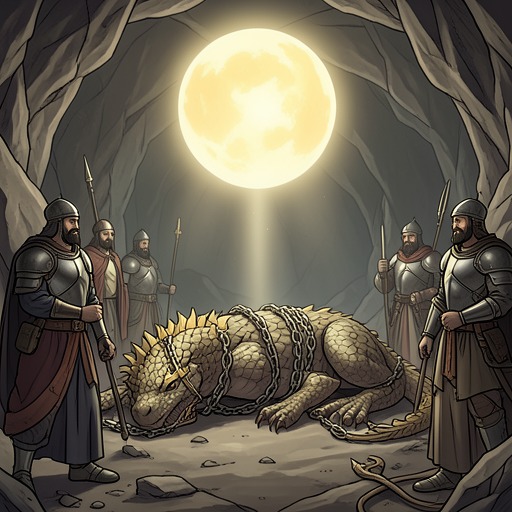
Vainqueur the DragonIshfania’s Greed-Law Principle is the political and economic doctrine that makes greed itself the law of Vainqueur Knightsbane’s empire and later frames the transformation of Ishfania into a free-market haven. Its decisive significance lies in the way it converts the dragon’s personal obsession with his hoard into public policy: taxation becomes an intolerable crime, commercial intrusion becomes legitimate when it answers demand, and legal freedom is defined less by protection than by the absence of restrictions.
Definition and Imperial Foundation
Vainqueur Knightsbane first gives the principle an explicit constitutional form after defeating Furibon. When Victor Dalton asks how the inhabitants of Murmurin will govern themselves under their new emperor, Vainqueur answers by identifying the separation of a dragon from his hard-won hoard as the greatest possible crime. His first commandment is therefore “no taxes, ever,” a rule that presents private accumulation as a protected sovereign right rather than a resource subject to communal claims.
The doctrine is not merely a slogan about keeping money. Vainqueur later describes his entire realm as his hoard: an empire founded on enlightened dragon principles, where no minion leaves imperial service even in death, demons may trade souls without paying taxes to mortals, and greed is law. The language collapses the distinction between treasure and territory. Land, labor, subjects, and commercial institutions all become extensions of the emperor’s hoard, while freedom from taxation becomes the visible sign of his dominion.
Economic Practices and Legal Boundaries
The principle emerges from a system in which waste, bodies, labor, and supernatural obligations can all be made economically productive. Vainqueur orders Victor Dalton to establish a shop selling discarded goods, monster parts, and corpses rather than allowing the remains to be left for animals. Victor subsequently signs a long contract with the Church of Camilla, surrendering corpses for necromantic transformation as their legal living relative. The transaction shows how the doctrine treats even death as a resource and how private contracts can authorize practices that Victor experiences as morally dirty.
The same logic supports Nethermart, the fiendish magic-item shop opened in northern Murmurin. The building is a conspicuous six-floor, ivory-draped structure and the tallest building near Vainqueur’s statue. Its opening announcement promises access to all monsters and mortals, offers soul-backed credit to those unable to pay in coins, and advertises a thirty-percent weapons discount before the coming war with Maure. The market therefore combines broad access with predatory collateral: exclusion by coin is replaced by indebtedness secured against the soul.
When Knight Kia challenges the legality of the demons occupying the building, Malfaisant answers that Nethermart is a free-trade area supported by the emperor and that the demons’ presence is perfectly legal. He presents the enterprise not as an invasion or a moral exception but as the normal consequence of economic demand. After the market breaks Maure’s monopoly, Malfaisant orders prices reduced and instructs his bodyguards to notify the shareholders, making the doctrine concrete through competition, investment, and commercial expansion.
Expansion into Ishfania
The principle becomes an international program when Miel explains what will happen to Ishfania. She characterizes the emerging order as a land ruled by and for greedy monsters, with no taxes, no regulations, and total freedom of religion. In her account, Ishfania will soon become a haven for chaotic mortals and non-humans because Victor Dalton has opened the market by breaking Maure’s monopoly. The policy thus presents deregulation as liberation while also making the territory available to competing supernatural powers.
This expansion is driven by a vacuum created through conflict. Nethermart’s presence follows the weakening of Maure’s commercial dominance, and the demons claim that they are only meeting needs left unmet by the previous order. The principle consequently treats political disruption as an opportunity for market entry. The language of neutrality conceals a transfer of power: the old monopoly is removed, but the resulting freedom permits another organized commercial force to establish itself immediately.
Contradictions and Consequences
The Greed-Law Principle promises freedom, yet the empire it supports contains forms of dependence that are difficult to reconcile with ordinary emancipation. Vainqueur’s declaration that minions never leave his service, even in death, turns loyalty into an enduring labor obligation. The corpse contract with the Church of Camilla makes legal kinship an instrument for postmortem labor, while Nethermart’s soul-backed credit makes inability to pay a basis for supernatural indebtedness. The system is therefore permissive toward owners and merchants while binding the bodies, deaths, and souls of those beneath them.
The doctrine also relies on spectacle to make economic power appear legitimate. Vainqueur declares an annual Vainqueur Day to celebrate Furibon’s destruction, complete with a cattle feast, a burning wood puppet, and a statue of the emperor in a werewolf village. After the celebration, the landscape resembles a volcanic disaster: houses have been overturned and no sheep remain alive. The party’s wasteful destruction contrasts sharply with the doctrine’s insistence that greed is a rational law, revealing an imperial economy founded not only on accumulation but also on conspicuous consumption and domination.
Vainqueur’s policy does acquire a protective dimension. After witnessing the suffering caused by Furibon and recognizing Victor’s efforts, he promises that no hoard in his empire will remain defenseless. Minions and hoarders may send their treasures to him for protection against the Furibons of the world, and the Class System rewards this decision with a level in Kaiser because it places minion welfare first. Protection is thus offered as a service tied to the emperor’s hoard, not as an impartial civic right; nevertheless, it marks a development from private hoarding toward a wider system of collective security.
Narrative and Political Significance
The principle is one of the book’s clearest transformations of character into institution. Vainqueur Knightsbane’s greed begins as an individual dragon’s fixation, but through declarations, contracts, shops, labor arrangements, and military expansion it becomes the organizing language of an empire. The Class System reinforces this transformation by rewarding noble leadership when Vainqueur protects other hoards, turning a partial change in conduct into formal political advancement.
Its irony comes from the gap between the rhetoric of freedom and the hierarchy beneath it. The empire rejects taxes and regulations, welcomes religious diversity, and opens commerce to monsters and mortals, yet its economy preserves imperial ownership, demon leverage, compulsory service, and soul-based collateral. Ishfania’s Greed-Law Principle therefore functions both as a governing rule and as a satire of market absolutism: it abolishes restraints in the name of liberty while allowing the strongest hoarders, merchants, and supernatural creditors to define what freedom means.