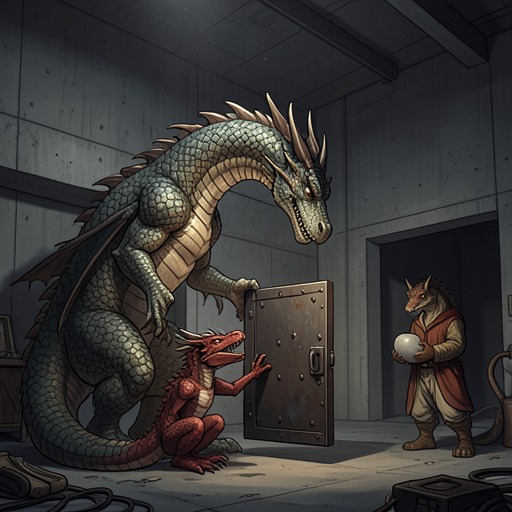
Jolie
Vainqueur the DragonJolie is a red dragon, Vainqueur Knightsbane’s niece, and one of the clearest signs that the dragon’s influence extends into a younger generation. Introduced first as a newly fledged child barely the size of a large horse, she later appears as an elegant red dragon larger than an elephant. Her development combines familial devotion, appetite for adventure, fascination with hoards and minions, and an emerging moral disagreement with Vainqueur’s belief that sentient creatures are legitimate food.
Identity and Family Background
Jolie belongs to Vainqueur’s close dragon family and is identified as his niece. At her first Bragging Day, she is still tiny by dragon standards and has only recently learned to fly. Vainqueur treats her as a cherished relative, nuzzling her when he arrives at her cave near the riverbank and bringing her a present. Her enthusiasm is immediate: she assumes the gift may be a minion, since another relative has already given her a catkin kitten, and she is delighted when Vainqueur reveals that the captive is instead a princess.
That childhood scene establishes the emotional pattern of their relationship. Jolie admires Vainqueur not merely as an elder but as an ideal of dragon magnificence. She greets him with ecstatic affection, calls him her uncle, and regards his gifts, adventures, and hoard-centered worldview as models of adulthood. Vainqueur, for his part, indulges her excitement and presents the captive princess as a toy-like treasure, even explaining that the captive makes a whining sound when squeezed and warning Jolie about knights who might attempt a rescue.
Growth and Appearance at Bragging Day
When Jolie next appears, she has grown into a small but elegant red dragon, already larger than an elephant. Her physical growth parallels a widening social and narrative presence. She lands on a tower beside Vainqueur during his Bragging Day and congratulates him, while he proudly acknowledges that she has grown bigger. Her maturity does not erase the warmth of their earlier bond; the child who once celebrated her first princess has become a confident young relative participating in a gathering of powerful dragons.
Jolie arrives among Vainqueur’s family, including the brown wind dragon Genialissime and his three dragonlings. Her presence helps make the celebration a family occasion rather than merely a display of Vainqueur’s wealth. At the same time, her developing identity is measured against competing dragon ideals. Icefang seeks to surpass Vainqueur through a larger hoard, beautiful princesses, and superior minions, whereas Jolie’s admiration is directed toward her uncle himself and toward the adventurous life associated with him.
Morality, Food, and the Dragon Family’s Contradictions
Jolie displays a moral position unusual within her family. She states that manlings and other sentient beings possess souls and that eating them or abducting their princesses is morally wrong. This places her in direct contrast with Vainqueur’s casual treatment of intelligent beings as livestock and treasure. Her objection is not abstract: after hearing that Vainqueur commands hundreds of undead minions and raises those he does not eat, she reacts with concern rather than uncomplicated admiration.
The disagreement exposes a generational fault line. Vainqueur maintains that every creature has a fundamental right to be eaten by him and even makes an exception for elves while defending the consumption of other peoples. Jolie’s protest challenges the consistency of that hierarchy, although the evidence does not show her fully rejecting dragon predation. Her ethics are therefore developing rather than settled. She can recognize the personhood of mortal races while remaining immersed in a culture that treats hunting, possession, breeding, and consumption as ordinary parts of dragon life.
That contradiction becomes explicit during the feast at Vainqueur’s castle. Jolie is fascinated by the captured fiend and claims him as a new kind of cattle. When he attempts to flee, she swallows him whole, after which the adult dragons pursue and devour the remaining fiends. The episode complicates her earlier moral declaration: Jolie condemns the eating of sentient beings in principle, yet participates eagerly when the victims are presented within the dragon family’s established food system. Her conduct suggests that her sympathy is selective, unstable, or still overwhelmed by inherited instinct and communal appetite.
Adventure, Hoard, and Relationship with Vainqueur
Jolie’s strongest aspiration is to become an adventurer like Vainqueur. During the celebration, she announces that she wants to find a minion whom she can love as much as she loves her uncle. The statement joins affection to the dragon’s possessive social vocabulary: a beloved companion is imagined as a minion, while adventure is connected to acquiring treasure, food, and valuable relationships.
Her desire is immediately encouraged by Vainqueur. He tells her that a great flying city full of elves and demons now belongs to him and offers to let her settle there. Jolie responds by promising to bring her hoard. The offer gives her both a destination and a material foundation for independence. She is no longer simply the child receiving a first princess from her uncle; she is being invited into the larger world of Vainqueur’s conquests, possessions, and adventuring economy.
Jolie’s ambition also reflects the way dragon society measures achievement. Hoards, minions, princesses, physical size, and the ability to hunt all function as signs of status. Her wish to adventure is not framed as self-discovery detached from family tradition. Instead, she seeks to reproduce Vainqueur’s model while adding her own desire for a minion she can love. The result is an affectionate but unmistakably possessive conception of companionship.
Change, Future, and Narrative Significance
Jolie’s trajectory moves from vulnerable novice to enthusiastic participant in dragon society. At her first Bragging Day she has only recently learned to fly and celebrates a captive princess as her first major treasure. At the later gathering she is large enough to hunt alongside adult dragons, socially confident enough to claim a victim, and eager to establish a nearby lair. Her future is therefore tied to both expansion and imitation: she wants the power, wealth, and adventure associated with Vainqueur, but her concern for the souls of sentient beings offers the possibility of a different dragon ethic.
Her significance lies in this unresolved tension. Jolie is not simply a younger version of Vainqueur, because she openly objects to eating manlings and abducting princesses. Nor is she yet a consistent reformer, because she joins the feast and accepts the logic of cattle, minions, and hoards when that logic is embedded in family celebration. She represents the possibility that Vainqueur’s influence can produce loyalty and ambition without entirely reproducing his moral indifference.
The narrative also uses Jolie to turn Vainqueur’s personal legend into an inheritance. His victories and possessions are no longer confined to his own hoard; they become a landscape in which his niece can settle, hunt, and seek her own adventures. Her delight at his arrival, her pride in his gifts, and her wish to emulate him make their bond emotionally genuine, while the princess gift and the fiend feast reveal the predatory assumptions beneath that affection. Jolie thus carries the story’s central contradiction into the next generation: dragons can love, educate, and protect their kin while still treating other sentient lives as commodities or food.