Malfaisant
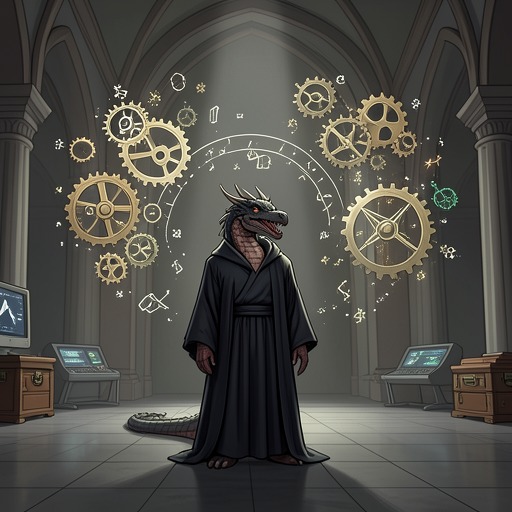
Vainqueur the DragonMalfaisant is an ice demon, bug fiend, and local manager of Infercorp whose intervention makes corporate capitalism an active power in Outremonde. Greedy enough to rival dragons yet pragmatic enough to recognize a profitable opening, he becomes Victor Dalton’s business partner, then rises to Infercorp’s vice-president of Mortal Market Development. His career links the monster settlement of Murmurin to Hell’s corporate machinery, while his methods expose the book’s comic but unsettling idea that almost any social need can be reorganized as a market.
Identity and Introduction
Malfaisant appears as a huge, bipedal, insectoid demon with an exoskeleton covered in ice plates and eyes like sapphires. His body is formidable, but his defining weapon is not physical violence. Monster Insight identifies him as unusually resistant to Unholy, Frost, Water, Physical, Disease, Poison, Critical Hits, Petrify, Bug, and Swarms, while Fire, Holy, Demonslayer, and Bugslayer attacks threaten him. The contrast establishes him as both a dangerous monster and a specialized corporate operator: he is built to endure most conventional forms of opposition, but remains vulnerable to precisely targeted forces.
His official position is local manager for Infercorp, a Hell-based corporation that presents itself as a legitimate business concerned with post-mortem customer safety. He comes to investigate the so-called demon slaughterhouse, where Chocolatine’s accidental summoning has brought him into the temple shared by Isengrim and Cybele. Instead of reacting as a simple enemy, he evaluates the people and institutions around him. His first judgment is that Victor and his companions may be useful partners rather than demon hunters.
Business Philosophy and Alliance with Victor Dalton
Malfaisant’s central talent is the conversion of moral discomfort into an accounting problem. He admires people who care about the bottom line and mortals willing to dirty their hands for a greater good. He initially feared that Victor Dalton was a cunning demon hunter, but Victor’s apparent concern with economic development convinces him that cooperation is possible. Malfaisant therefore offers a deal rather than a battle and asks Victor to call him Malfy, a diminutive that gives his polished charm a personal surface without softening his predatory logic.
The proposed arrangement is brutally efficient. Because Murmurin has more carnivores than available meat, Malfaisant offers to reroute the summoning channel so that victims of corporate downsizing and violent layoffs are sent to the settlement. Murmurin would receive labor and food; Infercorp would avoid the cost of carrying out executions and severance arrangements. Malfaisant presents the transfer of displaced people into coerced labor as a severance package in which everyone wins. Victor is horrified by the callousness, but the proposal also demonstrates why Malfaisant is effective: he finds a way to make the settlement’s ecological crisis, Hell’s execution costs, and corporate waste serve one another.
He sweetens the alliance with material incentives. Victor’s territory must provide food, accept whatever labor is demanded, obey local law including the prohibition on lead, and in return pay no taxes. Malfaisant promises to use his control-swarm ability to assist food production, while a share of venture revenue will flow back to Victor together with VIP privileges. The exchange makes the relationship reciprocal in form, but never equal in spirit. Malfaisant is buying access, legal shelter, and political influence while teaching Murmurin to understand public life through contracts and exemptions.
Rise within Infercorp and Protection of Victor Dalton
Malfaisant’s partnership with Victor Dalton produces a rapid professional promotion. When he later appears in a crisis involving Isabelle Maure’s forces, he is no longer merely a local manager. He introduces himself as Infercorp’s Vice-President of Mortal Market Development, explaining that the shareholders loved the new Murmurin project so much that they promoted him after his predecessor was “chocolatined.” The promotion confirms that his work in Murmurin has become a corporate success rather than a private experiment.
His new authority becomes decisive when Victor is seized by bug soldiers. Malfaisant enters with two thinner, formally dressed bug fiends and invokes Infercorp’s Faustian Associate Protection Program. According to the documents he presents, Victor is a genuine mortal partner of Infercorp on Outremonde and is protected by a non-competition clause. Any violence against Victor would therefore count as corporate warfare, inviting retaliation by Infercorp’s imp ninjas. Malfaisant does not rescue Victor through friendship or military superiority alone; he rescues him by turning Victor’s body and freedom into assets covered by a legal instrument.
The protection also expands Malfaisant’s leverage. He tells Victor that, now that Victor understands the benefits of having friends in low places, Infercorp expects approval for its construction project. The rescue is consequently both defense and negotiation. Malfaisant shields his partner from Isabelle Maure while making the favor part of an investment relationship, demonstrating that corporate protection carries an invoice even when it arrives at the moment of greatest danger.
Nethermart and the Corporate Remaking of Society
Malfaisant’s most visible achievement is Nethermart, a six-floor building in northern Murmurin constructed by bug fiends under his direction. Draped in ivory and shaped in a rounded style the fiends call modern and trendy, it becomes the tallest structure near Emperor Vainqueur’s statue. Its architecture marks a new kind of authority in the settlement: not a throne, temple, or fortress, but a branded commercial monument standing beside imperial symbolism.
At the grand opening, Malfaisant addresses a crowd of monsters, including the Kobold Rangers, while Victor prepares to cut the ribbon. He presents Nethermart as the first fiendish magic-item shop in Outremonde, open to monsters and mortals alike. Customers who cannot pay in coins may keep a tab by pledging their souls as collateral, and a thirty percent weapons sale celebrates the coming war with Maure. The shop therefore combines retail, credit, militarization, and spiritual risk. Its promise of access is inseparable from debt, and its festive opening turns preparation for war into a promotional campaign.
Malfaisant’s commercial expansion later reaches Ishfania. When Kia threatens to destroy Nethermart, he insists that the building occupies a free-trade area and has been established with the Emperor’s full support. He argues that its presence is legal and that the market is merely answering local needs after Maure’s monopoly has been broken. His claim to neutrality is strategic rather than innocent: the free market becomes the language through which Infercorp converts the collapse of one power into its own occupation of the vacant space.
The conflict with Kia makes the limits of that neutrality plain. Kia sees the replacement of Maure’s fiends by another group of exploitative fiends as ethically unacceptable, while Malfaisant describes the process as the normal result of market competition. He invokes nature’s alleged hatred of a vacuum to make commercial takeover sound inevitable. In practice, the market is backed by demons, imperial approval, and the ability to defend the premises by force.
Rivalry, Competition, and Narrative Significance
Malfaisant’s rivalry with Maure’s organization is not founded on moral opposition. He explains that Brandon Maure’s mother runs a different demon corporation and that the companies cooperate in joint ventures on Outremonde despite having no love for one another. Their competition is therefore a struggle between enterprises pursuing overlapping territories and revenues, not a conflict between good and evil. The distinction matters because Malfaisant can oppose Maure’s monopoly while remaining fully committed to exploitation.
His rivalry with Heaven reveals the same logic at a larger scale. When Miel arrives to prospect for new believers in Ishfania, Malfaisant mocks her as a redemption chaser and accuses Heaven of trying to learn from the better multiplanar company. Miel answers that Heaven’s donations are increasing and presents authorization from the Grand Vizier to invest in the region. Malfaisant protests that Infercorp has taken the market from Maure Hellcorporated and now intends to establish a monopoly; Miel responds by announcing competition from Heaven, Shesha, and the Church of the Dread Three.
Malfaisant orders his bodyguards to inform the shareholders and cut prices as sharply as Emperor Vainqueur cuts his foes. The response turns Ishfania into a theological and commercial battleground at once. The territory is envisioned as a place ruled by greedy monsters, without taxes or regulations and with total freedom of religion, drawing chaotic mortals and non-humans while allowing rival religious providers to compete for souls. Malfaisant’s significance lies in making that transformation concrete. He is not merely a comic demon salesman; he is the agent who gives markets buildings, lawyers, labor systems, tax policy, weapons, and a claim to legal legitimacy.