Melodieuse
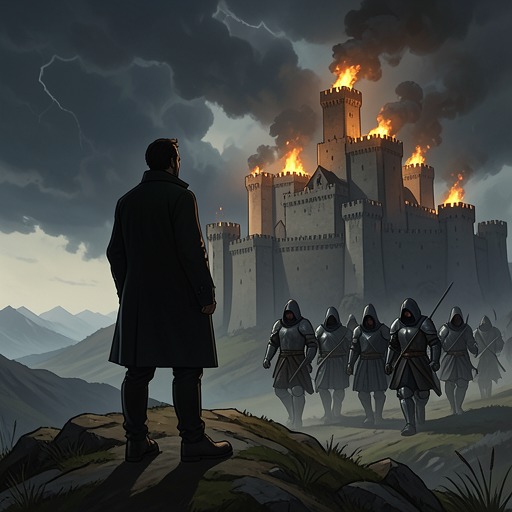
Vainqueur the DragonMelodieuse is a fomor witch whose beauty, magical power, and political duplicity make her one of the central hidden antagonists of the conflict involving Brandon Maure, Vainqueur Knightsbane, Victor Dalton, Gardemagne, and Outremonde. Called the Poisonous Flower, she moves between seduction, threat, ritual violence, and strategic conspiracy. Her decisive significance lies in the late revelation that the Apple of Knowledge, the Scorchers, and Maure’s invasion were not separate crises but parts of a plan she had helped arrange.
Identity and Introduction
Melodieuse first enters the narrative through an investigation into Brandon Maure’s search for weapons capable of reversing his military decline. Maure had researched technology from Earth whenever possible, regarding it as a complement to his own magic, and had offered substantial rewards to Claimed willing to share such knowledge. Melodieuse was the woman who brought him a Claimed carrying the Apple of Knowledge. Her involvement therefore reaches beyond courtly intrigue: she is a conduit between worlds, translating the technological resources of Earth into the service of Maure’s power.
Her reputation is framed in botanical and poisonous imagery. She is described as poison in human form, a beautiful and deadly flower whose touch kills. Later, she appears as a purple-haired manling with blood-rimmed eyes and a queenly black dress made from the fur of warbeasts and fiends. The visual presentation turns her body and costume into a deliberate persona: elegance does not soften the threat but displays it. Even Vainqueur Knightsbane, accustomed to monsters and violence, finds her gaze disturbing without being able to explain why.
Manipulation and the Demon Corrida
At the demon corrida, Melodieuse is presented as the honored guest responsible for carrying out the sacrifice of three noble ladies. The ceremony is advertised as a means of gaining Hell’s favor for the destruction of Gardemagne, and Princess Merveille is singled out among the intended victims. Melodieuse thus serves as both executioner and public emblem of the alliance between Maure’s court, the fiends, and the larger campaign against Gardemagne.
The ritual also exposes her relationship to Maure’s military agenda. When an arrogant elf demands that Vainqueur release Furibon, Maure’s lich servant, the elf invokes Maure’s will and orders Melodieuse to clear the arena of interfering peons. She accepts without hesitation. Vainqueur attacks her with a fireball, but she teleports away, displaying the same frustrating mobility associated with Furibon and establishing that direct force alone will not contain her.
Her role in the scene is therefore more than ornamental villainy. She is the operative who converts Maure’s political objective into spectacle, sacrifice, and immediate violence. The corrida joins religious favor, dynastic hatred, and military strategy in one arena, while Melodieuse stands at the point where those motives become action.
Threats, Alliances, and Magical Power
Melodieuse later confronts Victor Dalton in a markedly more intimate and unsettling register. She recognizes how far he has progressed and remarks that he has even learned necromancy, offering what she calls private lessons. Victor cannot determine whether the offer is flirtation or threat, and the ambiguity frightens him more than a plainly stated attack would. Her manner makes intimacy another instrument of domination: she tests his uncertainty while retaining complete control over its meaning.
Her warning is nevertheless concrete. She tells Victor that, after Vainqueur defeated Furibon, Brandon Maure had decided to leave his throne and come for Victor personally, advising him to expect an ambush. The disclosure makes Melodieuse temporarily useful even while she remains dangerous. Victor and Vainqueur interpret the warning as a reason to attack Maure’s capital preemptively, turning information supplied by an enemy into the basis for counteraction.
During the later aerial confrontation, Melodieuse descends from the sky through sorcery after Victor has been wounded and his forces are under pressure. She identifies Victor and the other manlings as Claimed, tells Vainqueur to leave, and offers a bargain: if the dragon takes his slaves away, she will order the princeling to let him rule Murmurin unchallenged. The offer is not reconciliation. It is an attempt to isolate the immediate dispute from the larger political struggle by appealing to Vainqueur’s territorial ambition.
Her power is demonstrated through mobility, defense, and attack. She strengthens a magical barrier while dragons destroy her escort, and she later casts Death Spike, causing sharp ice spears to rise beneath Victor. The spell leaves Victor aware that his defenses and preparations may not be enough. Melodieuse’s magic gives physical form to her broader method: she attacks from an unexpected direction, preserves herself through barriers or teleportation, and forces opponents to react after the decisive move has already begun.
The Hidden Conspiracy and Revelation
The clearest change in Melodieuse’s narrative position occurs when the hellgate has fallen and the battle has become a slaughter. Dragons descend on the opposing forces, while Melodieuse watches her escort die and moves closer to Victor with a hateful gaze. She declares that the fall of the hellgate has ruined her plans for Gardemagne. Her words transform the apparent battlefield defeat into the collapse of a long-term operation.
Victor then recognizes the pattern: Melodieuse had arranged the Apple, the Scorchers, and Maure’s invasion. What had seemed like disconnected elements of a widening war becomes a coordinated chain of interventions. Her power is consequently strategic as well as magical. She manipulates access to knowledge, uses distraction and military pressure, and works through Maure’s ambitions while pursuing an objective of her own.
Melodieuse confirms that Victor’s own actions have complicated her campaign. She argues that none of the disasters would have happened without him because he taught Vainqueur the secrets of the Class System. In her view, that knowledge has made the rightful quest to take back Outremonde harder than ever. This explanation supplies her motive without reducing it to personal hatred: Gardemagne is one theater of a larger restoration project, and Vainqueur’s newly empowered monster civilization threatens the balance she expected.
Change, Defeat, and Narrative Role
Melodieuse’s apparent control weakens as the plot exposes the cost of her scheme. At the demon corrida she commands the ritual and acts as Maure’s chosen instrument; later she negotiates from the air while offering Vainqueur political concessions; finally she stands amid the destruction of her escort and admits that the hellgate’s fall has wasted her plans. The progression moves from orchestration to emergency management, then to open recrimination.
Her defeat is not presented as a quiet disappearance. After blaming Victor for making the reclamation of Outremonde more difficult, she launches Death Spike against him. The attack ends the immediate exchange on a cliffhanger rather than resolving her fate. What is settled is her identity as the conspiracy’s architect and her antagonism toward Victor and Vainqueur; what remains unsettled is whether the fomor witch survives, how much of her plan remains possible, and whether the loss of the hellgate has permanently broken her campaign.
Melodieuse functions as a shapeshifting antagonist in structural terms. She can appear as a ritual executioner, an informant, a negotiator, a hidden conspirator, and a battlefield mage without ceasing to be recognizable. Her recurring contrast is between beauty and lethal intent, public ceremony and concealed calculation, and local conquest in Gardemagne and the wider claim to Outremonde. The narrative uses her to reveal that the war’s visible actors are not the only forces determining its direction: behind Maure’s invasion stands a strategist who turns knowledge, spectacle, and magic into instruments of a much larger design.