Minion Protocol
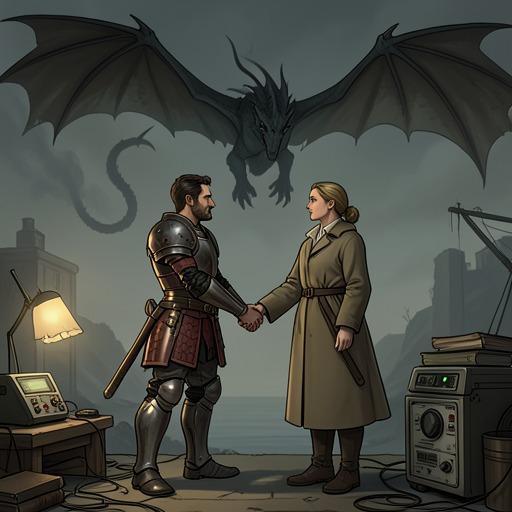
Vainqueur the DragonThe Minion Protocol is the governing hierarchy of Vainqueur Knightsbane’s servants and the clearest expression of how his dragon-centered society converts personal service into rank. Under it, Victor Dalton’s appointment as chief of staff is not merely an administrative promotion: it makes him the highest-ranking minion, the principal enforcer beneath Vainqueur Knightsbane, and an almost honorary component of the dragon’s hoard. The protocol therefore joins bureaucracy, military discipline, loyalty, and the grotesque logic of the food chain into one operating rule.
Definition and Hierarchy
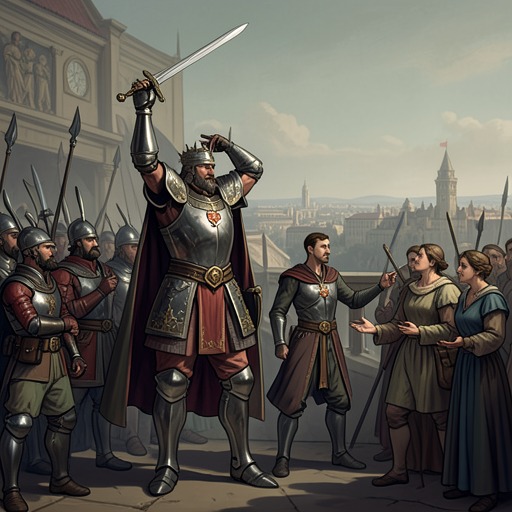
The protocol is introduced when the Kobold Rangers object to conflict among themselves. Yellow Ranger pleads with Vainqueur Knightsbane to forgive Victor Dalton, while Black Ranger mocks Yellow Ranger as a sycophant and Red Ranger strikes both of them on the shoulders. Red Ranger then invokes the rule that no argument may occur before the chief of staff. When Victor Dalton asks about the rule, Vainqueur Knightsbane identifies it as the Minion Protocol and realizes that he has never properly instructed his chief of staff in the management of minions.
Red Ranger explains that the chief of staff occupies the highest echelon of the minion pecking order. The office is described as the greatest honor a monster lord can grant, as well as the ultimate minion-killing machine: the ferocious enforcer serving the most dreaded master. Its imagined specification is fifty percent strength, fifty percent cunning, and two hundred percent loyalty. Victor Dalton responds with characteristic modesty by suggesting that the final figure is exaggerated, but the joke also clarifies the principle. The protocol values a minion not only for obedience, but for the capacity to impose the master’s will on everyone below.
Victor Dalton’s Place in the Order
Victor Dalton’s elevation follows his formal appointment as Vainqueur Knightsbane’s chief of staff and living signature. Vainqueur Knightsbane assigns him responsibility for managing paperwork on the dragon’s behalf, presenting the task as a great honor while leaving its unpaid nature unspoken. The system then confirms Victor Dalton’s new status through game-like progression: becoming the chief enforcer of a mighty dragon grants him a level in the Monster Squire class, together with substantial increases to health, stamina, strength, vitality, skill, agility, intelligence, charisma, and luck.
The protocol thus makes an otherwise humiliating workload legible as advancement. Victor Dalton is expected to recruit and discipline servants, prepare Vainqueur Knightsbane’s class progression, train the Kobold Rangers, and find profitable uses for monster remains. When Vainqueur Knightsbane orders him to open a shop selling junk, monster parts, and corpses, the dragon treats the demand as another natural duty of the chief of staff. Victor Dalton’s repeated signs of strain do not weaken the appointment; they demonstrate the office’s practical burden and its role as the bridge between Vainqueur Knightsbane’s grandiose commands and the labor required to execute them.
Authority, Loyalty, and the Food Chain
The protocol is inseparable from Vainqueur Knightsbane’s preciousness hierarchy. Vainqueur Knightsbane tells Victor Dalton that he stands immediately beneath the dragon and above princesses in preciousness, making him almost an honorary part of the hoard. This ranking is simultaneously affectionate, possessive, and threatening. A valued minion is protected and elevated, but remains classified within a system in which every creature below another may become food when hunger leaves no alternative.
Vainqueur Knightsbane explains that the preciousness rating also determines a servant’s place in the food chain. If food and minions were both unavailable, those higher in the chain could eat those beneath them as emergency rations. Victor Dalton is alarmed that the dragon therefore counts him as a possible meal. Vainqueur Knightsbane reassures him that this would happen only if no other food or minions existed, a condition he considers unlikely because the world is full of dragon food. The exchange captures the protocol’s central contradiction: loyalty can make Victor Dalton nearly part of the hoard, yet it cannot entirely remove him from the biological hierarchy that governs all minions.
This lesson has an immediate administrative consequence. Victor Dalton understands that recruitment must become a priority, and his previous chief of staff had already hired many goblins after the conversation. Minion resources are presented as a full-time and difficult responsibility, not as a decorative feature of the dragon’s court. The protocol therefore produces expansion: the more servants Vainqueur Knightsbane commands, the more effectively the chief of staff can protect the master, manage labor, and prevent the emergency food chain from becoming an immediate danger.
Military and Institutional Operation
The protocol becomes especially important when Vainqueur Knightsbane prepares for war against Furibon. Vainqueur Knightsbane insists that Furibon is evil and must be destroyed, repeating the declaration so that every applicant understands the stakes. Victor Dalton manages the recruitment process outside the orchard, where one hundred kobolds and several unusually powerful monsters, including a troll, a dryad, and a golem, wait for consideration. Vainqueur Knightsbane claims not to discriminate among creatures, although he defines equality through their shared inferiority to him and their possible status as emergency food.
Victor Dalton’s authority in this setting exceeds clerical service. He interviews applicants, assesses potential allies, and translates the dragon’s warlike objective into an organized force. His Monster Squire advancement later records the same function in numerical form: for fearlessly leading monsters to victory against superior opponents, he gains seven levels and several combat-related perks, including Monster Lifeforce (Red Dragon), Monster Rider, and Monster Insight. The protocol is therefore a chain of command that can become a military institution, with Victor Dalton serving as the operational link between Vainqueur Knightsbane’s authority and the collective action of monsters.
The same pattern extends into commerce and public organization. Victor Dalton negotiates the surrender of corpses to the Church of Camilla for necromantic transformation, signs the long contract as the legal living relative, and receives a fee for the transaction. Later, the commercial world associated with Vainqueur Knightsbane includes Nethermart, a magic-item shop open to monsters and mortals, where souls can serve as collateral and weapons are discounted for the coming war with Maure. The protocol’s administrative logic thus reaches beyond a household: it supports recruitment, contracts, resource extraction, training, and the construction of institutions that make monster power durable.
Systemic Meaning and Limits
The Minion Protocol belongs to a wider system in which rank is made visible through classes, levels, perks, and ceilings. Vainqueur Knightsbane gains a level in the Noble class through his ego and dragon bloodline; Victor Dalton gains the Monster Squire class through service; and Victor Dalton later receives seven additional levels and new perks through battlefield leadership. Advancement rewards behavior that the social hierarchy already values, making obedience, enforcement, recruitment, and victory appear as measurable capital.
Yet the system also imposes limits. A class ceiling at level thirty stops further advancement until a Crest is used, reducing experience gains to zero while leaving special deeds capable of granting perks. This rule shows that the protocol is not simply a personal arrangement between master and servant. It exists within a larger progression machine that distributes power according to conditions, thresholds, and recognized forms of achievement. Even Icefang’s skeptical challenge reveals the system’s institutional character: when he demands that the system appear before him, the invisible interface manifests, making awareness and qualifying statistics prerequisites for entry.
At its most revealing, the protocol turns submission into status without making submission cease to be submission. Victor Dalton receives authority over other minions, recognition as Vainqueur Knightsbane’s chief enforcer, and rewards for leading monsters, but he also inherits unpaid labor, dangerous obligations, and a permanent position beneath the dragon. The rule’s comedy comes from the distance between the grandeur of its language and the material reality of paperwork, recruitment, corpse disposal, and possible consumption. Its deeper function is to make Vainqueur Knightsbane’s chaotic dominion governable: the dragon may think in terms of hoards and emergency rations, but the Minion Protocol gives that appetite a hierarchy, an office, and a working chain of command.