Moon Man
Vainqueur the DragonMoon Man is an ancient moon beast and nominal deity whose presence exposes the unstable boundary between religion, monstrosity, and bureaucracy in Outremonde. Though his followers treat him as a god demanding sacrifices, he barely understands that he has a religion at all. His immense power and prehistoric hostility coexist with elderly confusion, making him both a cosmic threat and an absurdly inattentive patron whose accidental intervention reshapes Victor Dalton’s role.
Identity and Appearance
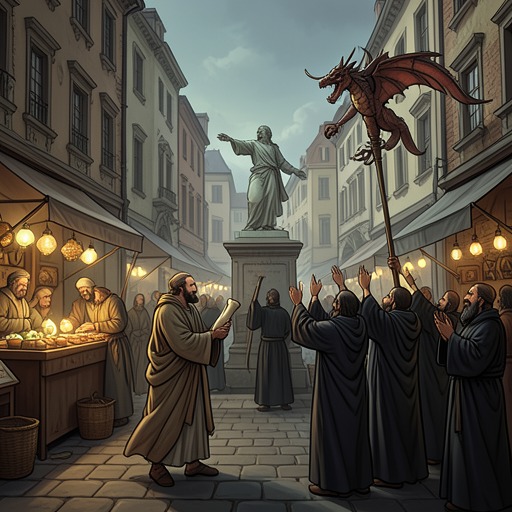
Moon Man is recognized as a tentacled squid-like being associated with the moon and with an ancient conflict between his kind and Dragons. In the religious display observed by Vainqueur Knightsbane, he is one of three altars without a tiny priest nearby. The omission distinguishes him from more actively administered cults, but it also reflects the neglect surrounding his own worship. His image stands beside a blood-drenched humanoid crow in a harlequin costume carrying a sharp scythe and a gigantic worm deity, while the manlings have savaged Moon Man’s statue.
His actual manifestation is vastly larger than any statue. When he appears beside Victor Dalton and Miel, Victor must look upward to see the whole creature: an enormous version of Thul-Gathar, more than sixty feet tall and larger even than Vainqueur Knightsbane. Moon Man wears old, tattered yellow robes, exposing his tentacled squid-like head and hands, and relies on a sorcerous cane as large as a pine tree to walk. The scale suggests an abomination from beyond ordinary human experience, yet the details of age, clothing, and bodily frailty immediately complicate that impression.
Cult and Divine Neglect
Moon Man’s cult is small but devout, and its members repeatedly summon him under the mistaken belief that he requires live sacrifices. The practice has spread because the cultists cannot understand what Moon Man says. Thul-Gathar explains that the deity is absent-minded, leaving others to care for his cults because he has so few followers; even a foolish congregation therefore matters to those trying to preserve his worship. Moon Man’s danger lies partly in this communication failure: a ritual intended as piety can become a recurring act of violence because the worshippers interpret silence and incomprehension as divine instruction.
The cult’s misunderstanding is particularly revealing because Moon Man does not present himself as a commanding ritual authority. He wishes the sacrifices would stop, but he does not know how to make his followers understand. Victor Dalton identifies the practical solution: because he can comprehend Moon Man’s telepathic speech, he can explain the deity’s wishes to the cultists and end the practice. The proposed relationship is therefore not one of ordinary priestly obedience. Victor becomes useful as an interpreter between an incoherent religious institution and the god it claims to serve.
Encounter with Victor Dalton
Moon Man’s arrival is arranged through Miel, who sends a request for a meeting on Victor Dalton’s behalf. She notes that Moon Man is in one of his good phases and is not rampaging, framing the encounter as an appointment rather than an invasion. The creature materializes almost immediately with a rumbling noise, but his first concern is whether he has forgotten the appointment. The contrast turns an apparently apocalyptic visitation into a badly managed calendar obligation.
Moon Man communicates directly inside Victor’s head rather than through spoken words. His telepathy initially makes him more alien, but his voice sounds to Victor like that of an elderly grandfather rather than an extraterrestrial horror. Miel introduces Victor as the prophet of the Murmurin cult and says that Thul-Gathar claimed him on Moon Man’s behalf. Moon Man responds with genuine confusion, asking whether he has a prophet and even whether he has a religion. His questions confirm that the cult’s central figure has almost no awareness of the institution built around him.
Victor asks whether Moon Man hears the prayers of his followers. Moon Man says that he hears voices often but does not recognize them as prayers, then launches into an elaborate conspiracy about cats and dogs secretly ruling Earth and ordering political assassinations through household pets. The digression makes his telepathic access no more reliable than the cultists’ interpretations of him. He possesses immense knowledge or at least an immense stream of perceptions, but cannot distinguish revelation, rumor, and nonsense in a manner useful to his worshippers.
Cosmic Power and Unreliable Revelation
Moon Man’s statements oscillate between prophecy and absurdity. Earlier, his kind is remembered as a force associated with world-destroying consequences when tentacled creatures are summoned, while his own followers treat him as a deity who can be invoked through sacrifice. Yet his personal conduct is marked by distraction, forgotten appointments, and uncertainty about the existence of his cult. The character thus reverses the conventional image of the omniscient god: the supernatural being is real, gigantic, and powerful, but the religious system surrounding him is more organized than he is.
His most enigmatic declaration comes when he says, "As dragons dance, so do Earth and Outremonde. The golden path is paved with fairy blood." The statement connects Earth and Outremonde through a parallel movement and introduces fairy blood as the material of a golden path, but its meaning remains opaque to Victor. When Victor asks for clarification, Moon Man translates the apparent prophecy into a practical instruction to return home and perform his prophet work, then admits uncertainty again. The scene presents revelation as a damaged transmission: the words sound momentous, but neither the recipient nor the speaker can securely explain them.
Narrative Role and Significance
Moon Man’s principal narrative function is to make divine authority visibly unreliable without making it powerless. He is not merely a monster worshipped by mistake, because his encounter with Victor produces a genuine religious appointment and gives Victor a role as prophet. Nor is he a conventional mentor: instead of offering a coherent map of the future, he supplies fragments that Victor must interpret, including the warning about Earth, Outremonde, dragons, and fairy blood. His guidance is an inversion of the heroic call, arriving through confusion rather than clarity and assigning responsibility rather than granting comprehension.
The character also extends the book’s recurring satire of institutions. A cult can be devout, ritualized, and willing to kill for its god while the god remains unaware that the cult exists. A meeting with an entity over sixty feet tall can become an exchange about forgotten appointments. A supposedly sacred sacrifice can persist only because the worshippers do not understand the deity’s language. Moon Man therefore embodies a theology in which scale does not guarantee competence, terror does not guarantee dignity, and revelation may be less dependable than a mortal interpreter.
His final image combines the three dimensions that define him: ancient cosmic force, bodily absurdity, and administrative confusion. The world-moving pronouncement about dragons and fairy blood is immediately followed by uncertainty over what he meant. Moon Man leaves Victor with a prophetic burden, but not with a stable explanation of it. His lasting significance lies precisely in that unresolved gap between what he may know, what he says, and what anyone else can understand.