Murmurin
Vainqueur the DragonMurmurin is the territorial and institutional heart of Vainqueur Knightsbane's rise from solitary dragon to ruler. Initially a small village beneath a volcano in a harsh, sparsely settled borderland, it becomes a fortified headquarters, a barony claimed after the War of the Hoard, and eventually the capital associated with Vainqueur's imperial title. The settlement's importance lies in this transformation: Murmurin is not merely a place where monsters gather, but the experimental frontier state in which Vainqueur turns treasure-hoarding, adventurer recruitment, labor management, and commercial enterprise into a form of rule.
Setting and Early Condition
Murmurin occupies a severe landscape dominated by a large volcano bordering the western sea. The countryside around it consists of brown badlands and arroyos, with few flowers or plants; a vast red sand desert begins beneath the southern horizon. A small population of manlings lives in a village at the mountain's foot, while primitive encampments stand near the desert's edge. The region is therefore strategically dramatic but agriculturally poor, offering little of the cattle supply that Vainqueur Knightsbane would have preferred for his lair.
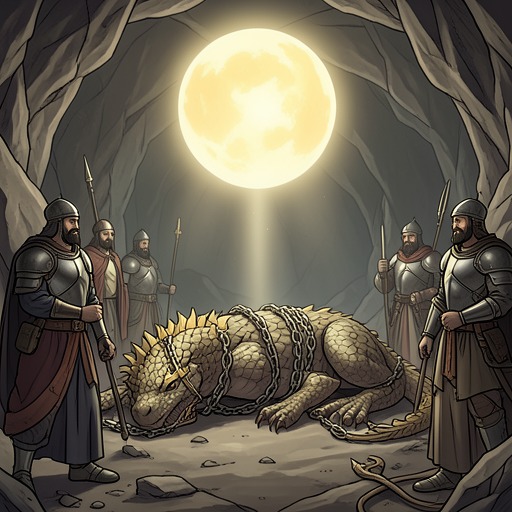
The volcano and the existing fortress nevertheless make Murmurin attractive to Vainqueur Knightsbane. The castle has lava, food reserves, and towers, making it an ideal place to store a hoard even though the surrounding land is unimpressive. Vainqueur Knightsbane also remembers having flown over the area two centuries earlier, when it looked considerably greener. That recollection places Murmurin within a landscape altered by historical catastrophe, while his indifference to the environmental decline underscores the dragon's habit of judging territory primarily by its usefulness to his hoard.
From Lair to Claimed Territory
Murmurin becomes the base of Vainqueur Knightsbane's operations during and after the War of the Hoard, a conflict whose final chapter is framed by the imperative that Furibon must die. The settlement's political status changes when Vainqueur Knightsbane destroys Furibon and Victor Dalton explains that Gardemagne had promised the victor the surrounding lands. The territory is identified as a barony, and Victor Dalton arranges for Savoureuse to notify the adventurer guild through a homing pigeon so that Vainqueur Knightsbane can officially be recognized as Baron of Murmurin.
That claim is both legalistic and practical. Murmurin lies far from Gardemagne, contains many monsters, and stands close to Maure's territory, making outside efforts to dislodge its new rulers dangerous. Vainqueur Knightsbane immediately reshapes the title into comic self-branding, preferring the name Baron King Vainqueur and calling the place the Barking of Murmurin. The joke reveals the settlement's political logic: formal recognition matters, but the actual power to hold the land comes from distance, force, and the ability to organize local creatures.
Population, Recruitment, and Administration
Murmurin grows through an unusually broad recruitment policy. When Vainqueur Knightsbane prepares for war against Furibon, Victor Dalton reports one hundred kobold applicants, along with higher-level inhabitants sent by Croissant, including a troll, a dryad, and a golem. Vainqueur Knightsbane declares that he does not discriminate among creatures, although his egalitarian language remains inseparable from his declaration that every creature is equally inferior and potentially emergency food. The settlement thus becomes a gathering point for monsters who would normally be hunted, excluded, or forced to conceal themselves.
The local shapeshifter community helps explain this population movement. Croissant says that monsters disguise themselves as humans to evade inquisitors and adventurers, who otherwise attempt to wipe them out. The community even maintains a school where mimics and other shapeshifters learn to blend into human society in a safe environment. Murmurin's appeal is consequently not only military. It offers a place where monster identity can be lived openly, where newcomers are welcomed, and where survival strategies developed under persecution can be converted into communal institutions.
The surrounding gnoll tribes also become part of Murmurin's labor force. They had lived south of the settlement under Furibon's rule, retaining their gold only so long as they obeyed him. Most fled during Vainqueur Knightsbane's war against the lich, but those who remained came to Murmurin seeking work. Vainqueur Knightsbane condemns their earlier service to Furibon, then forgives them and accepts them into his administration. Their incorporation is not peaceful in every respect: the gnolls prove less disciplined than the zealous kobolds, stop working when unwatched, and fight other minions, leading Vainqueur Knightsbane to eat twenty troublemakers before order is restored.
Infrastructure, Commerce, and Urban Expansion
Victor Dalton's responsibilities show Murmurin developing beyond a private lair. Vainqueur Knightsbane orders him to create a shop selling discarded materials, monster parts, and corpses, turning what had previously been waste into a source of money. Victor Dalton must perform this work while also preparing Vainqueur Knightsbane's class progression and training the kobolds. The command establishes an early form of resource administration in which the settlement's refuse, bodies, labor, and military preparation are all treated as assets.
The settlement later acquires a major commercial institution through Nethermart. In the northern part of Murmurin, bug fiends working under Malfaisant construct a six-floor, ivory-draped building, the tallest structure near Emperor Vainqueur's statue. Its grand opening is presented as the first fiendish magic-item shop in all of Outremonde, open to monsters and mortals alike. Customers unable to pay in coins can place their souls as collateral, and a thirty-percent weapons sale is advertised in preparation for the coming war with Maure. Nethermart therefore makes Murmurin a marketplace as well as a fortress, linking military mobilization to credit, magical goods, and predatory commercial contracts.
Murmurin's physical expansion follows its political consolidation. The minions build a large bridge to transport raw material from the mountain to the castle and rebuild the towers destroyed during the War of the Hoard. By the time Victor Dalton rides through the town square, the settlement has grown threefold, with additional houses and tents accommodating newcomers. A giant stone statue of Vainqueur Knightsbane stands in the square, while Vainqueur Junior is buried underground beside it, ready to ambush anyone attempting to pull the false sword. The town's architecture thus combines practical construction, monumental propaganda, and theatrical traps.
Capital of an Expanding Empire
Murmurin's status rises again when Vainqueur Knightsbane publicly claims the title Emperor of Murmurin and the Albain Mountains. During negotiations with King Roland Gardemagne, he also asserts authority over Ishfania, the devastated region once ruled by the Sablaris and later controlled by Brandon Maure. King Roland proposes a treaty under which Gardemagne will recognize Vainqueur Knightsbane's claim as Emperor of Ishfania, treating the territory as an official adventurer state while allowing him to rule it as he wishes. In return, Vainqueur Knightsbane must vow that his country will never take arms against Gardemagne and that both states will fight together against outside threats.
The treaty turns Murmurin from an isolated stronghold into the center of a recognized territorial project. It protects Vainqueur Knightsbane's access to his Emperor class while giving Gardemagne a buffer against the political vacuum left by Maure's death. Ishfania remains a demon-infested desert rich enough to attract rival powers such as the Eversun Empire, Barin, and Prydain, so Murmurin's imperial identity is connected to the management of contested resources and the prevention of another Century War. The settlement's authority consequently expands through both conquest and diplomatic legalization.
Social Life and Narrative Significance
Murmurin also functions as a stage for collective spectacle. During Bragging Day, dragons gather in the town square for a feast supplied with sheep, cattle, and cooked fiends. Because Vainqueur Knightsbane has no hoard to display, he orders half his minions to distract the visiting dragons with food while the rest search the wreckage left by the moth army for anything that can pass as treasure. The celebration makes the settlement temporarily resemble a court, a market, and a feeding ground at once.
The aftermath exposes the cost of that magnificence. After the feast, the entire area looks like the aftermath of a volcanic disaster: houses have been overturned and no sheep remain alive. Vainqueur Knightsbane then summons the Kobold Rangers, gnolls, mimics, and other servants and declares the party over, reasserting administrative control after the town has been consumed by imperial display. Murmurin's civic order is therefore repeatedly built and damaged by the appetites that sustain its ruler's prestige.
The settlement's future is tied to continued territorial enlargement. Vainqueur Knightsbane tells Jolie that a great flying city full of elves and demons now belongs to him and offers to let her settle there, allowing her to bring her hoard. Murmurin is consequently not an endpoint but a nucleus for further expansion, a place from which Vainqueur Knightsbane distributes territory, recruits relatives and followers, and turns adventuring success into dynastic geography. Its central paradox is that a barren frontier becomes prosperous and politically significant not by shedding its monstrous character, but by institutionalizing it.