Nethermart
Vainqueur the DragonNethermart is the first fiendish magic-item shop in Outremonde and one of the clearest institutions of the monster empire’s transformation from lair to economy. Conceived as a way to monetize junk, monster parts, and corpses that would otherwise be left for animals, it becomes a public commercial platform backed by Vainqueur Knightsbane, defended by demons, and contested by churches, knights, and rival enterprises. Its importance lies not merely in what it sells, but in how it converts waste, souls, religious promises, and political protection into market relations.
Origins and Physical Presence
Nethermart grows out of an administrative problem created by Vainqueur Knightsbane’s abundance. Victor Dalton initially describes the realm’s unwanted remains as something simply left lying around for animals to eat. Vainqueur responds by ordering him to find a way to make money from this “waste of skin,” then assigns him the additional burden of opening a shop selling junk, monster parts, and corpses. The proposed business therefore begins with disposal and resource extraction rather than with an established mercantile tradition. It is an extension of the dragon’s hoard logic: even refuse must be made valuable.
The institution is eventually given a conspicuous architectural form in Murmurin. Bug fiends working under Malfaisant construct a large, ivory-draped, six-floor building in the northern part of the city. It is the tallest structure near Emperor Vainqueur’s statue, making the shop both a commercial site and a monument to the new order. Chocolatine dislikes its rounded, “modern and trendy” architecture, but its height and unusual appearance ensure that Nethermart stands out within the capital’s developing urban landscape.
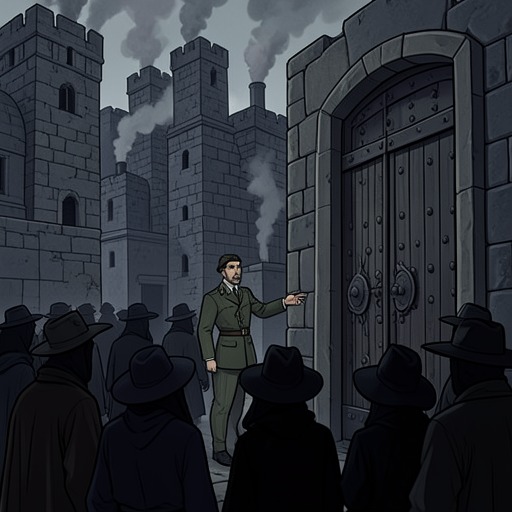
Its opening is staged as a public spectacle rather than a quiet launch. Monsters gather before the building, including the Kobold Rangers and Malfaisant, while a ribbon seals the entrance. Victor is prepared to cut it with his scythe while riding the Black Beast of Murmurin. The ceremony presents commerce as another imperial performance, complete with military imagery, ceremonial attendance, and a promotional sale tied to the coming war with Maure.
Business Model and Institutional Structure
Nethermart offers access to magic items and other goods to both monsters and mortals. Its opening announcement describes it as open to all and permits customers who cannot pay in coins to keep a tab, using their souls as collateral. This arrangement makes the shop more than a conventional store: it is simultaneously a lender, a creditor, and a supernatural intermediary. The customer’s future existence becomes an asset that can be pledged against present consumption.
The shop’s commercial language deliberately merges ordinary retail with infernal finance. Weapons are offered at a thirty percent discount in anticipation of the war with Maure, and the announcement urges customers toward universal armament. The sale therefore links private purchasing to collective mobilization. Nethermart does not merely respond to conflict; it uses conflict to stimulate demand, turning military preparation into a retail opportunity.
The business also reflects the division of labor within Vainqueur Knightsbane’s regime. Victor Dalton is expected to organize the enterprise while simultaneously serving as chief of staff, preparing Vainqueur’s class progression, and training the Kobolds. Nethermart thus belongs to a broader system in which political administration, military recruitment, education, and commerce overlap. Its creation exposes the pressure placed on Victor, but it also shows that the monster realm’s institutions are being built through delegated management rather than through Vainqueur’s direct labor.
Legality, Protection, and Conflict
Nethermart’s expansion into Ishfania provokes an immediate confrontation with Kia Bekele. Seeing the shop’s building, Kia threatens to bring it down, objecting that she had come to cleanse Ishfania of Maure’s fiends only to see other fiends take their place. Her objection is therefore political and ethical as well as military: the removal of Maure’s forces appears to have opened the territory to a new commercial occupation.
Malfaisant answers that the site is a free-trade area in which Happyland has invested with the full support of the Emperor. On that basis, he claims that the demons’ presence is perfectly legal. The argument gives Nethermart institutional protection that does not depend on moral approval. Its defenders invoke authorization, investment, and market status to transform an invasion-like presence into a recognized economic activity.
The dispute also reveals a sharp contrast between Kia’s language of ethical cleansing and Malfaisant’s language of market necessity. Kia regards the replacement of Maure’s fiends by other demons as unacceptable; Malfaisant replies that a free market naturally fills a vacuum and that his organization is merely answering demand. Nethermart therefore becomes a test case for whether legal commerce can legitimize the same kind of domination that a heroic campaign claims to oppose.
Competition and Religious Commerce
Nethermart’s market does not remain the exclusive preserve of Vainqueur Knightsbane’s demons. Miel announces that Heaven intends to prospect for new believers in the same territory, presenting the effort as religious competition. She produces a contract authorizing the expansion and states that Shesha also intends to invest, as does the Church of the Dread Three. The result is a marketplace in which commercial firms and religious institutions compete through overlapping forms of investment, conversion, donation, and promised benefit.
This development is foreshadowed by the wider economy of supernatural services surrounding Victor Dalton. Shesha’s miracles operate according to market rules: prosperity is provided in exchange for an appropriate monetary gift. Victor even asks what it would cost to be transported back to Earth, treating escape from Outremonde as a service whose price might be quoted. Nethermart belongs to the same world of transactional divinity, where miracles, salvation, protection, and access are all susceptible to calculation.
Victor’s soul becomes especially revealing within this system. After his death, Miel explains that Dice and the Moon Man both claim it, while Camilla offers a third afterlife proposal in recognition of Victor’s service to the undeathstrial revolution and friendliness toward her church. Shesha then appears as a dignified goddess of commerce and addresses Victor as a prospective asset. These competing claims make the soul function like a tradable resource, and Nethermart’s use of souls as collateral appears less anomalous than representative of the surrounding religious economy.
Monopoly, Expansion, and Significance
The opening of Nethermart has geopolitical consequences because Victor Dalton’s actions break Maure Hellcorporated’s monopoly. Miel explicitly frames the new market as the condition that allows Heaven to enter Ishfania. Once Maure’s exclusive control is removed, Malfaisant’s organization, Heaven, Shesha, and the Church of the Dread Three all prepare to compete for influence and market share. Malfaisant responds by ordering his bodyguards to inform the shareholders and cut prices, revealing that Nethermart’s presence triggers a corporate price war rather than a simple change of ownership.
The emerging Ishfania is described as a land ruled by and for greedy monsters, with no taxes, no regulations, and total freedom of religion. Nethermart is central to that transformation. It supplies the commercial infrastructure through which this supposedly unrestricted society can be populated by competing enterprises and faiths. The promise of freedom is therefore inseparable from aggressive commercial penetration: fewer public restraints mean more room for private, demonic, divine, and imperial actors to establish themselves.
The shop also has an everyday social dimension. Pink writes in Nethermart’s cozy drink shop and is interrupted when the Kobold Rangers notice that she is late for training and behaving suspiciously. This detail places the institution beyond its formal sales floor. It has become a gathering place where members of Vainqueur’s forces drink, write, socialize, and conduct private activity. The same building can serve as a corporate outpost, a religious battleground, a weapons supplier, and an informal social venue.
Nethermart’s decisive narrative function is to make the monster empire’s values materially visible. Vainqueur Knightsbane’s appetite for hoarding becomes inventory; Victor Dalton’s overburdened administration becomes organizational labor; warfare becomes a sales campaign; and souls become collateral. The institution’s claim to legality and free exchange does not neutralize its violence, but it gives that violence a polished commercial language. Nethermart is consequently both a shop and a model of power: a place where conquest survives by presenting itself as investment, freedom, and service to the market.