Princess Hunting Season
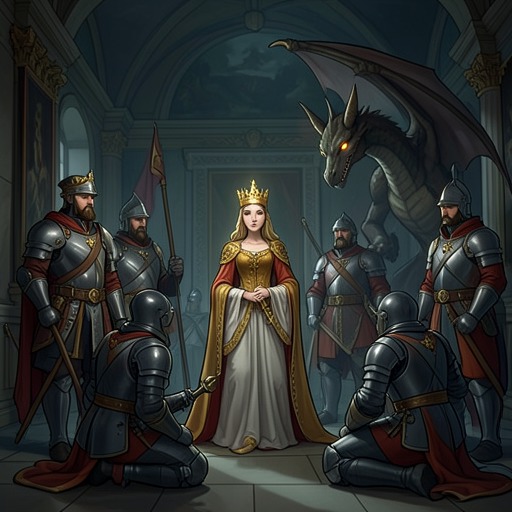
Vainqueur the DragonPrincess Hunting Season is a recurring dragon tradition centered on capturing princesses and incorporating them into draconic prestige. In the surviving account, it is both a calendar marker and a social institution: Vainqueur remembers it alongside his own Bragging Day, treats a captured princess as a present for his niece, and measures status through records of princesses preserved in a hoard. The custom therefore links violence, family celebration, competition, and accumulation, making the princess less a person within dragon culture than a trophy whose value can be displayed, inherited, and surpassed.
Place in Dragon Custom
Princess Hunting Season appears as one of the major occasions structuring Vainqueur’s memory and expectations. When he tries to understand why the solstice matters, he realizes that both his own Bragging Day and Princess Hunting Season are still far away. The recollection establishes the season as a predictable recurring period rather than an isolated raid, while its association with the solstice gives the hunting custom a ritual or calendrical dimension. Vainqueur’s confusion about the date also shows how closely the event is tied to the larger cycle of dragon life: recovering the memory of the season helps him reconstruct what has happened to him.
The season is also explicitly called the Princess Hunt Season in discussion of future plans. Genialissime says that he may organize a Bragging Day in about ten years, after the new Princess Hunt Season. This pairing makes the two customs complementary. Hunting supplies the achievement or treasure that can later be exhibited, while bragging provides the public or familial occasion on which the achievement acquires status. The sequence suggests that dragon prestige is produced through repeated acquisition and display rather than through a single permanent victory.
Vainqueur’s Gift to Jolie
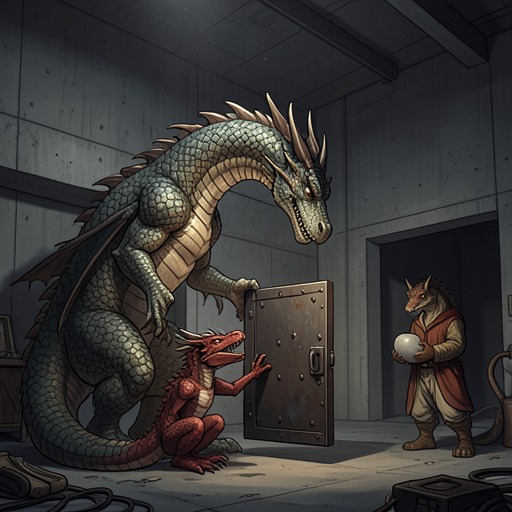
The clearest personal expression of the custom occurs when Vainqueur visits his young niece, Jolie, for her first Bragging Day. He emphasizes that he could not miss the celebration and brings a captive elfling as a present. Jolie expects a minion, since another dragon has already given her a catkin kitten, but Vainqueur presents the captive as something better: a princess. The scene converts the hunting season’s predatory outcome into a family gift and places the captive within a child’s developing hoard and social identity.
The exchange also reveals how dragon culture teaches value. Jolie’s first assumption is that a minion would be an appropriate possession; Vainqueur’s correction ranks a princess above that ordinary category. The princess is not merely useful property but a prestigious object capable of enhancing a young dragon’s reputation. Vainqueur’s pride in Jolie’s hoard confirms that accumulation begins early and is treated as a source of familial honor. The season thus reproduces itself through inheritance: older dragons hunt, younger dragons receive, and the next generation learns to interpret captured lives as signs of accomplishment.
Records, Rivalry, and Hoards
Princess Hunting Season also fuels competition among dragons. After a devastating loss, Vainqueur finds that the treasure gathered by his surviving minions is far inferior to the hoard he sacrificed to a goddess. The crystallized princesses kept on top of the remaining hoard partly compensate for the missing wealth, however, because they preserve a visible distinction that ordinary treasure cannot fully replace. Their presence helps sustain Vainqueur’s claim to greatness even when the hoard itself has been diminished.
The same collection provokes Icefang, who is furious that Vainqueur’s record for twin princesses has been surpassed. The detail turns princess hunting into an arena with measurable achievements, rival records, and wounded pride. A princess is valuable not only as an individual trophy but also as evidence in a competitive ledger of dragon supremacy. The custom’s social force therefore depends on comparison: a hoard can be praised, a record can be broken, and a family member’s accomplishment can become an insult to a rival.
Violence Beneath the Celebration
The festive language surrounding the season does not erase its coercive foundation. Vainqueur’s gift to Jolie is a captive elfling who is whining and shivering, and the presentation treats the captive’s terror as part of the object’s novelty. The distance between the dragon family’s delight and the captive’s distress is central to the custom’s meaning. Princess Hunting Season transforms an act imposed on a vulnerable outsider into a source of amusement, affection, and status for the dragons who benefit from it.
That contrast extends to the broader dragon worldview. Vainqueur’s family speaks casually about raids, hoards, and the condition of being killable, while the lives of elflings and other weaker peoples are reduced to materials for draconic identity. The season consequently functions as a dark inversion of a communal festival: it creates anticipation and shared celebration for the hunters, but its prizes carry the fear and helplessness of those hunted. Its recurrence makes the violence structural rather than exceptional.
Narrative Significance
As a narrative device, Princess Hunting Season joins memory, inheritance, and status. Vainqueur’s attempt to recall the solstice leads him through ruined elfling castles and toward a recovered flashback, so the season becomes part of the mechanism by which the past returns. It is not simply background lore; it helps organize the chronology of his lost experience and connects present investigation with earlier family scenes.
The custom also exposes the book’s satirical treatment of game-like progression and aristocratic prestige. Elsewhere, Vainqueur and Victor receive classes, levels, perks, and stat increases for ego, service, leadership, and combat, while Vainqueur’s hoard culture assigns comparable value to princesses, magical items, and records. Princess Hunting Season stands at the intersection of these systems: it is a recurring quest pattern whose rewards become social capital. By placing a frightened captive inside a birthday-style gift exchange, the narrative makes dragon civilization’s values legible through grotesque comedy. The season promises glory, but its glory depends on turning another being’s captivity into proof of greatness.