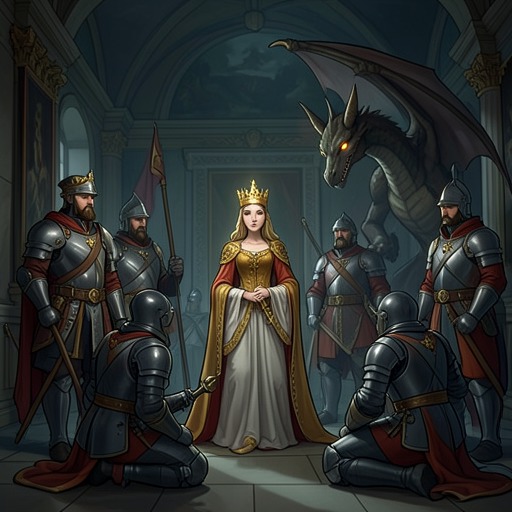
Princess Merveille
Vainqueur the DragonPrincess Merveille is the princess held in crystal captivity during Vainqueur’s celebration, and her confinement gives the surrounding political drama its clearest human stake. Although she does not speak or act directly in the recorded scenes, her recovery mobilizes King Roland, Kia, and Gardemagne’s royal retinue, exposes the cultural distance between human royalty and the dragons, and ends with her return to her family after an unsettling encounter with two hundred dragons.
Identity and Captivity
Princess Merveille is identified as King Roland’s niece and as one of the princesses imprisoned by Vainqueur. Her imprisonment is not treated by the dragon as an ordinary criminal detention: Vainqueur holds her among a group of princesses and plans to release them only after his celebration. The arrangement places her simultaneously in the roles of captive, royal relative, and valued figure within Vainqueur’s collection-oriented view of princesses.
The immediate circumstances of her confinement also establish the imbalance between the two sides. Vainqueur’s court is populated by dragons and kobold minions, while Princess Merveille remains sealed in a crystal prison that can be opened only by a sufficiently capable magical intervention. Her condition therefore requires both political negotiation and technical rescue rather than a simple departure from the premises.
Recovery Mission and Royal Intervention
The attempt to recover Princess Merveille brings King Roland, Kia, and Gardemagne’s royal retinue to Vainqueur’s territory. Manling Victor explains that the royal party had initially panicked after seeing dragons feasting and dead demons scattered along the road. Their fear subsided when Charlene told them that Vainqueur had killed Maure, allowing the delegation to approach as a diplomatic party rather than an attacking force.
King Roland’s presence is directly connected to his niece’s captivity. After the arrival and initial negotiations, he asks his elf wizard whether the princess can be freed from her prison. The wizard admits that the unknown caster’s level exceeds his own, but claims that his artifacts and optimized Perks make the release trivial. This exchange frames Princess Merveille’s rescue as a problem of magical superiority: the prison is formidable, yet the king’s retinue possesses enough specialized power to overcome it.
Vainqueur does not release the princesses immediately. He says that they will be freed after the celebration, treating their liberation as part of the schedule of his imperial display. The delay reveals how completely he controls the setting: even a royal rescue mission must proceed according to the timetable of the Monster Lord who holds the captives.
Release and Encounter with the Dragons
After the elf wizard releases Princess Merveille and the other princesses from their crystals, their first response is to scream at the sight of two hundred dragons. The scene reverses the expected emotional perspective. Vainqueur regards the dragons as his family and his assembled guests as participants in a feast, whereas the newly freed princesses see an overwhelming mass of monsters immediately outside their prison.
It takes King Roland twenty minutes to calm them. The duration makes their terror more than a momentary startle and emphasizes the gulf between the princesses’ assumptions about royal rescue and the reality of being liberated into a dragon gathering. Their release therefore resolves the physical captivity without erasing the danger and shock of the world into which they return.
Vainqueur offers the human delegation one of his princess bags to carry the princesses home, but the manlings refuse and use horses instead. He blames the choice on a culture clash. The offer is revealing: Vainqueur understands the princesses through the material logic of his hoard, while King Roland’s party insists on transporting them according to human royal custom. Princess Merveille’s recovery thus becomes a comic but consequential confrontation between incompatible ideas of care, status, and possession.
Return and Narrative Significance
Princess Merveille’s departure officially ends Vainqueur’s party. He waves to his family as they fly into the sky, and the princesses’ return gives the celebration a satisfying public conclusion even as Vainqueur remains sad at losing his three princesses. The ending preserves the contradiction at the heart of his relationship with them: their liberation is a diplomatic success and a humane resolution, but it is also experienced by Vainqueur as the loss of treasured members of his collection.
Her recovery strengthens Vainqueur’s political standing rather than simply diminishing it. The event helps him receive King Roland and the royal retinue as guests, demonstrate control over Ishfania’s monsters, and gain recognition as an Emperor and Monster Lord. The immediate consequence for Princess Merveille is a return to her royal family; the broader consequence is that her captivity and release become part of Vainqueur’s public transformation from dangerous dragon into a ruler capable of hosting foreign royalty, negotiating with them, and converting a potential confrontation into a ceremonial success.