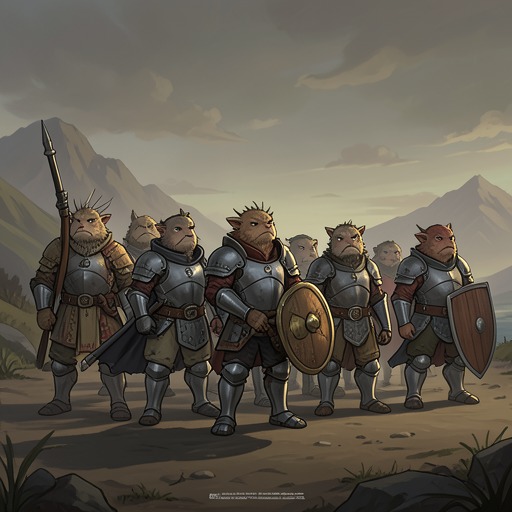
Recruitment of the Kobold Rangers
Vainqueur the DragonRecruitment of the Kobold Rangers is the episode that transforms Victor Dalton’s unpaid administrative burden into an actual institution. In the basement beneath an inn, Victor discovers five kobolds rehearsing a synchronized ranger presentation, accepts them as unpaid interns after they plead to become his minions, and inadvertently becomes responsible for their training, advancement, and deployment. Their recruitment gives Vainqueur Knightsbane a recognizable corps of servants while giving Victor the first practical proof that the Class System rewards organization as much as individual heroics.
Discovery and First Encounter
Victor Dalton is initially searching the underground for the rats that Lynette believes have been stealing food. The search leads instead to a small tunnel dug from the countryside into the basement, establishing that the intruders are not ordinary vermin but organized scavengers. Behind a crate, Victor finds five small, lizard-like humanoids, each roughly the size of a human child. They possess sharp claws, short horns, long tails, and differently colored scales: red, blue, yellow, black, and pink. Their color scheme is so conspicuous that Victor privately sees the group as a rainbow rather than a conventional band of monsters.
The kobolds are not caught in a raid or ambush. Victor finds them practicing. A high-pitched voice insists that everything must be said with the heart and that the group must rehearse its pose. The five then perform a call-and-response routine that culminates in the declaration, "We are… The Kobold Rangers!" Their theatrical confidence contrasts sharply with Victor’s confusion. The group is already trying to invent a collective identity, and its identity depends on choreography, color, slogans, and public recognition as much as on combat ability.
Their self-presentation is deliberately extravagant. The red kobold celebrates the fact that the choreography has finally been mastered, while the blue, yellow, and pink members contribute additional lines about striking at night, training in unity, and striving in discord. The performance makes them ridiculous, but it also reveals discipline: they have practiced together, assigned roles, and imagined themselves as a unit before acquiring a recognized employer or battlefield record.
Victor’s Recruitment Decision
The encounter changes when the yellow kobold identifies Victor as an "Ultra Reptile." Victor has recently spent enough time with Vainqueur Knightsbane for the dragon’s smell to cling to him, and the insult implicit in that observation becomes an unexpected credential. Rather than retreat from his humiliating position, Victor exaggerates it. He announces that he is Vainqueur’s chief of staff, guide, and class manager and orders the kobolds to cower before him.
The claim works because the kobolds understand the social power of a dragon’s chief of staff. They recognize Victor as a genuine minion official, and the pink kobold responds to his performance with tears of admiration, describing the impression as raw charisma. Victor therefore recruits them not through force, payment, or a formal contract, but through a mixture of borrowed authority and improvised spectacle. The episode turns bureaucratic language into a form of magic: the title that Victor regards as burdensome becomes the very thing that makes him attractive to potential followers.
The kobolds then make the decisive request themselves. Red bows and asks the mighty chief of staff to accept them as minions, explaining that they have no experience, that this would be their first minion work, and that they are hardworking and versatile. Their appeal is both comic and sincere. Victor sees their large, hopeful eyes and finds them strangely endearing despite their monstrous appearance. He accepts them as interns, but specifies that the internships will be unpaid. His attempt to preserve an ordinary professional distinction merely reproduces Vainqueur’s exploitative habits; Victor immediately recognizes that the dragon has rubbed off on him.
The Class System formalizes the recruitment. For recruiting his first group of expendable minions, Victor gains two levels in Monster Squire, along with increases to his stamina, strength, vitality, skill, agility, intelligence, and luck. He also gains the Monster Student Class Perk. That perk allows him to learn monster-exclusive Perks after being taught or targeted by them and makes him count as a monster for class-access criteria. Recruitment thus alters Victor’s status as well as his workload: by accepting monsters as subordinates, he becomes more legible to the monster side of the Class System himself.
Training, Labor, and Military Expansion
The new minions do not remain a novelty. Vainqueur assigns Victor the task of finding profitable uses for discarded meat, monster parts, and corpses rather than simply giving such materials away for animals to eat. Victor is expected to open a shop, manage waste as commercial inventory, prepare Vainqueur’s class progression, and teach the kobolds whatever classes seem suitable. The recruitment therefore creates an organizational chain in which Vainqueur issues broad, self-serving commands, Victor translates them into procedures, and the Kobold Rangers become the labor force expected to carry them out.
The group’s purpose is tied to Vainqueur’s hoard. The kobolds sell recovered materials so that their master’s hoard will grow, and they believe that anything added to it will remain part of it forever. Victor identifies this as a powerful culture clash. To him, the arrangement looks like unpaid labor and emotional indoctrination; to the kobolds, service is a path to permanent belonging. Their loyalty is not merely fear-based. It is expressed through the hope that work performed for Vainqueur will secure an enduring place within his wealth and power.
The Rangers also become combatants. After Victor leads monsters against superior opponents, the Class System awards him seven additional levels in Monster Squire and grants the Monster Lifeforce (Red Dragon), Monster Rider, and Monster Insight Perks. The scale of this reward marks a sharp change from the harmless basement discovery. The kobolds have become an instrument through which Victor can command monsters, survive dangerous encounters, and accumulate class power. Their recruitment is consequently both an employment arrangement and a military apprenticeship.
The unit’s cohesion is tested by casualties. After Yellow and Blue are lost, Red and Black carry the corpses of their fallen comrades to Victor. The survivors apologize for interrupting his attempted murder, showing that they now treat his dangerous activities as part of ordinary office routine. Red immediately complains that the choreography is two members short and that the group cannot serve Vainqueur properly without replacing them. Black proposes adding green and white scales, while Pink asks for a sixth member with shining silver scales and specifically hopes for a young, virile male. Even in mourning, the Rangers interpret loss through recruitment, color design, and service obligations. Their response preserves the unit’s identity while revealing the cost of the wars into which that identity has drawn them.
From Five Kobolds to a Monster Organization
The recruitment episode later becomes a model for larger-scale mobilization. When Vainqueur prepares to fight Furibon, the applicants outside the orchard include one hundred kobolds, alongside other monsters with significant class levels: a troll, a dryad, and a golem. Victor has been instructed to gather inhabitants above level twenty, and the original Rangers’ existence helps establish the idea that monsters can be selected, trained, classified, and deployed as a coordinated force.
Vainqueur frames the coming conflict in absolute terms, repeatedly insisting that Furibon is evil and must be destroyed because the matter is war. His claim that all creatures are equally inferior to him is comic, but it also describes the inclusive logic of his recruitment system: species does not disqualify a potential servant, provided the servant can contribute to the hoard or the campaign. The five colored kobolds are therefore the prototype of a heterogeneous monster army rather than an isolated comic side group.
Their institutional presence continues beyond the original basement and battlefield. At the grand opening of Nethermart, the first fiendish magic-item shop in Outremonde, the Kobold Rangers are among the monsters gathered before the new six-floor, ivory-draped building. The store accepts souls as collateral when customers cannot pay in coins and advertises a thirty percent weapons sale for the coming war with Maure. The Rangers’ appearance at this ceremony places them inside Vainqueur’s expanding commercial and military network: they are no longer merely food thieves seeking employment, but visible participants in a public monster economy.
After another Bragging Day leaves the surrounding area devastated, the Kobold Rangers answer Vainqueur’s summons with gnolls, mimics, and other servants. Red bows on behalf of the group and asks how they can serve. Their readiness confirms the permanence of the recruitment. What began with five voices practicing a pose has become a formal corps that can be called upon amid the aftermath of catastrophe.
Narrative Significance
Recruitment of the Kobold Rangers satirizes the language of modern employment while granting that language real consequences in a fantasy world. Victor calls the kobolds unpaid interns and repeats the rhetoric of career opportunity, but the Class System rewards him for acquiring expendable labor, and Vainqueur treats the resulting workforce as an extension of his hoard. The joke about internships therefore carries an institutional edge: recruitment creates advancement for the manager, belonging for the recruits, and an increasingly efficient supply of labor for the dragon.
The episode also reverses the usual monster-adventurer hierarchy. Victor enters the basement expecting to find pests, yet the supposed pests possess names, colors, aspirations, rehearsed culture, and a desire for professional recognition. Their first collective declaration makes them a branded organization before any authority acknowledges them. Victor’s acceptance gives that identity an employer, while the Class System gives it measurable effects. The group’s later training, casualties, replacement plans, military expansion, commercial appearances, and ceremonial obedience show how quickly an improvised performance can harden into an institution.
For Victor, the Kobold Rangers are the beginning of a recurring contradiction. He resents the work, the lack of pay, and the impossible accumulation of duties, yet he is moved by the kobolds’ hope and becomes increasingly capable through their service. For Vainqueur, they are minions whose labor enlarges the hoard and extends the dragon’s authority. For the kobolds themselves, service promises a permanent place in that authority. Their recruitment therefore matters not simply because five monsters join the cast, but because it demonstrates how loyalty, exploitation, game-like rewards, and organizational identity combine to build Vainqueur’s emerging monster civilization.