Rolo
Vainqueur the DragonRolo is a self-aware steel golem and exceptionally dedicated farmer whose apparently humble profession becomes one of the most consequential forms of power in the story. He enters the narrative as a prospective minion, but his unusual soul, determined purpose, and practical expertise make him far more than a disposable shield: he becomes a cultivator, teacher, priestly participant, battlefield combatant, and essential contributor to the greening of the dry region around Murmurin.
Identity and Introduction
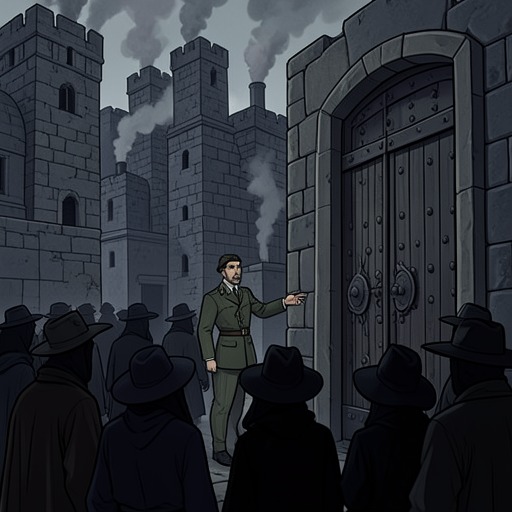
Rolo is introduced alongside a dryad as part of a set of potential recruits. Vainqueur immediately rejects the idea that steel golems are suitable minions, despite their great strength. The judgment reflects Vainqueur’s preference for useful subordinates as he defines usefulness, but it also establishes the contrast that governs Rolo’s characterization: physical power is less important to him than patient, specialized work. The interview is supposed to determine whether the candidates can serve as meat shields, yet Rolo’s significance lies precisely in the fact that his value cannot be reduced to combat.
The explanation of Rolo’s nature makes him exceptionally rare among golems. Only one percent of steel golems awaken with free will, and Rolo is one of them. Because he possesses a soul, he can acquire class levels; he has reached level sixty-seven, all of them in the Farmer class. That total exceeds even the Shining Knight’s level, making Rolo the highest-level Farmer Victor has encountered. His singular commitment is reinforced by his refusal to take levels in any other class until his agricultural goal has been achieved.
Dream and Purpose
Rolo’s defining declaration is that he wants to see the red desert green again. The dream is not presented as a vague wish for comfort or decoration. It is tied to the region’s history and to the memory of a landscape that once had more vegetation. Rolo explains that the area became dry after the Sablaris Empire dried out the region, and his voice carries anger when he describes that damage. His farming therefore has a historical and restorative dimension: cultivation is a response to environmental destruction and an attempt to reclaim a lost future.
The dream also gives Rolo a stable identity within a world where the Class System turns behavior into measurable advancement. Other characters gain power through combat, rank, or extraordinary deeds, but Rolo’s levels embody sustained labor. His single-minded refusal to diversify his class suggests that the system can record commitment as effectively as violence. At the same time, his level count gives farming an unexpectedly epic scale. The story treats the restoration of soil and water as a heroic objective while allowing the absurdity of a level sixty-seven Farmer to challenge conventional ideas about strength.
Agricultural Knowledge and the Greening Project
Rolo’s expertise becomes decisive when the lands beside the volcano prove too dry to feed Vainqueur’s guests for Bragging Day. Victor organizes a large greening project, and Rolo supplies knowledge that allows the project to function. Gnolls dig canals from the sea toward Murmurin, while kobolds gather trees to provide shade so grass can grow. Rolo teaches the workers to use spades, tools that can both dig the ground and mine gold. Agriculture, infrastructure, and resource extraction thus become connected activities rather than separate occupations.
Rolo’s influence extends beyond tools. The project includes irrigation canals and pits for drawing water from underground mountain sources, as well as the planting of trees by Rolo and Allison. Rolo also identifies the need for magical plants capable of thriving in sandy soil and removing salt from seawater. The group experiments with seawater greenhouses for agriculture, showing that his farming is not confined to traditional methods. His knowledge helps transform a hostile environment into an engineered system of canals, shade, soil treatment, and controlled cultivation.
This work changes the relationship between the volcano and its surrounding territory. The region remains dry, but the land immediately around the volcano is somewhat fertile, and the project builds on that limited advantage rather than pretending the environmental problem does not exist. Rolo’s methods make the landscape productive through cooperation among different kinds of minions. The same ruler who initially viewed him as unsuitable comes to depend on the results of his labor, even while Vainqueur nearly regrets having fired Victor, the organizer who put the project into motion.
Religion, Animals, and Practical Magic
Rolo’s agricultural vocation is also connected to religious practice. At the temple he shares with Allison, he brings a sheep and asks Cybele to bless it. He then activates the Perk Multiply Cattle, causing the sheep to divide first into two, then four, and then eight. The scene presents multiplication as an ordinary extension of farm work, but it also shows how Rolo combines faith, livestock management, and supernatural ability. His productivity is not merely symbolic; it directly increases the available animals.
The episode places Rolo beside Allison, whose own levels are mostly in Druid and Vestal and who can serve as a healer. Their partnership links plant cultivation, animal care, divine blessing, and healing. Rolo’s work is therefore communal rather than solitary. Even his personal dream depends on a network of laborers and allies, while his magical abilities make the network more capable of feeding and sustaining a population.
Combat and Unexpected Abilities
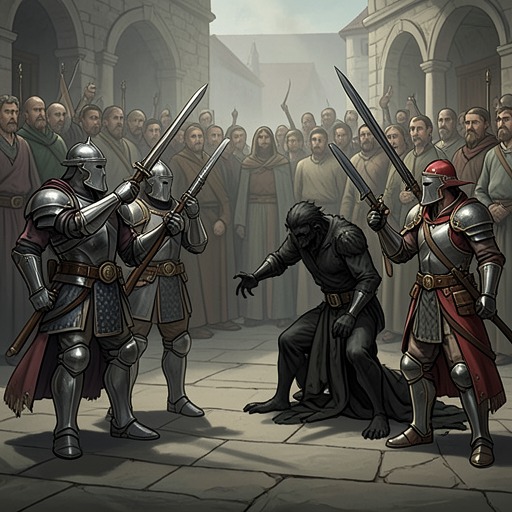
Rolo’s farming does not prevent him from entering battle. When fairy beasts and gargoyles threaten the village, Rolo and Allison join the fighting. Rolo attacks a gargoyle with a shovel, an implement that remains unmistakably agricultural even when used as a weapon. He then casts Sheepinize, transforming the giant gargoyle into a black sheep and moving the result out of his way.
The ability astonishes Victor, who asks whether Farmers can perform such magic. Rolo answers that he can do so at level fifty-one and raises his shovel toward the hostile fiends, declaring that they will all become his sheep. The moment turns his supposedly noncombat class into a form of battlefield authority. Rolo does not abandon farming when violence arrives; instead, he makes the farm’s animals, tools, and transformations part of his method of survival. His combat identity remains an extension of his profession.
Narrative Role and Significance
Rolo functions as a corrective to the hierarchy implied by Vainqueur’s recruitment practices. Vainqueur initially evaluates him as a possible minion and dismisses steel golems as unsuitable, but Rolo’s value emerges through the precise activities that a combat-centered ruler might overlook. His level sixty-seven Farmer class, environmental mission, technical instruction, and magical livestock production demonstrate that a society cannot be sustained by warriors alone.
The Class System reinforces this point while also supplying the story’s comedy. Vainqueur gains a level in the Noble class through ego and dragon blood, Victor gains levels in Monster Squire through service and leadership, and later receives perks for leading monsters against superior opponents. Rolo’s advancement follows another logic: his identity is so thoroughly organized around cultivation that every level remains Farmer. The system makes his dedication legible as power, but Rolo’s dream gives that power a moral direction that the system itself does not provide.
Rolo’s presence also complicates the boundary between machine and person. His awakening with free will and possession of a soul establish that a steel body does not prevent consciousness, aspiration, anger, or religious participation. He is not defined by the material from which he is made, nor by the role Vainqueur first assigns him. He is defined by the future he intends to grow: a green desert, restored through knowledge, labor, cooperation, and stubborn fidelity to the Farmer class.