Silver Rapier
Vainqueur the DragonThe Silver Rapier is both the missing object at the center of Louise de Carabas’s reward quest and the material link between the Carabas family’s origin legend, the Century War, and Vainqueur Knightsbane’s renewed presence in Midgard. Its recovery promises one thousand gold pieces, but the sword’s history makes it far more consequential than an ordinary stolen weapon: it carries the memory of a family’s ascent, exposes the limits of local knowledge about the dragon, and draws Victor Dalton into a life debt and forced minionhood.
Identity and Historical Provenance
The Silver Rapier is identified as the prized family heirloom of Louise de Carabas. The reward notice describes it as a weapon last reported in the hands of goblins in the Albain Mountains and includes a drawing of the sword, giving Victor Dalton a concrete object to pursue rather than a vague treasure legend. Its material value is stated plainly in the one-thousand-gold-piece reward, yet the marquise’s account establishes that its importance is dynastic as well as financial.
According to Louise de Carabas, her ancestor once befriended a manling adventurer who tricked a King of Gardemagne into granting the young man the king’s daughter in marriage. In return, that adventurer gave the ancestor the Silver Rapier and the marquisate of Carabas. The family therefore traces its rule of Carabas to an exchange in which the weapon functions as both gift and proof of inherited status. The sword is not merely something the family possesses; it is part of the story by which the family explains why it possesses power.
The rapier’s history also contains a rupture. Looters removed it from the corpse of Louise’s great-grandfather during the Century War, separating the heirloom from the family that used it to remember its own beginnings. Louise does not know how it passed from the looters into the claws of a red dragon, and she had not even known that a dragon had taken up residence in the country. The sword’s disappearance thus connects an old wartime theft to a much more recent crisis of information: the Carabas household has lost both its heirloom and an accurate sense of the danger surrounding its recovery.
The Reward Quest and Victor Dalton’s Recruitment
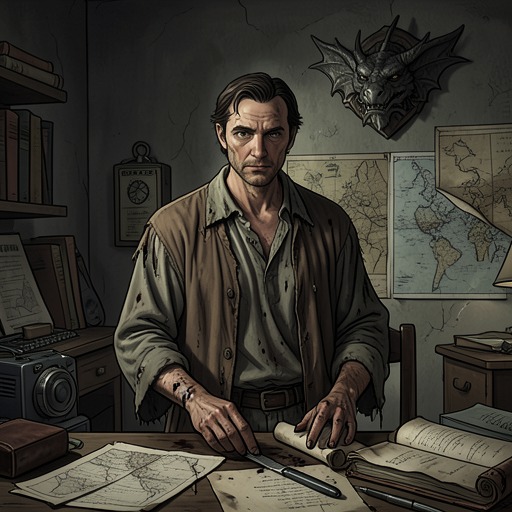
The Silver Rapier enters the plot through Louise’s public request for its return. Victor Dalton initially reads the commission in practical and opportunistic terms. Since most goblins had fled the Albain Mountains years earlier, he assumes the job will provide easy money. He also sees the expedition as a chance to scout the Carabas estate for anything else worth taking, so the rapier’s recovery is entangled from the outset with his own interest in theft and reconnaissance.
That plan changes when Victor Dalton encounters Vainqueur Knightsbane. Rather than simply sending Victor to retrieve the weapon, Vainqueur Knightsbane orders him to put the rapier back where he found it and to lead the dragon directly to the Guildhall so that the request can be examined. Because Vainqueur Knightsbane is short on goblins, he declares Victor Dalton his new minion until Victor repays a life debt. The sword therefore operates as the immediate mechanism of Victor’s subjugation: a commission undertaken for profit becomes the circumstance that places him under a dragon’s authority.
Victor Dalton regards the appointment as an honor he does not deserve and protests that he is wholly unsuited to the role. Vainqueur Knightsbane dismisses the objection through the dragon’s simple hierarchy of power, reminding Victor Dalton that Vainqueur Knightsbane is a dragon and concluding that Victor Dalton is now his minion. The rapier’s retrieval is consequently displaced by a larger obligation. Victor Dalton must still guide the dragon toward the request, but the weapon’s commercial value has been overtaken by the life debt created around it.
Louise de Carabas and the Hidden Stakes of Recovery
Louise de Carabas’s decision to hire thieves reflects the danger and asymmetry surrounding the Silver Rapier. The reward is generous enough to attract people willing to trespass and steal, while the family’s own knowledge of the weapon’s whereabouts is too incomplete to secure it directly. The request’s formal language presents the matter as a straightforward recovery from goblins, but the actual expedition reveals that the presumed antagonists are no longer the decisive threat.
The Carabas estate itself reinforces the rapier’s dynastic setting. Vainqueur Knightsbane sees the marquise’s palace as an inferior lair: a small, one-towered castle on a low hill, protected by stone walls and bowmen. The guards fire arrows when Vainqueur Knightsbane and Victor Dalton land at the entrance, and the dragon retaliates by knocking several of them to the ground with his tail before waiting for their master to appear for a civilized conversation. The encounter shows how quickly a request concerning one family object expands into a confrontation between aristocratic defenses and draconic force.
Louise’s explanation of the heirloom clarifies why the Carabas household is saturated with feline imagery. The estate contains cats, lions, tigers, and even a sphinx, while its summit bears a flag depicting a cat with boots. These details make the sword’s origin legend visible in the household’s symbols. The family’s identity is organized around a remembered adventurer, a royal marriage, a marquisate, and the weapon exchanged for that elevation; the rapier is the portable remnant that binds those elements together.
Vainqueur Knightsbane’s Reputation and the Rapier’s New Meaning
The Silver Rapier’s movement into Vainqueur Knightsbane’s claws changes its meaning from family relic to evidence of the dragon’s return. Louise had not known that Vainqueur Knightsbane was present in the country, and Victor Dalton has to ask whether the wyrm possesses a reputation. The Count of Provencal answers that Vainqueur Knightsbane was the bane of Midgard for centuries before vanishing fifty years earlier. Legends further claim that the dragon fought a Wild Hunt party single-handedly and exchanged blows with a level-sixty-seven elf knight.
Against that history, the marquise’s request appears tragically misclassified. Louise believes she is seeking the return of a stolen heirloom from goblins, while the weapon is actually associated with a creature whose name carries centuries of fear. The sword becomes the point at which local domestic memory meets a much larger political and legendary history. Its disappearance has not simply created a gap in the Carabas family’s possessions; it has helped conceal the fact that an old power has re-entered the world.
The rapier also exposes the instability of ownership. It began as a gift that legitimized a marquisate, was removed from a noble corpse by wartime looters, passed into the possession of goblins, and eventually came into the claws of Vainqueur Knightsbane. Each transfer strips away the assumption that inheritance alone determines possession. The family calls the weapon an heirloom because of its origin, the reward notice treats it as recoverable property, Victor Dalton treats the commission as an opportunity, and Vainqueur Knightsbane treats the object as part of an encounter that entitles him to command his new minion.
Narrative Function and Significance
As a plot device, the Silver Rapier is a classic quest object with a deliberately comic inversion. Its advertised function is to motivate a paid retrieval mission, but the mission does not produce the expected easy money. Instead, it leads Victor Dalton to Vainqueur Knightsbane, converts a theft-related errand into a life debt, and directs the dragon toward the Guildhall and the request itself. The quest’s apparent prize is less important than the chain of authority and revelation that forms around it.
As a material object, the rapier also makes the past physically intrusive. The Carabas family’s founding legend, the Century War, the looters who violated a great-grandfather’s corpse, and Vainqueur Knightsbane’s forgotten reign of terror are not presented as disconnected historical notes; they converge in one weapon. Its absence forces the family to act, its recovery summons outsiders, and its association with the dragon reveals that the old order has not disappeared as completely as the people of the present assumed.
The Silver Rapier therefore stands at the intersection of treasure, inheritance, and danger. It promises wealth to Victor Dalton, prestige to Louise de Carabas, and an occasion for Vainqueur Knightsbane to impose his will. By the time its history is explained, the sword has ceased to be a simple object awaiting return. It has become the plot’s hinge between a noble family’s self-mythology and the dragon’s violent reappearance in the living world.