Soul Nethermart
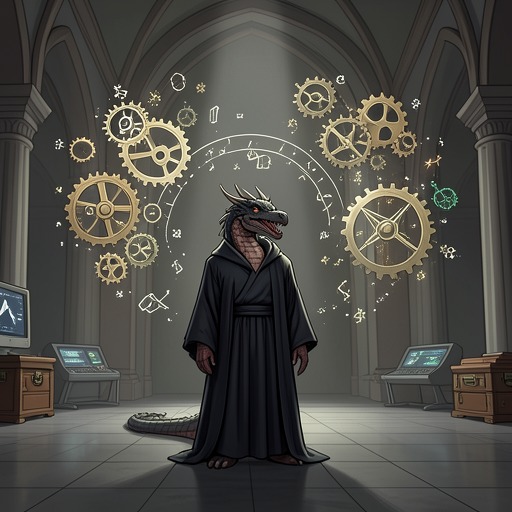
Vainqueur the DragonSoul Nethermart is the commercial expression of Vainqueur Knightsbane’s monster empire: a free-trade institution where weapons, magic items, monster goods, and souls circulate under the protection of the Emperor. Its decisive importance lies in the way it converts a local response to waste and adventuring into a broader economic order. The market does not merely sell objects; it reorganizes relations among monsters, mortals, demons, churches, and rulers, making greed into law and presenting exploitation as ordinary business.
Origins and Commercial Purpose
Soul Nethermart grows out of Victor Dalton’s attempt to give economic value to what Vainqueur Knightsbane considers waste. Vainqueur orders Victor to stop giving away discarded meat and monster remains and instead find a way to make money from them. His proposed solution is a shop selling junk, monster parts, and corpses, while Victor must also prepare class progression and train the Kobold Rangers. The assignment establishes the institution’s underlying logic: materials that once had no recognized value become commodities once an organized intermediary finds buyers for them.
The market’s commercial ethic is inseparable from Vainqueur Knightsbane’s hoard-centered worldview. When Victor receives payment for arranging the sale of corpses to a necromancer, Vainqueur treats the transaction as proof that wealth is growing, while Victor feels morally compromised by having sold bodies for postmortem slave labor. Vainqueur then pays Victor eight gold coins, only after redefining the promised tenth as one one-tenth. The exchange captures the institution’s mixture of hierarchy, humor, and exploitative accounting: Soul Nethermart rewards useful administration, but its terms remain controlled by the dragon at the top.
The Nethermart Building and Opening
The institution eventually receives a conspicuous physical headquarters in northern Murmurin. Bug fiends working under Malfaisant construct a large, six-floor building covered in ivory drapery. Its rounded architecture is described by the fiends as modern and trendy, and it becomes the tallest structure in the area beside Emperor Vainqueur Knightsbane’s statue. The building’s height and visibility make the market an architectural counterpart to imperial authority: commerce is not hidden in a back room but displayed as one of the defining monuments of the new order.
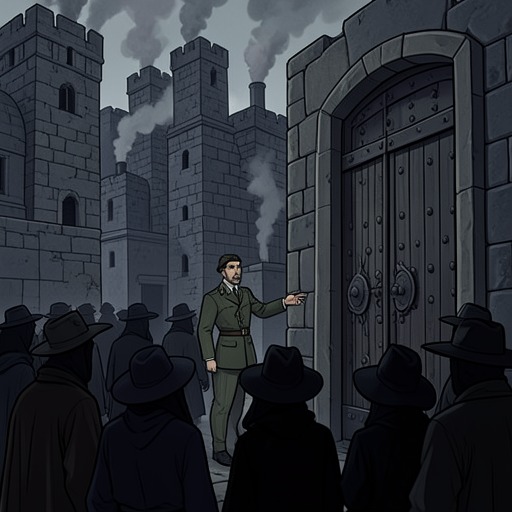
At the grand opening, monsters gather outside, including the Kobold Rangers and Malfaisant. Victor is prepared to cut the ribbon with his scythe while riding the Black Beast of Murmurin. Malfaisant announces that Nethermart is the first fiendish magic-item shop in all of Outremonde and that it is open to monsters and mortals alike. Customers unable to pay with coins may keep a tab using their souls as collateral, while a thirty-percent weapons sale celebrates the coming war with Maure. The opening therefore joins retail spectacle, credit, militarization, and damnation in one promotional event: the same shop that sells consumer goods also finances conflict and makes the soul a security deposit.
Political and Legal Order
Soul Nethermart operates with the full support of Vainqueur Knightsbane’s imperial regime. Vainqueur describes his empire as a country where minions never leave his service, even in death, and where demons can trade souls without paying taxes to mortals. He presents this arrangement as an application of enlightened dragon principles, but its practical foundation is mass undead labor and the unrestricted circulation of spiritual property. When Knight Kia recognizes these practices, she reacts with alarm, while Victor admits that the reality is difficult to defend.
The market’s defenders answer ethical objections through legality and economic necessity. When Kia threatens to destroy the Nethermart building, Malfaisant argues that it is a free-trade area backed by the Emperor and that the demons’ presence is perfectly legal. Kia objects that allowing another group of fiends to occupy Ishfania after Maure Hellcorporated’s removal merely replaces one exploitation with another. Malfaisant replies that this is the normal result of a free-market economy: nature abhors a vacuum, and the demons are only answering market demand. The dispute gives Soul Nethermart its central institutional contradiction. Its legal status is presented as evidence of legitimacy, even while its labor practices and soul trade remain ethically repellent.
Monopoly, Competition, and Religious Commerce
Soul Nethermart becomes especially significant after Victor Dalton helps break Maure Hellcorporated’s monopoly. With Maure’s control weakened, other organizations can enter the territory and compete for customers, souls, and influence. Malfaisant responds to the threat by ordering his bodyguards to inform the shareholders and cut prices as aggressively as the Emperor cuts his foes. The language of corporate competition turns political conquest into market strategy, with military victory functioning as the condition that makes new commercial expansion possible.
Heaven enters the same competition. Miel arrives with authorization from the Grand Vizier to prospect for new believers in the newly opened market. Malfaisant accuses her of trying to steal market share; Miel insists that donations are rising and presents Heaven’s expansion as an investment justified by the free-market principle. The confrontation makes religion another commercial provider competing through promises, contracts, and customer acquisition rather than a sphere separate from trade.
This pattern is foreshadowed by Victor Dalton’s search for a way back to Earth. He asks whether Shesha can transport him home, and the goddess’s priesthood treats miracles as services available for an appropriate monetary gift. Later, after Victor’s apparent death, Miel explains that Dice and the Moon Man claim his soul, while Camilla has submitted a further afterlife proposal in recognition of his service to the undead labor revolution and his friendliness toward her church. Shesha then appears as a goddess of commerce and tells Victor that it is his lucky day. These episodes place Soul Nethermart within a larger religious economy in which salvation, transportation, divine protection, blessings, and afterlife destinations are all subject to bargaining, claims, fees, or competing offers.
Expansion and Narrative Significance
Soul Nethermart helps transform Ishfania into a haven for greedy monsters, chaotic mortals, and non-humans. Miel summarizes the emerging political formula as a land ruled by and for greedy monsters, with no taxes, no regulations, and total freedom of religion. She also credits Victor Dalton’s opening of the market after Maure’s monopoly was broken with making Heaven’s own expansion possible. The shop consequently functions as both infrastructure and ideological engine: it attracts commerce, invites rival institutions, and gives competing powers a legal vocabulary for occupying the same social space.
Its growth also reflects the expanding scale of Vainqueur Knightsbane’s organization. The Emperor recruits large numbers of potential fighters, including one hundred kobold applicants and high-level monsters such as a troll, a dryad, and a golem, for the war against Furibon. The market and the war effort belong to the same imperial system. Resources are gathered, workers and fighters are classified, goods are sold, and enemies are framed as obstacles to the hoard. Even the recurring chronicle label The War of the Hoard, ending with the declaration that Furibon must die, places commercial accumulation at the center of military and narrative purpose.
After another Bragging Day, the surrounding area is left looking like the aftermath of a volcanic disaster, with houses overturned and livestock dead. Vainqueur Knightsbane immediately summons the Kobold Rangers, gnolls, mimics, and other servants to end the celebration and asks for Victor Dalton. The juxtaposition is revealing: imperial spectacle produces destruction, while the commercial and administrative system is expected to restore order, collect value, and continue expanding. Soul Nethermart is therefore not a side business attached to the empire. It is the institution through which Vainqueur Knightsbane’s appetite becomes policy, through which demons and churches compete for social territory, and through which the novel makes the language of markets serve as both comic justification and serious mechanism of power.