The Great Calamity
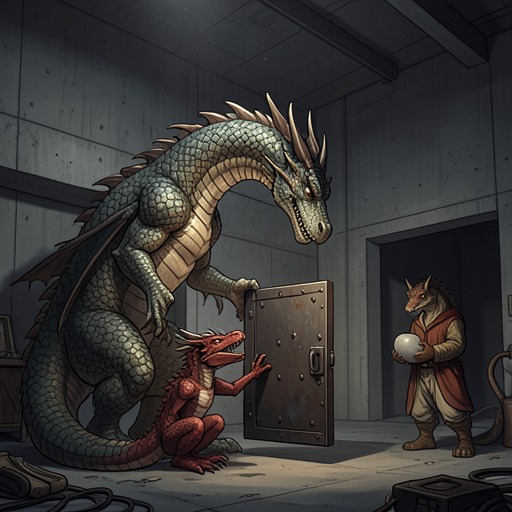
Vainqueur the DragonThe Great Calamity is the episode in which Vainqueur Knightsbane, First of His Name and later called the Great Calamity of the Age, awakened amid the ruins of Colognenburg and discovered that he had devastated an entire western region of the Midgard Republic. The rampage made him known as the Red Terror of Midgard, yet the event is presented not as a deliberate campaign but as the aftermath of a lost night, a drunken binge, and a dragon’s sudden realization that his true emergency was the safety of his hoard.
Causes and Historical Setting
The event occurred in 1198 After Mithras, one hundred years before Manling Victor Dalton’s ill-fated attempt to rob Vainqueur Knightsbane. Its starting point was Colognenburg, described as the biggest western city of the Midgard Republic. The historical label Great Calamity therefore refers not merely to a private misadventure but to destruction on a civic and regional scale, an episode important enough to define Vainqueur’s public identity long after the immediate circumstances had vanished into uncertainty.
The surviving account offers no strategic motive or political objective. When Vainqueur awoke, a fog obscured his memories, and even trying to reconstruct the previous night caused him pain. His first concern was physical sickness: his head throbbed, his eyelids felt heavy, and movement required effort. The later explanation was brutally simple. He had eaten three dwarves, become drunk from doing so, and then grown uncontrollably violent. The calamity thus begins with an appetite that crosses into intoxication and ends with a reputation that sounds like deliberate terror.
Destruction of Colognenburg
Vainqueur regained consciousness in a vast crater among the ruins, fire, and devastation of what had been a large manling city. His flames had ravaged the districts and reduced most of them to cinders. A large castle still burned at the center of the destruction, its towers likened to candles, while the surrounding area seemed empty of life except for the sound of wood burning. The image makes the city’s collapse both monumental and strangely quiet: the violence has already happened, leaving only fire, smoke, and a dragon too confused to explain it.
At first Vainqueur did not recognize the place or know whether he had destroyed it. Finding no food among the ruins to clarify the night, he spread his wings and took flight. Fresh air gradually improved his condition, but the aerial view converted a local disaster into something far larger. From above the city’s ramparts, he saw that the devastation continued through the countryside in a straight line for miles. He had not destroyed one city; he had set an entire coastal region ablaze.
The scale of the destruction surprised Vainqueur because such rampages normally belonged to a specific grievance. He generally became this destructive when someone stole from his hoard. That association supplies the calamity with its decisive turn: once he remembered the hoard, his weakness disappeared, and his wings drove him directly home. The emotional value at stake shifts from bewilderment and sickness to furious proprietary alarm, with the dragon treating the possible loss of treasure as more urgent than the human devastation behind him.
Return to the Hoard
Vainqueur crossed the distance to his lair in approximately one hour, his furious wingbeats felling trees beneath him. His destination was a cave beneath a grassy hill in a valley that the manlings had given him after he ordered them to do so. Around the cave, goblin minions had constructed a small settlement of wood and mud. They reproduced rapidly, lived on vegetables that Vainqueur disdained, and served as part of the material world surrounding his treasure.
The dragon arrived to find three greenish, childlike goblins asleep on duty. Their negligence intensified his rage after the long flight home. He landed before the cave with enough force to send them crashing against its walls, then roared for his minions and his hoard. The gesture compresses the event’s governing hierarchy into one scene: the region outside has been burned for miles, but Vainqueur’s immediate standard of catastrophe is whether his servants have protected his possessions.
Explanation and Aftermath
The missing explanation eventually arrives through Genialissime, who tells Vainqueur that he had eaten three dwarves and then could not stop. When Blightswamp and Genialissime tried to restrain him, he became violently uncontrollable and called Blightswamp by a forbidden word associated with wyverns. Vainqueur’s horrified misunderstanding of that insult adds a comic correction to the calamity’s otherwise apocalyptic scale. His own account of the night is unreliable because he cannot remember it, while the testimony of those who tried to restrain him supplies the causal chain he lacks.
The consequences are also practical. The deserted region suggests that Vainqueur’s rampage frightened away the food supply for miles. He expects that finding another manling shopping barn will require hours of flight and that catching a princess may take days. Destruction has therefore damaged the local ecology of his own predatory life: by consuming and terrifying the region, he has made feeding himself more difficult.
Vainqueur responds by deciding to migrate south toward the Albain Mountains, a colder but taller and more densely supplied area. He imagines the mountains as suitable for his size and believes their elevation will discourage thieves, particularly ratlings, from taking his treasures. The proposed migration is not repentance or restitution. It is a logistical adjustment designed to preserve access to food and improve the security of the hoard.
Reputation and Significance
The calamity’s lasting result is the title Red Terror of Midgard. Vainqueur’s private confusion contrasts sharply with the public meaning of the destruction: the devastated city and miles of burned countryside produce a historical monster-name, while the dragon himself remembers almost nothing and is chiefly concerned with whether his treasure survived. That gap between reputation and self-understanding gives the event its central irony.
The aftermath also turns catastrophe into self-coronation. Vainqueur imagines himself as Vainqueur Knightsbane, First of His Name, Great Calamity of this Age, and King of the Albain Mountain, judging the title impressive because it sounds grand. His political imagination grows directly out of the disaster’s spectacle, transforming accidental devastation into a foundation for imagined sovereignty. Yet the final promise never to eat dwarves again keeps the episode grounded in appetite, bodily consequence, and comic restraint rather than heroic grandeur.
As a narrative event, The Great Calamity is both a revelation and a reversal. It reveals the scale of Vainqueur’s destructive power while exposing the absence of conscious mastery behind it. The same dragon who can erase a city and burn a region is physically helpless after overeating, dependent on witnesses to reconstruct his own actions, and guided afterward by the mundane need to find food and protect treasure. Its significance lies in that collision of epic devastation with grotesque domestic logic: a catastrophe large enough to rename an age, produced by a drunken dragon who wakes up asking what happened to his hoard.