Undead
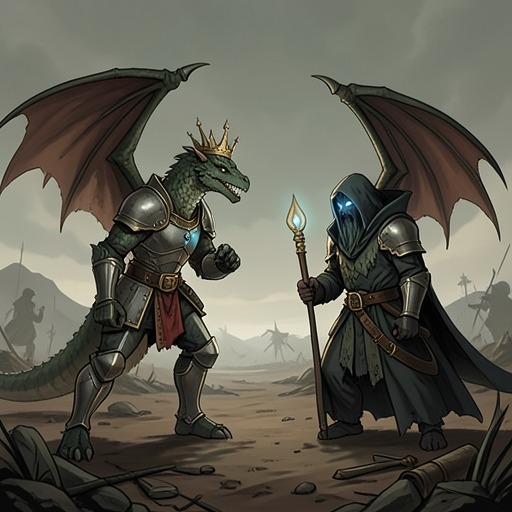
Vainqueur the DragonUndead are not merely monsters in the novel’s world. They are bodies returned from death, workers sold through contracts, servants employed by powerful masters, intelligent beings who retain identity, and objects of competing religious and economic systems. Their presence turns death into a negotiable condition: corpses can be purified, buried, sold, animated, or restored, and the dead remain entangled with the living through law, debt, labor, and allegiance.
Forms and Physical Presence
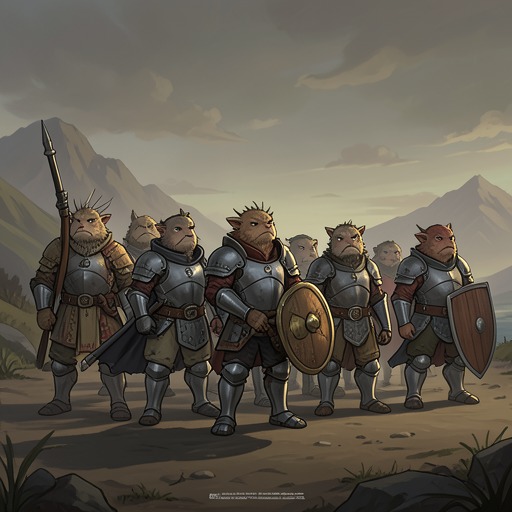
Undead appear in sharply different forms. The church of Mithras treats ordinary corpses as dangerous remains, promising to purify six human bodies and a Manticore corpse so that they do not rise as spontaneous undead before burning them without charge. Alternatively, priests of Isengrim and Cybele can bury the bodies in the forest so that they return to nature. This practical treatment presents undeath as a hazard requiring disposal, but Vainqueur Knightsbane immediately reframes the same bodies as a possible source of payment.
The most striking individual undead is Furibon, a lich whose body is skeletal but whose appearance is lavish and unnervingly powerful. He is larger than most of the humanoid races, with a long serpentine neck, a skull resembling a manling’s, gold-like bones, jeweled teeth, and bright purple light shining from empty eye sockets. He wears expensive red and purple robes and possesses long, thin arms, but no legs; magic keeps him airborne. His crown is so attractive to Vainqueur Knightsbane that the dragon wants it before fully confronting its owner, while Victor Dalton’s observation identifies Furibon as level fifty-eight. The lich therefore embodies both the spectacular horror and the material splendor associated with the undead.
Death as Labor and Commodity
The novel develops undeath into an explicit industry. Victor Dalton explains that living relatives sell corpses, which are transformed into mindless zombies and assigned labor ranging from mining to farming. The practice is legally permitted in a small number of cities whose charters authorize it, and its advocates hope that more towns will adopt it after recognizing the benefits of making the dead serve the living. The proposed future includes zombies working fields throughout Midgard and Ishfania and fearless skeletons rescuing helpless orphans from forest fires. The rhetoric converts the undead from a source of fear into an allegedly efficient public resource, while leaving the coercive nature of postmortem labor plainly visible.
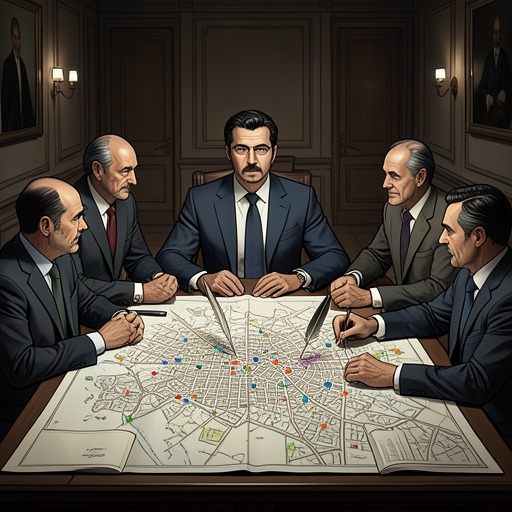
Victor Dalton eventually signs a lengthy contract with the Church of Camilla as the legal living relative of the corpses. By doing so, he agrees to surrender them for necromantic transformation. He feels morally contaminated by having sold corpses to a necromancer for postmortem slave labor, but Vainqueur Knightsbane celebrates the transaction because it enlarges his hoard. The payment exposes the unequal terms of their arrangement: Vainqueur Knightsbane promises his chief of staff eight gold coins, then reduces the supposed commission to “one one-tenth” when Victor Dalton expects one-tenth of the sales. Undeath thus becomes a meeting point between religious legality, commercial exploitation, and the dragon’s obsession with accumulation.
The industry also produces ideological converts. Jules Rapace, later a corpseling, explains that he joined the Empire of Murmurin because it lacks Gardemagne’s heavy taxation on undead labor and welcomes mass zombification. He anticipates a “great corpse boom” and hopes that the empire will begin an “undeathstrial revolution.” His language treats corpses as an economic reserve and undeath as an industrial transformation, making the undead central to the empire’s imagined prosperity rather than peripheral to its supernatural identity.
Animation, Resurrection, and Retained Identity
The undead state is not uniform. Victor Dalton gains the Necromancer class after working with a necromancer to enter the death market, along with the Animate Dead Perk. That ability allows a user to revive corpses as undead with a touch. Sacrificing money or items can instead restore a living being as an intelligent undead who retains both the original soul and class levels; the required funds depend on the soul’s value, which the user intuitively understands.
Victor Dalton immediately applies this power to two dead kobolds. He judges that each is worth a few hundred coins, more than he possesses, so he removes his sun bracers, each worth approximately that amount, and uses them as payment. An unholy purple glow consumes the bracers, then binds the broken remains back together and consumes the flesh. The scene defines resurrection as an exchange in which valuable objects are destroyed to restore valuable persons. It also distinguishes intelligent undead from mindless laborers: the former can retain soul and progression, whereas the latter are treated as tools within the corpse market.
The same economy surrounds Victor Dalton’s own death. The angel Miel visits him at his bedside in the shape of a blonde woman with shining green eyes, silver wings, and a white dress, announcing that she has come to save his soul. Miel explains that two deities, Dice and the Moon Man, claim him, while Camilla offers a third afterlife proposal because of his exemplary service to the undeathstrial revolution and continued friendliness toward her church. When Shesha arrives, she reveals that mortals paid a generous church donation for Victor Dalton’s revival on Outremonde. Resurrection is therefore neither purely miraculous nor purely personal: it is financed by religious institutions and supporters, negotiated among deities, and attached to a person’s economic and political usefulness.
Religion, Marks, and the Afterlife Market
The undead condition exists within a competitive religious marketplace. Shesha’s priestess describes her goddess as a power who trades miracles according to market rules, providing prosperity or transportation for an appropriate monetary gift. Victor Dalton even asks about the price of being transported back to Earth, showing that the boundary between worlds can be approached as a service quotation. The prospect of revival and the claims upon his soul extend the same logic beyond ordinary commerce: death becomes a field in which gods compete by offering terms.
Victor Dalton also carries visible signs of supernatural allegiance. A Moon Beast touches his left arm, leaving the shining white mark of a full moon, the Moon Man’s symbol. The blessing grants him the Claimed by the Moon Man Perk, giving him an additional ten percent chance of gaining a Charisma point whenever he levels up and immunity to madness and Moon effects except those caused by the Moon Man and his servants. His body consequently becomes a record of divine ownership, and undeath is linked to claims that can be marked, inherited, and contested.
Victor Dalton later displays dice and moon tattoos on his sleeve while speaking with a dryad who bears the mark of Cybele. These marks place different supernatural loyalties on comparable bodily ground: they are simultaneously religious identities and evidence of participation in a wider system of claimers, blessings, and obligations. The Moon Man’s influence is not merely an abstract cult affiliation; it can alter Victor Dalton’s abilities and immunities, while the competing offers from Dice, Camilla, and Shesha make the afterlife resemble a market of rival jurisdictions.
Servitude, Loyalty, and Political Significance
Vainqueur Knightsbane’s relationship with the undead reveals the category’s social flexibility. Unable to wear certain items himself, the dragon agrees to loan usable treasures to Victor Dalton because the minion has proved exemplary and reliable. Vainqueur Knightsbane wants to keep him safe and healthy while rebuilding his minion stable, presenting protection as both possessive ownership and practical investment. He later insists that Victor Dalton alone can be trusted to wield sacred treasures in battle, even while describing the items as a hoard he dislikes spreading beyond his sight.
The relationship becomes more explicit after Vainqueur Knightsbane’s promotion to Emperor. He demands that Victor Dalton repay twelve million, five hundred forty-five thousand, one hundred thirty-three gold coins, adding the amount to the life debt owed for raising Victor Dalton as his prized chief of staff. Victor Dalton accepts the burden with unusual calm and promises to find a way to repay it. Their bond therefore exceeds ordinary employment without escaping hierarchy: Victor Dalton is called a minion, protected, resurrected, trusted with weapons, and bound by debt.
The undead also help convert Vainqueur Knightsbane’s rule into an imperial program. Jules Rapace believes that Murmurin’s permissive attitude toward mass zombification can initiate an economic revolution, while Vainqueur Knightsbane evaluates the proposal chiefly by asking how much money the business could generate. The empire’s future is consequently imagined through the organized use of undead labor, even as its ruler continues to understand political institutions through treasure, obedience, and personal glorification. Undead are not simply enemies for heroes to defeat; they are workers, citizens, assets, legal subjects, religious clients, and instruments of state-building.