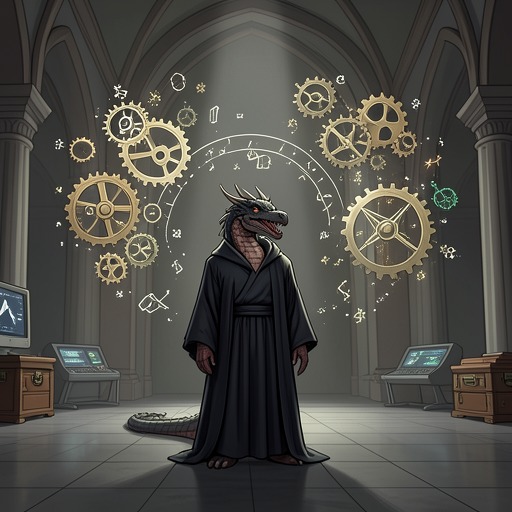
Undead Labor Trade Law
Vainqueur the DragonThe Undead Labor Trade Law is the legal and commercial framework that permits corpses to be purchased from living relatives, transformed into mindless undead, and assigned to labor. Its decisive significance is that it makes death transferable property: a body can become a contract, a payment, a workforce, and eventually an instrument of national modernization. The rule is presented not as an established universal custom but as a new industry, legally available only where individual cities have authorized it in their charters.
Definition and Legal Basis
The trade is described as perfectly legal, although its legality depends on local civic authorization. The undead are used for work ranging from mining to farming, and advocates imagine their deployment throughout Midgard and Ishfania. The proposed expansion is openly political and economic: towns are expected to adopt the practice after recognizing the benefits of enslaving the dead for the living. Mindless zombies cultivating fields and fearless skeletons rescuing orphans from forest fires are offered as examples of public utility.
The law operates through the living relative’s authority over the corpse. In the transaction arranged by Vainqueur Knightsbane and Victor Dalton, Victor signed a long contract with the Church of Camilla as the legal living relative, swearing before the gods to surrender the corpses for necromantic transformation. The contract therefore converts family standing into legal consent and gives religious authorities a recognized route to acquire bodies for postmortem labor. The arrangement is not framed as an informal sale or battlefield custom; it is a binding legal transfer enforced through contract.
Commercial Operation
The trade assigns explicit monetary value to the dead. A necromancer offered fifty gold pieces for each corpse and five hundred for the Manticore, producing a total payment of eight hundred gold pieces. Vainqueur Knightsbane accepted before Victor Dalton could object, while Victor received eight gold pieces as his promised one-tenth share. The division of proceeds places the dragon at the top of the transaction and makes Victor both administrator and compensated intermediary.
The arrangement also reveals how the law links waste disposal, conquest, and commerce. Vainqueur Knightsbane had Victor consider opening a shop to sell junk, monster parts, and corpses, then demanded that discarded bodies become a source of profit rather than food for animals. Once the corpseling approved the remains, the contract made the bodies marketable wares. Necromancy thus supplies an economic afterlife in which an enemy’s corpse continues producing value after death.
The contract specified that the reanimated corpses would be sent to Ferpuit and Minecreuse for immediate mining labor. The trade therefore includes more than permission to animate the dead: it contains a chain of custody, a destination, and a defined industrial use. Jules Rapace, whose true name appeared in the contract, thanked the sellers for supporting his country’s modernization, presenting the transaction as part of a national development program rather than an isolated act of opportunism.
Institutions and Disputed Legitimacy
The law is administered through overlapping institutions. The Church of Camilla supplies the necromantic service and inspects the corpses before accepting them, while the contract establishes the seller’s authority to surrender them. At the same time, Lady Shesha’s religious market raises the question of whether mass necromancy will create long-term consequences that outweigh its added market value. Even the goddess associated with commerce is described as uncertain about the industry’s eventual effects.
The advocates of undead labor answer such doubts with a defense of safety and comparative ethics. A necromancer insists that there is no proof necromantic energy harms the environment and argues that mindless labor is more ethical than animal slavery because animals have feelings while animated corpses do not. This argument does not resolve the question of consent; instead, it relocates ethics from the dead person’s former identity to the absence of sensation in the animated body.
Regulation remains a central obstacle to expansion. Later, Jules Rapace explains that the Empire of Murmurin is attractive precisely because it lacks Gardemagne’s heavy taxation on undead labor and welcomes mass zombification. He predicts a corpse boom and hopes that the empire will begin the “undeathstrial revolution.” The contrast shows that the law is also a matter of fiscal policy and jurisdiction: different governments can encourage, burden, or restrict the same practice, and businesses move toward the most favorable legal environment.
Consequences and Narrative Significance
For Victor Dalton, participation in the trade produces both moral unease and a supernatural reward. He complains that he has sold corpses to a necromancer for postmortem slave labor and that the act feels dirty. The Class System nevertheless grants him the Deadfriend Personal Perk for ruthlessly selling his enemies’ corpses to the Church of Camilla. The perk causes mindless undead to mistake him for one of their own unless he attacks first, and grants him additional charisma when dealing with undead or worshippers of Camilla. The system therefore converts an ethically troubling act into advancement, social access, and protection.
For Vainqueur Knightsbane, the law fits an acquisitive vision in which the growth of the hoard justifies nearly any profitable exchange. He is more interested in the quick payment than in local politics and treats the sale as a successful business deal. The rule consequently reinforces the dragon’s habit of translating bodies, loyalty, administration, and war into resources. Victor’s promotion to chief of staff and living signature, together with his Monster Squire class, supplies the bureaucratic labor necessary to make that exploitation function.
The law also anticipates a wider institutional transformation. Nethermart is later opened as the first fiendish magic-item shop in Outremonde, offering goods to monsters and mortals and accepting souls as collateral, while the coming war with Maure is used to advertise a thirty-percent weapons sale. Although Nethermart is not itself an undead-labor institution, its commercial logic parallels the trade’s expansion: extraordinary powers become retail services, war becomes a market opportunity, and supernatural beings are reorganized through contracts, prices, and scalable supply.
The most consequential feature of the Undead Labor Trade Law is therefore its normalization of postmortem exploitation. It places family authority, religious administration, state charters, industrial demand, and personal profit into one legal mechanism. The dead are presented simultaneously as property, workers, environmental risks, and objects of moral argument. By rewarding Victor Dalton for the transaction and allowing Jules Rapace to imagine an empire-wide corpse economy, the Class System and the surrounding institutions treat the law not merely as a rule governing necromancy but as a pathway toward a new political economy built on the labor of those who can no longer refuse.