V&V
Vainqueur the DragonV&V is the adventurer company created for Vainqueur Knightsbane and Victor Dalton, and its importance lies in the way it turns an improbable partnership into a recognized institution. What begins as a bureaucratic registration forced upon a dangerous dragon becomes a hybrid organization: part adventuring party, part monster administration, part commercial enterprise, and eventually a vehicle for territorial rule and dragon-led adventuring.
Founding and Legal Form
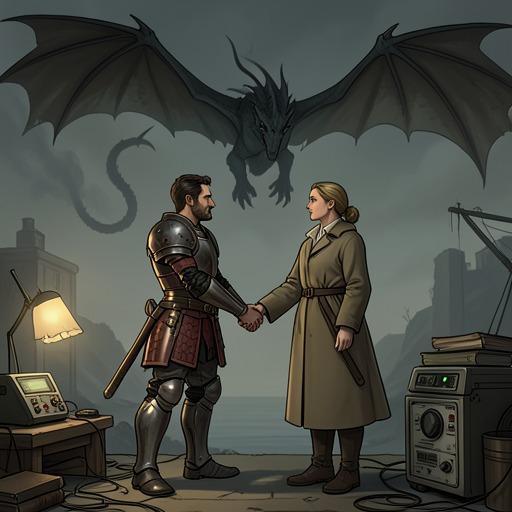
Charlene establishes V&V when Vainqueur Knightsbane and Victor Dalton seek recognition as adventurers. Faced with the dragon’s implied threat and a huge pile of paperwork, she registers the pair as a new adventurer company and requires both signatures. Vainqueur immediately transfers the practical burden to Victor, promoting him to chief of staff and living signature. The arrangement gives the company a clear internal hierarchy: Vainqueur is the sovereign proprietor and public power, while Victor handles documents, contracts, administration, and the decisions that cannot be settled by appetite or intimidation.
The name V&V initially seems so abrupt that Victor mistakes it for a prank. Its plainness nevertheless becomes useful. The company name binds Vainqueur and Victor together as a recognizable public unit, even though their relationship is unequal and their personalities sharply opposed. Victor’s administrative labor makes V&V legible to human institutions; Vainqueur’s reputation, violence, and wealth make it impossible for those institutions to treat the company as an ordinary adventuring team.
The Class System reinforces this organizational division. Vainqueur gains a level in the Noble class through his ego and dragon bloodline, while Victor gains the Monster Squire class after becoming the chief enforcer of a mighty dragon. Victor’s later leadership of monsters earns him seven additional Monster Squire levels, together with major stat increases and the Monster Rider and Monster Insight Perks. The company therefore does not merely employ Victor in an informal capacity: its supernatural rules convert his administrative and military service into an institutional identity.
Operations and Expansion
V&V’s work quickly exceeds the usual recovery of treasure or completion of isolated quests. Vainqueur orders Victor to find a profitable use for discarded monster parts and corpses rather than allowing them to be left for animals. Victor consequently has to consider a shop selling junk, monster parts, and corpses, while also preparing Vainqueur’s class progression and training the Kobold Rangers. The company’s resources are treated as an organized supply chain, and Victor’s role expands whenever Vainqueur discovers another way to enlarge his hoard.
The corpse trade shows how V&V operates across competing legal and religious systems. Victor signs a lengthy contract with the Church of Camilla as the legal living relative of the deceased, surrendering corpses for necromantic transformation. He receives eight gold coins as his fee, while Vainqueur treats the transaction as another way to make the hoard grow. The episode gives V&V an ethically unsettling commercial dimension: its business model can convert battlefield remains into labor, and Victor’s signature supplies the legal mechanism that makes the conversion possible.
The company also develops a recruitment and military function. Before the planned raid on Furibon’s dungeon, Vainqueur declares that the enemy is evil and must be destroyed, framing the expedition as war rather than ordinary monster hunting. Victor reports one hundred kobold applicants and recruits with class levels above twenty, including a troll, a dryad, and a golem. V&V therefore becomes a multi-species organization whose membership is not restricted to humans or to a single monster lineage. Its recruitment language presents Vainqueur’s rule as a place where all creatures may seek advancement, even while Vainqueur openly describes every creature as potentially inferior and suitable for emergency food.
Conflict, Branding, and Public Presence
The company’s public image is inseparable from Vainqueur’s theatrical self-promotion. After rescuing manlings, Vainqueur has them chant, "Vainqueur, best dragon!" He then presents himself as an adventurer arriving to rescue them and demands cattle as his reward. The scene establishes V&V’s unusual promotional logic: heroic reputation, appetite, intimidation, and payment are not separate categories. The company’s brand is built around the dragon’s ego, and its services are advertised through the spectacle of his presence.
Furibon’s dungeon becomes the defining conflict around which this branding hardens. The chronicle of the War of the Hoard ends with the phrase "Furibon must die," while Vainqueur imagines the treasure Furibon will drop. The company’s campaign is therefore simultaneously a war of vengeance, a treasure-seeking expedition, and a public claim to legitimacy. V&V presents violent acquisition as adventuring, while the surrounding institutions increasingly accept that description because the company produces results that ordinary authorities cannot easily obtain.
The same expansion appears in Murmurin’s commercial life. After Vainqueur’s rise, the monsters build Nethermart, a six-floor ivory-draped magic-item shop and the tallest building beside Emperor Vainqueur’s statue. At its opening, V&V is physically and symbolically present: the Kobold Rangers attend, Victor prepares to cut the ribbon with his scythe while riding the Black Beast of Murmurin, and the shop offers credit secured by the customer’s soul. Although Nethermart is not identical with V&V, its opening demonstrates the company’s wider organizational ecosystem, in which adventuring, monster administration, commerce, and militarization reinforce one another.
Political Recognition and Privilege
V&V’s success changes its relationship with the state. After Maure’s death and the destruction of the Ishfanian army, King Roland arrives with Kia and Gardemagne’s royal retinue to recover Princess Merveille. The delegation is initially alarmed by dragons feasting and dead demons along the road, but Charlene explains that Vainqueur killed Maure, and the king accepts the result with surprising calm. V&V has become valuable precisely because it can remove threats that leave conventional authorities with costly political problems.
The company receives a remarkable financial privilege when Vainqueur demands that its quests be exempt from guild fees and taxes. King Roland immediately agrees that V&V will be forever exempt from the fees normally applied to adventurer companies, while the Kingdom will fund Charlene’s local chapter. This arrangement transforms the company from a licensed private group into a specially sponsored instrument of government. Its exemption is not merely a reward; it is an investment in maintaining relations with the new Ishfanian government and in ensuring that V&V remains available when external threats arise.
The political settlement goes further. Roland proposes that Gardemagne recognize Vainqueur’s claim as Emperor of Ishfania, making it an official adventurer state. Vainqueur may rule the territory as he wishes and retain the benefits of the Adventurer Guild, while promising that the countries will never take arms against one another and will fight together against outside threats. V&V thus becomes the institutional bridge between adventuring-company status and sovereign authority. Its legal recognition allows a dragon’s conquest to be recast as a treaty relationship rather than left as an unregulated act of violence.
Institutional Legacy
The company’s influence culminates in the public normalization of dragon adventuring. When the dragons dispute the existence of the Class System, Vainqueur demonstrates that awareness of the system and the required beginner-class statistics are enough to make it appear. Icefang’s disbelief becomes a public test, and his reaction confirms that the system is accessible beyond Vainqueur’s immediate circle. The resulting recognition opens the possibility that dragons can enter the same advancement structure that has empowered V&V.
Charlene is then ordered to accommodate the dragons if they want to create their own adventurer companies under Gardemagne’s auspices. The guild’s condition is that such companies must not eat quest givers. This restriction reveals the compromise at the center of V&V’s model: the state accepts monster-led adventuring because it solves real dangers, but it attempts to preserve a minimum boundary between adventurer and client. Vainqueur immediately interprets the development as the beginning of a new era of dragon adventuring, crediting himself with inspiring it.
V&V’s legacy is therefore institutional rather than merely personal. Its structure gives Vainqueur a legal identity that supports his appetite for treasure, gives Victor a recognized administrative and military office, gives monsters a route into organized recruitment and advancement, and gives human governments a partner capable of defeating enemies such as Furibon and Maure. Even the aftermath of Vainqueur’s Bragging Day, when the surrounding area lies devastated and the Kobold Rangers and other servants rush to receive orders, shows the company’s continuing reach. V&V survives as the machinery through which a dragon’s boast becomes administration, commerce, warfare, and diplomacy.