Vainqueur Knightsbane
Vainqueur the DragonVainqueur Knightsbane is the great red dragon at the center of the book’s political, economic, and comic transformation of the monster world. A sixty-foot legend with radiant ruby scales, jet-black wings, golden eyes, and a crown of horns, he begins as a solitary predator measuring life by cattle, conquest, and the size of his hoard. His decisive significance lies in the contradiction between his ancient self-image as the apex of creation and the surprisingly modern institutions he builds: an adventurer service, a trained monster force, commercial enterprises, and an empire whose laws and customs increasingly bear his name.
Identity and Early Background
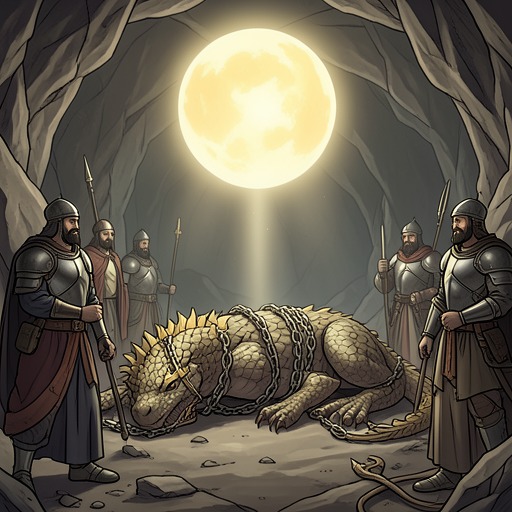
Vainqueur awakens in a cave deep within the southern mountains of the Albain Mountains, lying on wealth taken from beastkin, mermaids, an elven princess’s retinue, and armored manlings who challenged him. The hoard is made of rubies, diamonds, and gold coins, yet he considers it disappointingly small and plans to double it before returning to hibernation. This establishes the governing instinct of his character: possession is both material accumulation and proof of superiority. His appetite is equally direct; even after sleeping for decades, his first practical concern is finding cattle to eat.
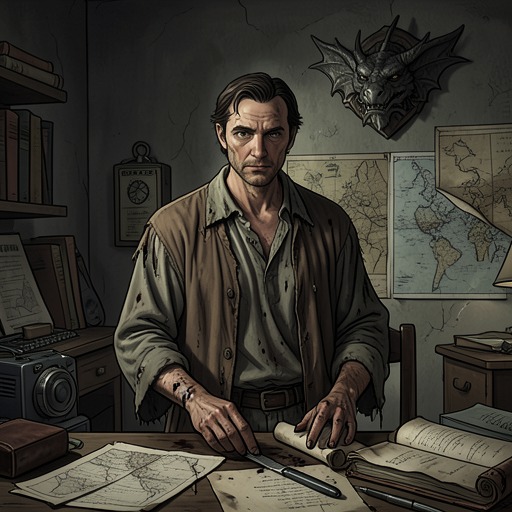
His reputation precedes his political identity. He is called the Great Calamity of the Age and, in an earlier historical frame, the Red Terror of Midgard. One hundred years before Victor Dalton’s attempted robbery, Vainqueur Knightsbane wakes amid the ruins of Colognenburg, the largest western city of the Midgard Republic. A vast crater, fire, devastated districts, and a burning castle surround him, with no living presence apparent. The scene presents his destructive power before the narrative presents any organized purpose behind it: he is first encountered as aftermath, a dragon whose existence can be measured in ruined cities as readily as in treasure.
Awakening of the Class System
Vainqueur’s certainty that dragonkind has already mastered every meaningful power is challenged when the Class System responds to his ego and noble dragon bloodline. He gains a level in the Noble class, turning his pride from a personality trait into a mechanically recognized source of advancement. The system therefore does not correct his arrogance; it rewards it, creating a recurring irony in which his grandiose self-assessment becomes literally effective.
The same system makes him unusually receptive to institutional experimentation. After ordering Victor Dalton to return the Silver Rapier and lead him to the Guildhall, Vainqueur converts the manling’s defeated survival into a formal relationship. Victor becomes his minion until the life debt is repaid, and Vainqueur explains the arrangement through his own unanswerable premise: he is a dragon, and Victor is therefore his minion. The appointment is simultaneously coercion, employment, and the beginning of the partnership that allows Vainqueur’s private impulses to acquire administrative form.
Vainqueur later uses the system’s Menu function to inspect his status and sees himself identified as Vainqueur Knightsbane, Level 3, Noble 3. His progression is not limited to personal combat. When he promotes Victor to minion chief of staff and living signature, the chief enforcer gains levels in the Monster Squire class, with increases to health, stamina, strength, vitality, skill, agility, intelligence, charisma, and luck. Vainqueur’s power consequently expands through delegation: by assigning work to Victor, he creates a structure in which obedience, management, and service generate measurable advancement.
That structure becomes militarized when Victor fearlessly leads monsters against superior opponents. The victory earns seven Monster Squire levels and the perks Monster Lifeforce (Red Dragon), Monster Rider, and Monster Insight. Vainqueur’s command style thus produces more than loyalty or battlefield success. It converts an assortment of monsters into a developing organization, with training, classification, promotion, and specialized abilities. Even the system’s later restriction reinforces this pattern: at level 30, Vainqueur reaches the class ceiling and cannot gain further levels without a Crest, although special deeds can still grant perks. His growth is therefore redirected from ordinary experience toward exceptional acts and public achievements.
From Hoard to Institution
Vainqueur’s first major ideological adjustment comes when he recognizes that his usual method of enlarging the hoard is inefficient. He initially intends to burn a village for the crimes of its manlings, but notices wealth lying unused and concludes that allowing it to remain unclaimed is a sin. He announces that Vainqueur the Dragon will answer inferior species’ requests and solve their problems in exchange for coins. Charlene doubts that a dragon can become an adventurer; Vainqueur answers that he is overqualified. The joke contains the practical principle of his rule: he does not abandon predation, but repackages it as a paid service.
The resulting enterprise also changes Victor’s duties. Vainqueur orders him to turn discarded meat, monster parts, and corpses into a source of income rather than giving the material away. Victor is expected to open a shop, prepare Vainqueur’s class progression, and train the Kobold Rangers. Vainqueur’s hoard is no longer merely a private pile guarded in a cave; it becomes the financial center of a supply chain involving waste, commerce, instruction, and military labor. The demand that the kobolds’ spoils be sold so they can become part of Vainqueur’s hoard reveals the cultural divide at the heart of this system: the monsters understand incorporation into the hoard as a form of permanent belonging, while Victor sees the arrangement as exploitation and bureaucratic overload.
The Castle of Murmurin gives this expansion a monumental setting. Built of black stone on a rock in a crater filled with hot lava, the dungeon is surrounded by smoke, towers, fortifications, dragon statues, carrion birds, crows, and giant worms moving through the magma below. Its half-destroyed bridge and enormous entrance suit Vainqueur’s scale, unlike the temple he found inadequate. The castle is both fortress and symbol: an underground lair transformed into a court, headquarters, and visible center of monster sovereignty.
Vainqueur’s recruitment practices likewise widen beyond a single species. During the campaign against Furibon, he observes a line of applicants consisting mostly of kobolds but also other unusual monsters. Victor reports one hundred kobold applicants, along with a troll, a dryad, and a golem whose class levels exceed twenty. Vainqueur insists that he does not discriminate because all creatures are equally inferior to him, and claims he will always fight for everyone’s right to become his emergency food. His empire’s inclusiveness is therefore genuine only in its reach, not in its hierarchy: difference is accepted beneath an absolute dragon supremacy.
Titles, Empire, and Public Authority
Vainqueur’s political imagination develops through language. When he learns that Emperor ranks above King, he abandons the narrower title he had used simply because he believed nothing higher existed. He adopts the name His Majesty Vainqueur Knightsbane, First of His Name, Great Calamity of this Age, and Emperor of Murmurin and the Albain Mountains, taking obvious delight in the new word. The title is not ceremonial decoration. It is a new possession, a verbal territory added to the gold, jewels, and land he already claims.
His authority becomes more concrete when King Roland recognizes that Vainqueur has performed a service for Gardemagne by felling the Demon King before the latter could bomb its cities. Vainqueur responds not with modesty but with a demand that the bounty on his head be raised to fifteen million, arguing that the existing figure insults his net worth. When offered land, he pretends that he is too wealthy to lower himself by claiming the king’s hoards, then accepts a large swath of territory. He publicly expands his title again to Vainqueur Knightsbane, First of His Name, Great Calamity of the Age, Defender of the Hoard, and Emperor of Murmurin, Ishfania, and the Albain Mountains.
The title also becomes a contested instrument of legitimacy. Vainqueur repeatedly asserts his emperorship in case the Class System fails to recognize it, while the surrounding human authorities treat his accomplishments as politically useful even when his motives remain avaricious. King Roland is prepared to let dragons create their own adventurer companies under Gardemagne’s auspices, provided they do not eat quest givers. Vainqueur interprets this arrangement as the beginning of a new era of dragon adventuring, claiming that he has inspired it just as Grandrake invented princess hunting. His boast turns an administrative concession into a civilizational achievement.
Relationships, Conflict, and the Comic Bond with Victor Dalton
Victor Dalton is essential to Vainqueur’s conversion from solitary calamity into functioning ruler. At first Victor is simply a captured manling whose life debt gives Vainqueur a legalistic excuse for command. Over time, he becomes chief of staff, living signature, trainer, organizer, and sidekick. Vainqueur continues to describe him through the language of service, but the relationship develops beyond the original coercive contract. When Victor explains that a friend is someone who remains present even after being released from service, Vainqueur answers by forbidding him to sleep until he repays a debt of 12,545,133 gold coins, added to the life debt incurred when Vainqueur raised him as his prized chief of staff.
The absurd accounting does not erase the emotional change. Victor accepts the burden with unexpected peace and promises to find a way to repay it. Vainqueur then imagines the two of them working until both become gods and demanding reimbursement from the goddess who made the service so expensive. Friendship is therefore absorbed into Vainqueur’s economic vocabulary, but it is not reduced entirely to economics. The debt is ridiculous, yet its persistence also functions as a promise that the partnership will continue.
Vainqueur’s conflicts preserve the same mixture of personal vanity and institutional consequence. The War of the Hoard is framed by the uncompromising declaration that Furibon must die, turning a treasure dispute into a public war with a slogan. Vainqueur’s campaigns, commercial ventures, and public celebrations repeatedly place his servants and enemies inside the same economy of possession: opponents threaten what belongs to him, while allies are recruited into the expanding structure that bears his name.
Change, Recurrence, and Narrative Role
Vainqueur’s greatest transformation is not from weak to strong; he is already overwhelmingly powerful when the story begins. It is from unstructured power to organized power. The Class System gives his ego levels and perks, Victor translates orders into paperwork, the Kobold Rangers become a trained force, the Castle of Murmurin becomes an imperial center, and the promise of paid quests makes dragon violence legible as public service. Even Nethermart, the first fiendish magic-item shop in Outremonde, belongs to this trajectory: it opens in a six-floor ivory-draped building, sells to monsters and mortals, accepts souls as collateral when customers lack coins, and advertises weapons at a thirty percent discount during the coming war with Maure.
Yet institutionalization never civilizes Vainqueur completely. After each Bragging Day, the surrounding area resembles a volcanic disaster, with houses overturned and no sheep left alive. When the party ends, Vainqueur summons the Kobold Rangers, gnolls, mimics, and other servants and asks for Victor, prepared to resume command. His public festivities therefore reproduce the original dragon’s appetite on a larger scale: celebration, destruction, collection, and administration follow one another in a recurring cycle.
His apparent restoration of the Emperor title confirms the importance of spectacle to his identity. After regaining the title with style, he recovers his perks and prepares to roar and breathe flames across the sky in celebration, only to be interrupted by the Iron Eagle diving toward his volcano. The interruption captures the character’s governing rhythm. Every triumph becomes an opportunity for display, every display invites another crisis, and every crisis supplies material for a still larger boast.
Vainqueur Knightsbane is consequently both the book’s central agent of expansion and its sharpest satirical instrument. He treats class advancement as proof of innate nobility, administration as an extension of hoarding, diplomacy as a negotiation over valuation, and friendship as an indefinitely extended debt. His empire is monstrous, but it is also inventive: by forcing predation through systems of work, reward, recruitment, commerce, and law, Vainqueur makes the monster world politically visible. The result is not a redeemed dragon but a dragon whose vanity has become a civilization-building engine.