Vainqueur–Icefang rivalry
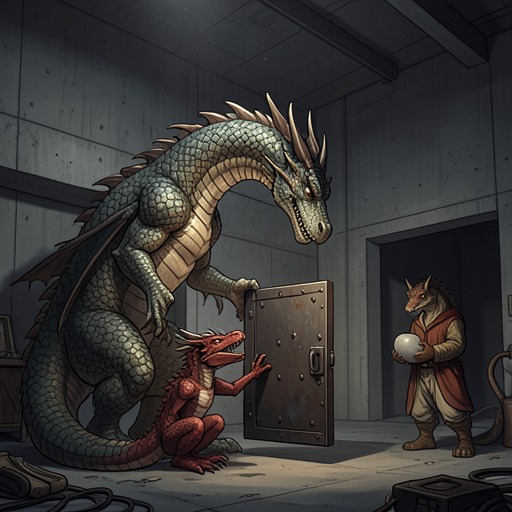
Vainqueur the DragonThe Vainqueur–Icefang rivalry is a persistent contest for dragonly supremacy, organized around wealth, breeding, treasure, and the ability to command attention. Vainqueur treats Icefang as a hated rival who exists to challenge his status, while Icefang has made surpassing Vainqueur the central purpose of his life. Their exchanges are openly insulting, but the rivalry also supplies a recurring measure of Vainqueur’s ambitions: every claim to greatness becomes meaningful only when Icefang is present to contest it.
Origins and Rivalry Structure
The conflict is rooted first in the natural opposition between red and frost dragons. Vainqueur considers red dragons obviously larger and wealthier, while Icefang, a white frost dragon with icicle spikes along his back and striking blue eyes, refuses to accept that inherited advantage as proof of superiority. The rivalry therefore combines a species-based hierarchy with a personal competition. Icefang has spent his waking time gathering a larger hoard, beautiful princesses, and the finest minions, pursuing every category by which Vainqueur measures greatness.
Icefang’s ambition is not merely occasional envy. The narration describes overtaking Vainqueur as his life’s purpose. Yet the effort repeatedly fails: despite his accumulation of wealth, princesses, and servants, he has never managed to upstage Vainqueur. His fifty-year nap has only deepened his bitterness, suggesting that the rivalry survives even across long periods of inactivity. Vainqueur, for his part, interprets Icefang’s challenge as an insult demanding an immediate answer rather than as a neutral comparison of resources.
Bragging Day Confrontation
The rivalry reaches a particularly visible stage when Icefang arrives at Vainqueur’s castle during the celebrations surrounding Bragging Day. Six dragons descend onto the castle towers, but Icefang is singled out as the exceptional guest: a nearly great-red-dragon-sized frost dragon who stares smugly at Vainqueur from above. Vainqueur greets him in the old dragon tongue and immediately attacks the subject of Icefang’s inability to breed, turning the family gathering into a contest of status and masculinity.
Icefang answers by questioning Vainqueur’s wealth and announcing himself as Great King Icefang. He does not even land, instead flying above the castle in a foppish maneuver that makes his entrance itself a performance of superiority. Vainqueur denies ever having been poor, but Icefang insists that he is poor by comparison. The exchange escalates through direct boasts: Vainqueur dismisses Icefang’s silver hoard as inadequate because it does not shine enough, while Icefang declares that wealth has no limits and promises to count every coin supporting Vainqueur’s claims. Vainqueur responds that the counting will last until the end of time, refusing to concede either the argument or the theatrical final word.
When Icefang’s presence begins to draw attention away from Vainqueur, the Emperor of Murmurin attempts to reclaim the spotlight by announcing a preview of his magnificent hoard. Icefang treats the invitation as another opportunity for mockery, suggesting that Vainqueur cannot even bathe in his own treasure. The joke establishes the stakes of their competition: the hoard is not merely property but a visible body of authority, a resource whose size and splendor determine who deserves admiration.
Treasure, Rank, and One-Upmanship
The hoard contest reveals how completely both dragons translate dignity into material display. Vainqueur is unwilling to allow any possession to remain an ordinary possession; weapons loaned to trusted servants are still described as sacred treasures, and even temporary access to them is controlled as an extension of his authority. He tells Victor Dalton that only Victor is worthy to wield those treasures in battle because Vainqueur trusts him not to lose them. Against this background, Icefang’s challenge is especially threatening: a rival who can claim a greater hoard threatens not only Vainqueur’s pride but the symbolic foundation of his rule.
Vainqueur’s response to Icefang is therefore defensive and performative at once. He insists that silver does not count as truly impressive because it lacks sufficient shine, preserving a distinction that allows him to reject Icefang’s apparent wealth without admitting inferiority. The argument is less an economic assessment than a struggle over the criteria of value. Icefang counts coins; Vainqueur decides which coins possess enough beauty to count. Each dragon tries to control the standard by which the other will be judged.
The rivalry also echoes the broader exchange system surrounding Vainqueur. He loans equipment to servants while retaining ownership, pays Victor Dalton an intentionally confusing fee of eight gold coins after the sale of corpses, and later treats Victor’s resurrection as a debt worth twelve million, five hundred forty-five thousand, one hundred thirty-three gold coins. These transactions show that Vainqueur understands relationships through possession, repayment, and rank. Icefang is the rival who contests him within that same vocabulary, attempting to prove that his hoard and retinue can purchase greater prestige.
Conflict and Mutual Recognition
The two dragons are openly hostile, but their hostility depends on mutual recognition. Icefang would not devote his waking life to surpassing an irrelevant dragon, and Vainqueur would not be so eager to answer every insult if Icefang did not represent a credible standard of comparison. Their contempt thus confirms the importance of the opponent. Each dragon’s identity is sharpened by the other’s refusal to accept his superiority.
This structure makes their insults unusually revealing. Vainqueur attacks Icefang’s breeding prospects, while Icefang attacks Vainqueur’s poverty. The chosen targets expose the resources each dragon believes should establish rank: reproductive success and lineage on one side, treasure on the other. Neither disputes the legitimacy of competition itself. Instead, each claims that the other has failed according to the rules of dragon greatness.
Icefang’s arrival also brings the private rivalry into a public and political space. Vainqueur is not merely a dragon displaying possessions to another dragon; he is an emperor attempting to stage an imperial celebration. Icefang’s refusal to land, his title of Great King, and his challenge to the hoard turn the castle into an arena where personal vanity and public authority overlap. Vainqueur’s decision to reveal the hoard early is consequently a strategic act of reputation management, designed to restore the attention he believes belongs to him.
Narrative Significance
The Vainqueur–Icefang rivalry turns the conventional dragon treasure-hoard motif into a comic social system. Wealth is treated as measurable, displayable, and endlessly contestable, yet the contest can never be settled because each dragon can redefine what counts as valuable. Vainqueur’s insistence on shine, size, and spectacle contrasts with Icefang’s emphasis on counting and accumulation, but both remain trapped within the same competitive logic.
The rivalry also functions as a recurring pressure on Vainqueur’s self-image. He can tolerate servants borrowing his weapons, churches charging for resurrection, and enormous debts being assigned to Victor Dalton, but he cannot tolerate the possibility that Icefang might appear richer or more impressive. Icefang’s challenge forces Vainqueur to convert every gathering into a performance and every possession into evidence. Their conflict is therefore more than a feud between two dragons: it is a contest over who gets to define greatness, whose hoard becomes the standard, and whether admiration can ever be secured once a rival is determined to count every coin.