Vainqueur–Melodieuse antagonism
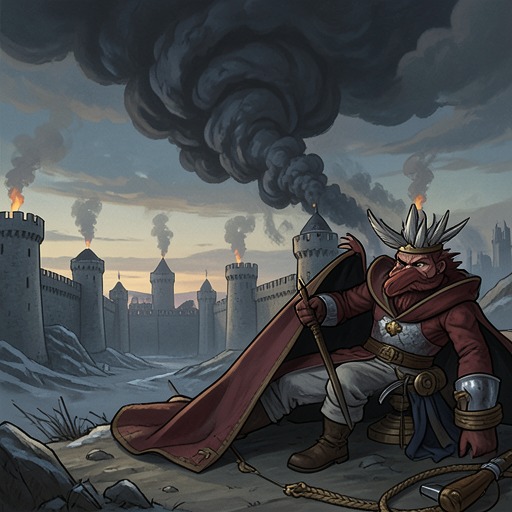
Vainqueur the DragonVainqueur–Melodieuse antagonism is one of the book’s clearest collisions between a dragon’s possessive authority and a fomor’s covert campaign to reshape the political order. Their conflict moves from territorial confrontation to open magical warfare and finally to revelation: Melodieuse identifies Vainqueur’s allies and the class system itself as reasons her plans have failed, while Vainqueur comes to recognize her as the hidden force behind several disasters.
Origins and Opposed Claims
Melodieuse first appears in this conflict as a fomor descending through sorcery after Vainqueur has already been drawn into the crisis. She addresses the manlings as Claimed and orders them to leave, then turns directly to Vainqueur with an offer framed as political compromise: if he takes his slaves away, she will order the princeling to let him rule Murmurin unchallenged. The proposal reveals the terms of her opposition. She does not treat Vainqueur as a legitimate partner or equal claimant, but as a disruptive dragon whose ambitions can supposedly be managed through territorial concessions.
Vainqueur rejects both the command and the offered settlement. He recognizes the scent associated with Mag Mell and suspects that Melodieuse may be that fairy in disguise or another of its spawns. His answer is immediate contempt for her identity as a fairy and his refusal to acknowledge any superior power. The exchange therefore establishes more than a personal dislike: it places dragon pride, fomor authority, and control of Murmurin on the same battlefield.
Summoned Warbeasts and Repeated Combat
When Vainqueur refuses to withdraw, Melodieuse escalates from command to execution. She casts Call the Hunt, filling the ruined arena with purple smoke and summoning four elephant-sized black hounds formed from dark shadows. These fairy hounds were warbeasts created by the fomors to fight dragons, and Vainqueur had killed them by the dozens in his younger days. Their return converts an old species-level hostility into a present attack directed at Vainqueur and Manling Victor.
Vainqueur meets the assault through overwhelming physical force. He knocks the first hound against the last standing wall of the arena, collapsing the structure over the creature, and his body then reacts instinctively as more beasts enter reach, discovering increasingly entertaining ways to punch and jab them. The scene makes the antagonism physical and historical at once: Melodieuse weaponizes an old fomor creation, while Vainqueur’s own body carries the memory of having destroyed such enemies before.
The conflict recurs at the sheep pens north of the village. Five fairy hounds break into the pens and trample the food gathered for the dragon guests, while Melodieuse oversees the attack from the back of a horned black pegasus, accompanied by three monstrous crows and wyvern riders. Her position above the scene gives her the role of commander rather than ordinary combatant. The damage also provokes a broader defensive response, drawing in Rolo, Victor, Savoureuse, Junior, and the dragons who later descend from the sky.
The battle turns against Melodieuse’s forces when dragons attack the wyvern riders and fairy birds, leaving Victor to feast on the fairy hounds and sheep without discrimination. Melodieuse strengthens her barrier, but her escort is not protected from the same destruction. Her war apparatus collapses into a one-sided slaughter, and the contrast between her controlled aerial supervision and the dragons’ indiscriminate appetite exposes the limits of her command once Vainqueur’s side gains the advantage.
Revelation of the Hidden Conflict
After the defeat of her escort, Melodieuse moves closer to Victor and explains the larger stakes in a hateful confrontation. She declares that the Hellgate has fallen and that her plans for Gardemagne have been wasted. Victor then realizes that she was responsible all along, linking her to the Apple, the Scorchers, and Maure’s invasion. This disclosure transforms the relationship from a visible clash between dragon and fomor into the exposure of a concealed campaign.
Melodieuse accepts the connection but shifts responsibility back onto Victor. She argues that none of the disasters would have occurred without him because he taught Vainqueur the secrets of the cursed Class System. In her account, that knowledge has made the rightful quest to reclaim Outremonde more difficult than ever. Her accusation identifies the class system as a strategic turning point: knowledge that empowered Vainqueur has simultaneously obstructed Melodieuse’s larger objective.
The antagonism consequently contains a struggle over interpretation as well as action. Victor sees Melodieuse as the architect of successive catastrophes, while Melodieuse sees Victor’s instruction of Vainqueur as the decisive interference. Each side assigns causality to the other, but the revelation confirms that Melodieuse’s hostility is not merely a reaction to Vainqueur’s interruptions. It is part of a sustained plan involving political invasion, magical objects, organized attackers, and the attempted recovery of Outremonde.
Death, Fury, and the Unresolved Balance
The conflict reaches a more intimate and violent register when Vainqueur discovers that someone has been killed. His voice shakes the minions with fear as he roars, "Who dared do this?!" A green dragon reports that the killer was the fairy who teleported away after he tried to eat her. Vainqueur’s fury is sharpened by the report, even as the green dragon casually praises the taste of Vainqueur’s sheep. The juxtaposition places Melodieuse’s escape beside the dragons’ grotesque feasting and shows how personally Vainqueur now experiences her actions.
Vainqueur’s attempt to counter her magic also fails in a humiliating way. The system announces that his Charisma check has failed and that the Necrophobia status cannot be dispelled. He cannot understand how the world’s most charismatic dragon, the destroyer of Furibon, could fail such a check. He has only weakened the crystal curse Melodieuse placed on his princesses rather than dispelling it, and he recognizes that her sorcery surpasses even Furibon’s. The encounter thus reverses Vainqueur’s usual confidence: his physical dominance and legendary self-image do not guarantee victory against Melodieuse’s magic.
Yet the defeat is incomplete rather than final. Melodieuse escapes before breaking the seal that contains the evil associated with the scythe, while Vainqueur retains the weapon and begins to grasp the reality of the situation. Their opposition remains unresolved, but its terms have changed. What began as a demand that a dragon abandon a contested territory becomes a personal vendetta connected to the princesses, the Hellgate, Gardemagne, Maure’s invasion, the Class System, and the fate of Outremonde.
Narrative Significance
The Vainqueur–Melodieuse conflict combines rivalry, pursuit, and discovery. Melodieuse acts as a hidden architect whose plans become visible only after her forces are defeated, whereas Vainqueur functions as the proud obstructing power whose victories are repeatedly complicated by magical effects he cannot simply overpower. The antagonism also opposes two forms of world-making: Vainqueur’s rule grows through possession, minions, appetite, and the disruptive spread of class knowledge, while Melodieuse seeks to recover Outremonde through manipulation, invasion, and coordinated supernatural force.
The repeated fairy-hound imagery gives the rivalry a mythic depth without making it abstract. These creatures are specifically designed to fight dragons, and Vainqueur’s earlier slaughter of them makes every new summoning a return of an old enemy. Melodieuse’s use of them turns inherited species conflict into deliberate strategy; Vainqueur’s instinctive destruction of them turns personal pride into embodied memory. Their encounters therefore function as both battles and arguments over whether older powers can survive the transformations introduced by Vainqueur and Victor.
Melodieuse’s survival and the persistence of the crystal curse prevent the relationship from resolving through a simple triumph. Vainqueur can destroy summoned beasts, rout an escort, and expose the enemy’s role in the wider crisis, yet he cannot dispel her strongest magic or prevent her teleportation. The antagonism remains significant precisely because each confrontation produces knowledge and damage without settling the larger contest over Murmurin, Gardemagne, and Outremonde.