Vainqueur’s Bragging Day
Vainqueur the DragonVainqueur’s Bragging Day is the recurring imperial celebration devised by Vainqueur Knightsbane to display his wealth and dragon supremacy. It begins as a commemorative feast for the defeat of Furibon, but expands into a competitive spectacle involving princesses, rival dragons, a vast audience of guests, and the public performance of imperial magnificence. Its decisive significance lies in the reversal at its center: the day meant to prove that Vainqueur has become untouchable instead reveals that his hoard, authority, and emotional security remain vulnerable.
Origins and Purpose
Vainqueur conceives Bragging Day after the defeat of Furibon, when his hoard has been cured of lead sickness and has grown large enough to show to other dragons. He tells Victor Dalton that ordinary boasting is insufficient because dragons have not yet witnessed the scale of his riches. In Vainqueur’s logic, a true hoard also requires a princess captured in the wild, not merely wealth accumulated in isolation. He therefore demands a well-paid quest that will provide a princess to parade as the crown jewel of his collection.
The celebration is also designed as a ritual of victory. Vainqueur declares that the festival will recur every year on the anniversary of Furibon’s defeat, with a great cattle feast, a wooden likeness of Furibon burned before a cheering crowd, and a statue of Vainqueur erected in the werewolf village. The proposed statue is to exceed the images of the gods in human temples, making the event more than a private display of treasure: it is an attempt to turn personal pride into public religion, civic memory, and imperial iconography.
Princesses and Dragon Competition
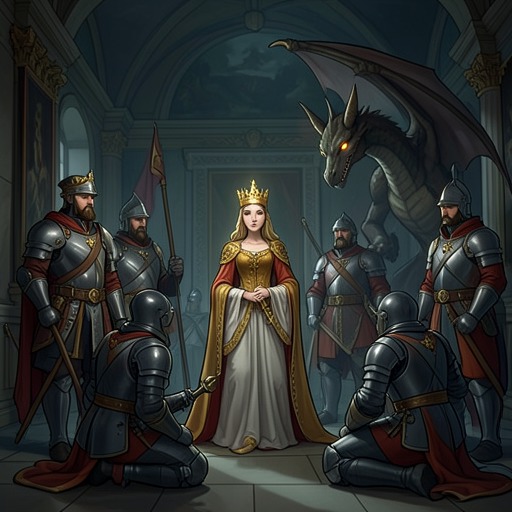
The scale of the event changes when Vainqueur learns that his rival Icefang has captured twin princesses. A single princess is no longer enough for the planned spectacle. Vainqueur insists that he needs three, because he refuses to be overshadowed at his own celebration. The demand exposes the competitive principle beneath the ceremony: every object in the hoard is also a ranking claim, and every rival’s achievement threatens Vainqueur’s identity as the greatest dragon.
The event’s rules are shaped by dragon values rather than human ethics. When Jolie notices two beautiful elven princesses and a human trapped inside fairy crystals, she objects to the treatment of the human captive. Icefang, for his part, complains that crystallized princesses cannot dance or sing and calls the arrangement insufficiently dragonlike. Vainqueur and Icefang nevertheless agree that princessness belongs to the wild; creating nobles and princesses through Vainqueur’s Dynasty Perk would dilute the value of maidens obtained through hunting. The debate makes the celebration depend upon a paradoxical form of authenticity: its trophies must be acquired through danger and pursuit, even though the resulting display immobilizes them as possessions.
The Public Spectacle at Murmurin
As preparations proceed, the Emperor of Murmurin tries to keep attention fixed on himself. When Icefang’s arrival begins to draw the spotlight away from its intended center, Vainqueur announces a preview of his magnificent hoard before the official celebration. He frames the display as a reward for Icefang’s prompt arrival, but the gesture is plainly competitive. The hoard is not simply wealth; it is a stage on which Vainqueur expects every guest to confirm his superiority.
That performance is interrupted by an alarm. Vainqueur first hears the castle’s warning and suspects an intruder in the vault, while Victor identifies the threat as Maure. The distinction between a political attack and a theft alarm collapses immediately, because Vainqueur experiences both as an assault on the same thing: his hoard. The event shifts from ceremony to emergency, and the promised public display becomes the setting for a struggle over possession, survival, and imperial legitimacy.
Reversal and Aftermath
The conflict culminates in Vainqueur defeating Brandon Maure and ending the threat of the Iron Eagle. The victory produces a Crest, a golden shield-like reward covered with colored gemstones, allowing Vainqueur to break through the level-30 class ceiling that had stopped his advancement. In mechanical terms, the battle validates his progress: the class system recognizes the deed, grants the needed Crest, and converts victory into renewed potential.
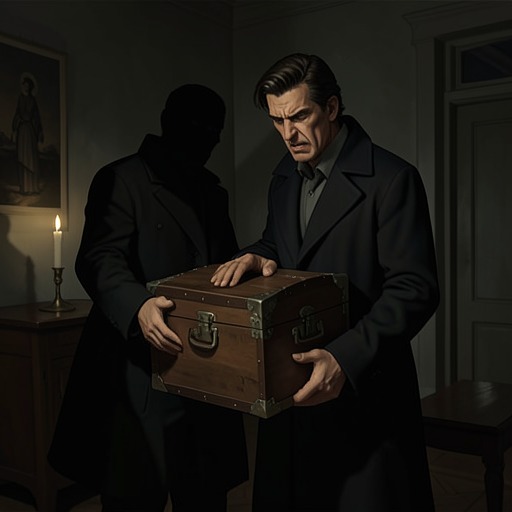
Yet the material outcome of the celebration is devastating. After the battle, Victor awakens to find that most of Vainqueur’s hoard has vanished, leaving a large empty space at its center. Only a few thousand gold pieces, assorted magic items, and the crystallized princesses remain. Vainqueur is found whining in a corner, more distressed than Victor has ever seen him. The contrast between the golden reward awarded by the system and the physical loss suffered by the dragon turns Bragging Day into an anti-triumph: Vainqueur wins the battle and receives advancement, but loses the possession that gave the ceremony its meaning.
The crisis also produces a transformation in Victor. Corpseling Jules and Rolo the golem find him among the damaged and grieving minions, and Vainqueur discovers that his chief of staff has grown wings and a tail like his master. The change follows Victor’s earlier rise through the Monster Squire class, including the seven levels earned for leading monsters against superior opponents and the acquisition of Monster Lifeforce, Monster Rider, and Monster Insight. At the very moment when Vainqueur’s public image is fractured, Victor becomes visibly more like the dragon he serves, making the event both a failed exhibition of treasure and an unexpected milestone in their shared development.
Ritual, Debt, and Lasting Significance
Bragging Day repeatedly converts relationships into obligations. Vainqueur lends Victor equipment only because he trusts him not to lose sacred treasures in battle; after Victor’s death and revival, Miel explains that mortals funded the resurrection through a church donation, while Vainqueur later assigns Victor a debt of twelve million, five hundred forty-five thousand, one hundred thirty-three gold coins. The celebration’s language of gifts, rewards, fees, and trophies therefore rests on accounting as much as ceremony. Wealth generates loyalty, but it also generates claims that can outlast death.
The event likewise reveals the game-like structure governing Vainqueur’s world. Vainqueur gains a level in the Noble class through ego and dragon blood, Victor gains the Monster Squire class through service, and later deeds produce perks and a Crest. When Vainqueur demands that the system appear before Icefang, Icefang’s disbelief is punctured when invisible text becomes perceptible to him. Bragging Day thus belongs to both an imperial mythology and an executable rules system: status must be performed before witnesses, but it is also confirmed through notifications, levels, perks, and material rewards.
As a narrative pattern, the celebration resembles a coronation that immediately undergoes deflation. Vainqueur seeks to make himself the center of history through a feast, a burning effigy, a monumental statue, and three princesses, but the missing hoard leaves the intended emperor diminished and exposed. The ceremony does not complete a stable return to glory. Instead, it turns triumph into vulnerability, and public boasting into a test of what remains when the treasure that supposedly proves greatness is gone.