Victor Dalton
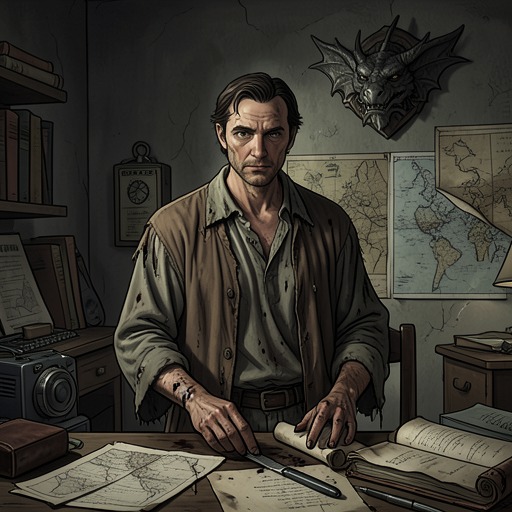
Vainqueur the DragonVictor Dalton is the human adventurer whose forced service to Vainqueur Knightsbane becomes the practical engine of the dragon’s rise. Initially claimed as a substitute for scarce goblins and bound by a life debt, Victor survives by translating Vainqueur’s arrogance into plans, institutions, military orders, commerce, and diplomacy. His arc is defined by an inversion of heroic fantasy: the supposedly lesser manling does not defeat the dragon or escape his service, but acquires authority by making the dragon’s impossible ambitions operational, until sacrifice and resurrection transform him into a dragonized companion and Vainqueur’s first and only friend.
Identity and Introduction
Victor is introduced as a trembling human who can barely withstand Vainqueur’s majesty. When asked his name, he answers, "Victor, sir…" rather than presenting himself as a powerful adventurer. Vainqueur immediately overwhelms that modest introduction by proclaiming himself "Vainqueur Knightsbane, First of his Name, Great Calamity of this Age and King of the Albain Mountains" and instructing Victor to address him as Your Majesty. The exchange establishes the unequal vocabulary that governs their relationship: Victor speaks cautiously, while Vainqueur converts every interaction into a declaration of rank.
Vainqueur then orders Victor to return the Silver Rapier, lead him to the Guildhall, and serve as his new minion until the life debt is repaid. Victor protests that he is wholly unsuited to the role, but Vainqueur treats the objection as irrelevant. The dragon’s answer, "I am a dragon," is presented as sufficient justification for authority, followed by the blunt conclusion that Victor is now his minion. Victor’s identity therefore begins not with voluntary allegiance but with coercion, humiliation, and an absurdly grand title imposed upon an ordinary human survivor.
From Minion to Administrator
Victor’s usefulness quickly exceeds the narrow role of guide or captive. Vainqueur promotes him to chief of staff and living signature, assigning him responsibility for managing the dragon’s paperwork. The appointment gives Victor formal authority while leaving him little hope of payment; his practical value lies in absorbing the tedious labor that Vainqueur considers beneath a dragon. The Class System recognizes this work immediately: becoming the chief enforcer of a mighty dragon grants Victor a level in the Monster Squire class, along with increases to health, stamina, strength, vitality, skill, agility, intelligence, charisma, and luck.
The office expands as Vainqueur’s possessions and ambitions multiply. Victor is expected to prepare class progression, train the Kobold Rangers, and find a commercial use for discarded monster parts and corpses. When Vainqueur orders him to stop giving such remains away and instead establish a shop, Victor correctly interprets the demand as the foundation of a business selling junk, monster parts, and corpses. His work is not merely clerical. He becomes the intermediary who turns the dragon’s hoard-centered greed into systems of production, recruitment, training, and exchange.
Victor also learns to perform the role publicly. After the Kobold Rangers identify him as a dragon’s chief of staff, he declares himself Vainqueur’s chief of staff, guide, and class manager and commands the kobolds to cower before him. The boast is comic, especially because Victor still smells of Vainqueur despite having bathed, but it succeeds: the kobolds recognize the office and respond to his charisma. The scene marks an important shift from imposed title to performed authority. Victor begins by repeating Vainqueur’s hierarchy, then gradually acquires influence through the institutional meaning attached to his position.
Class Growth and Military Leadership
Victor’s advancement is repeatedly tied to deeds rather than ancestry. After fearlessly leading monsters against superior opponents, he gains seven levels in Monster Squire and receives the Monster Lifeforce (Red Dragon), Monster Rider, and Monster Insight Perks. The rewards formalize what the narrative has already shown: Victor’s power comes from coordinating creatures stronger, stranger, or more numerous than himself. The system turns management, courage, and loyalty into measurable character development.
His military responsibilities culminate when he leads an army of minions against overwhelming odds in the name of Vainqueur. During the battle, Victor places Red Ranger in command and instructs the Kobold Rangers to use ambush and retreat, explicitly recalling the tactics used at Haudemer. This is not the dragon’s theatrical violence but Victor’s adaptive command. His orders distribute responsibility, preserve the force through withdrawal, and rely on remembered experience rather than brute strength. The Class System responds by promoting him from Monster Squire to Monster Knight (Red Dragon), strengthening the Rally Minion and Mook Promotion Perks.
Victor’s rise nevertheless encounters a mechanical limit. After reaching level thirty, he is informed that he has hit the class ceiling and can no longer gain levels until he uses a Crest; ordinary experience gains are reduced to zero, although special deeds can still grant Perks. The restriction gives his progression a structural tension. His achievements make him powerful, but advancement depends on navigating the rules of the system as carefully as he navigates Vainqueur’s demands. Victor is therefore both an adventurer within the world and a manager of the game-like machinery that defines its possibilities.
Commerce, War, and Institutional Expansion
Victor’s administrative role broadens into organizational entrepreneurship. He helps convert monster resources into commercial value, recruits applicants for war against Furibon, and works with a force that includes one hundred kobolds as well as a troll, a dryad, and a golem whose class levels exceed twenty. Vainqueur claims not to discriminate among these creatures because all are equally inferior to him, but Victor’s recruitment practice creates a more inclusive military structure than the dragon’s rhetoric suggests. The organization grows by drawing together different species and abilities under a shared objective: defending the hoard and serving its master.
The same practical logic extends into Nethermart. Malfaisant’s grand opening presents the shop as the first fiendish magic-item store in Outremonde, open to monsters and mortals, accepting souls as collateral when customers cannot pay in coins, and offering a thirty percent weapons sale ahead of the war with Maure. Victor is present at the ceremony, ready to cut the ribbon with his scythe while riding the Black Beast of Murmurin. Whether or not he personally owns the enterprise, his earlier assignment to monetize monster remains belongs to the same institutional transformation: Vainqueur’s personal hoard becomes a network of markets, labor, weapons, and obligations.
Victor’s commercial significance becomes explicit when Miel describes Ishfania’s emerging political order as a realm ruled by greedy monsters, without taxes or regulations and with total religious freedom. The opening of the market after Victor breaks Maure’s monopoly allows Heaven to enter and compete. Victor thus affects power beyond Vainqueur’s immediate household. His improvisations undermine monopolistic control, create new channels of exchange, and help make a monster-centered economy legible to mortal and divine interests alike.
Death, Resurrection, and Dragonization
Victor’s body and status are repeatedly exposed to the consequences of the world he helps build. After resurrection, death feels to him like waking from a happy sleep, but the return is immediately made awkward when Chocolatine approaches to kiss him and startles him into jumping away. Resurrection is therefore both a literal restoration and a disruption of ordinary social expectations. Victor returns alive, yet not unchanged in the eyes of those around him.
His most consequential transformation follows the destruction of his pet and the loss of his ordinary mobility. Victor has been forced to learn to fly, but he has not mastered the skill. When he encounters King Roland Gardemagne, Knight Kia, and the black elf after a major battle, Kia recognizes him as Vainqueur’s chief of staff and asks what happened to him, noticing the tail emerging from his clothing. Victor answers with the evasive joke "Puberty," adding that the proper exclamation is "what the Happyland" now. The humor conceals a profound physical change: Victor is no longer simply a human administrative retainer but a dragonized being struggling to inhabit a new body.
Vainqueur later recasts that change as the ultimate proof of devotion. He tells other dragons that he gathered a greater golden hoard and sacrificed it all to revive his greatest treasure, his prized, dragonized chief of staff. Victor kneels in gratitude while the minions acclaim Vainqueur as the best dragon. The scene reverses the original life debt. Victor once owed his life to Vainqueur; now Vainqueur has spent his hoard to restore Victor, converting wealth into an act of attachment that even the dragon’s greedy worldview can recognize.
Friendship and Narrative Significance
Vainqueur finally promotes Victor to his first and only friend, though he frames the honor as a test Victor must prove himself worthy of. Victor initially answers with hope, then corrects himself into a firm promise that he will prove worthy. The declaration changes the relationship without erasing its hierarchy. Victor remains subordinate, and Vainqueur remains possessive and imperious, but the language of service is supplemented by mutual recognition. Furibon’s disgusted reaction underscores how startling the emotional development is within a relationship otherwise built from commands, debt, and exploitation.
Victor’s remembered account of one drunken aftermath shows how thoroughly he has become embedded in the monster society around Vainqueur. He recalls the dragons discovering the system, Kia’s anger over the Soul Nethermart, teaching Beer Pong to Savoureuse and Corpseling Jules, asking Allison about conversion to the Church of Cybele, the gnoll fight, and comforting Charlene after Croissant drunkenly confessed that he had fed her cakes to fatten her for dinner. The sequence is comic and chaotic, but it also reveals Victor as a social connector. He mediates between dragons, adventurers, worshippers, kobolds, fiends, and mortals, carrying habits and institutions across communities that otherwise have little reason to cooperate.
As a character, Victor combines the underdog, trickster, and reluctant-administrator archetypes. His victories rarely come from solitary superiority; they arise from translating grandiose orders into workable procedures, recognizing opportunities in waste, recruiting heterogeneous allies, and adapting after bodily and political reversals. The Class System rewards these actions with levels and Perks, while the surrounding narrative repeatedly exposes the gap between the official language of rank and the unglamorous labor that makes power function. Victor’s decisive achievement is not that he becomes indistinguishable from Vainqueur, but that he makes Vainqueur’s monstrous sovereignty materially effective while retaining enough flexibility to reshape its consequences. His final status as dragonized chief of staff and first friend completes an arc from disposable manling to indispensable institution-builder, without ever allowing the comedy of servitude to disappear.