Victor Dalton’s Resurrection
Vainqueur the DragonVictor Dalton’s Resurrection is the decisive reversal of Victor Dalton’s death after Melodieuse kills him with a supernatural attack that leaves ordinary reanimation impossible. The event moves through three distinct thresholds—murder, failed undead restoration, and divine revival—before returning Victor to the living among the people and minions who depend on him. Its emotional center is Vainqueur Knightsbane’s recognition that Victor is not merely a replaceable servant but the unique “crown jewel” of his hoard.
Causes and the Fatal Attack
Melodieuse attributes the crisis to Victor’s influence over Vainqueur Knightsbane. In her view, Victor taught the dragon the secrets of the cursed Class System, encouraging other dragons to follow his example and making the rightful quest to reclaim Outremonde more difficult. Victor dismisses the accusation as exaggerated, but Melodieuse answers that the consequences matter more than the dispute. She raises her hand and casts “Death Spike,” turning the confrontation into an execution rather than an argument.
The attack is preceded by “Darkest Fear,” a power that engulfs Victor in a dark aura and drains his life and vitality. His HP and SP fall to one, while Terror and Necrophobia take hold. The scene makes death frightening before it makes death visible: Victor experiences an irrational fear of dying and sees the threat from above, then sharp ice spears rise beneath him. The later ice spike through his chest confirms what the earlier status effects had already made imminent. His death is therefore both mechanically legible within the Class System and experientially overwhelming, combining quantified bodily collapse with a fear that attacks his ability to confront mortality.
Death and the Limits of Reanimation
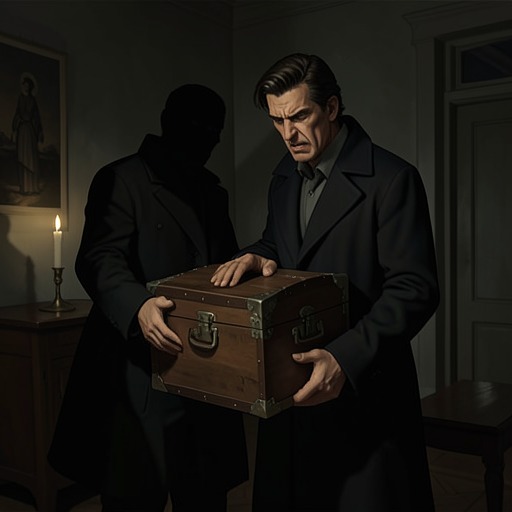
Vainqueur Knightsbane does not immediately understand that Victor has died. When guests arrive, he expects his chief of staff to answer and attempts to wake him from what appears to be a nap. The dragon’s assumption collapses when he notices the ice spike piercing Victor’s chest and the lack of life in his empty white eyes. The discovery turns a routine summons into a personal catastrophe, and the narrative’s brief interruption at the moment of recognition emphasizes the shock of finding the indispensable minion suddenly absent.
The usual solutions fail because Melodieuse’s curse has altered the conditions of Victor’s death. Rolo the Golem states that nobody can cure death, while Vainqueur orders Corpseling Jules to raise Victor as the kobolds are raised. Jules explains that Victor cannot be reanimated, even as an undead, because the killer applied the Necrophobia status before murdering him. Malfy likewise cannot claim Victor’s soul and incarnate him as a fiend. Victor’s death thus exposes a specific limitation in the setting’s supernatural system: death can ordinarily be manipulated, but a status effect approaching the divine can block both necromancy and fiendish incarnation.
Vainqueur nevertheless refuses to accept the failure of these methods. He orders Malfy away and places his hand on Victor’s remains, activating his favorite Perk, “Spell Purge.” The attempt shows both the dragon’s resourcefulness and the desperation beneath his commands. It also establishes that Victor’s return will require more than a routine spell or a minion’s standard service; the curse must first be overcome or removed.
Vainqueur’s Sacrifice and the Divine Transaction
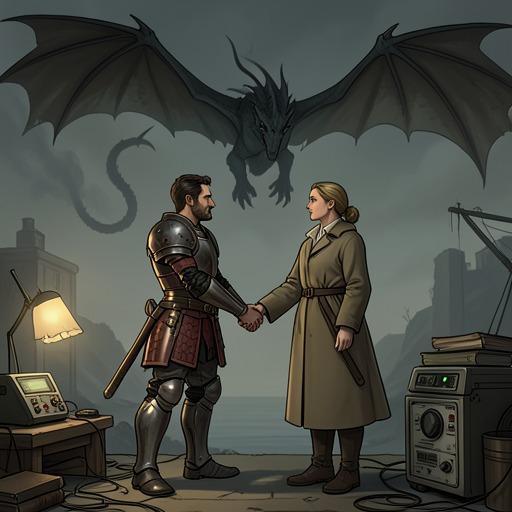
A last possibility emerges through Jules, who warns that raising Victor will demand a great sacrifice. Vainqueur answers that he will give anything to save his favorite minion. His response is significant because another dragon has already dismissed Victor as merely a manling—albeit a dragon-shaped and well-trained one. Vainqueur rejects that scale of value. He can find another minion, but he can never find a second Victor, and his Bragging Day cannot be complete without him.
The resurrection ultimately passes into the hands of Miel, the goddess of commerce. She tells Victor that mortals paid a generous church donation for his revival on Outremonde. Victor suspects that the villagers of Murmurin pooled their money, since Vainqueur would never willingly part with his coins. The payment makes the resurrection communal as well as personal: Vainqueur’s attachment motivates the rescue, while the inhabitants of Murmurin appear to finance the divine service.
Miel also removes the obstacle that defeated the earlier attempts. When Victor asks about Necrophobia, she explains that, as a goddess, she can overcome the status trivially even though the caster’s level approaches the divine. Her service is presented as a business arrangement rather than a purely merciful miracle. She will not collect her reward if Victor refuses to return, and she offers a free Perk as an inducement. Victor accepts the arrangement, after which Shesha touches his left arm and causes a tattoo of a coin bearing a snake symbol to materialize on his skin. The transaction grants him the Personal Perk “Claimed by Shesha,” which gives him an additional ten percent chance to gain Charisma or Intelligence when leveling, makes merchants, bankers, and entrepreneurs regard him as trustworthy, and provides a twenty-percent discount.
Return to the Vault
The subjective contrast between the two thresholds is stark. Death is painful; resurrection feels like waking from a happy sleep. The change strips the supernatural event of solemn distance and renders it startlingly intimate, even comic. Victor opens his eyes to Chocolatine’s face approaching for a kiss, jumps in alarm, and discovers that the apparent welcome is a trap rather than an act of medical necessity. Allison immediately clarifies that CPR would not have been required, preserving the story’s irreverent treatment of a life-and-death miracle.
Victor awakens deep inside the vault, where the response to his return reveals the breadth of his place in Murmurin’s society. Minions and important inhabitants have gathered in a circle, including Charlene and Croissant. Malfy carries Victor’s scythe, Pink Ranger cries out that the chief is alive, and Allison welcomes him as a friend. The gathered witnesses make the resurrection a public restoration rather than a private magical reset. Victor returns not to an empty room but to a community that has remained fixed on his absence.
The setting also records the consequences of the preceding conflict. The gate to Hell is closed, while Vainqueur’s guests sit before it with full bellies, shocked and silent. Victor’s body has been restored, but the surrounding scene preserves the cost and strangeness of the events that made the return necessary. The closed gate marks containment; the silent guests mark the interruption of celebration; and Victor’s reappearance reconnects the domestic, political, and supernatural threads that his death briefly severed.
Narrative Significance
The event combines rescue, sacrifice, and return, but it deliberately refuses the solemn pattern of a conventional heroic resurrection. Victor is not restored because death has revealed a grand destiny in him. He is restored because several unequal forms of value converge: Vainqueur’s possessive loyalty, the Murmurin villagers’ apparent collective payment, Miel’s contractual power, and Victor’s singular usefulness within the dragon’s hoard. The language of ownership remains emotionally genuine without becoming uncomplicatedly noble. Vainqueur calls Victor his favorite minion and crown jewel, yet the insistence that no replacement exists also acknowledges Victor as an irreplaceable individual.
The resurrection further clarifies the difference between ordinary minionhood and Victor’s actual role. Vainqueur’s dragon guest sees only a manling, whereas Vainqueur understands that Victor has become the organizing intelligence and personal companion of his reign. His return is necessary not simply because a servant is missing, but because the social and emotional order surrounding Vainqueur depends on him. Victor’s revived body therefore carries a changed status: he remains a minion in vocabulary, but the rescue demonstrates that he occupies a position above any interchangeable subordinate.
Finally, the event gives death a temporary but consequential authority. Melodieuse’s curse defeats familiar forms of resurrection, produces genuine terror, and briefly makes Victor unavailable even to the powers that normally govern souls and corpses. Yet the setting’s supernatural economy converts that finality into a solvable condition once a goddess intervenes. The result is neither a denial of death nor a simple cancellation of its meaning. Victor suffers, Vainqueur grieves, the community pays, and Victor returns marked by Shesha’s Perk; resurrection preserves the consequences of death even as it reverses its outcome.