Werewolves
Vainqueur the DragonWerewolves are a shapeshifting monster people who occupy one of the clearest fault lines in the world of the novel: they are intelligent enough to build communities and negotiate allegiance, yet remain vulnerable to inquisitors, adventurers, predatory hierarchies, and the appetites of dragons. Their most sustained representatives are Croissant and Chocolatine, whose family, village, and recruitment into Vainqueur Knightsbane’s service turn werewolves from a bestiary category into a collective with customs, dangers, and political choices.
Nature and Physical Traits
Werewolves possess both humanoid and bestial forms. Croissant is identified as a werewolf who can transform at will into a giant wolf-human hybrid, but the full moon drives him berserk. His profile also records specific resistances to Moon, Beast, Madness, and Fairy effects, alongside weaknesses to Silver, Manslayer, and Beastslayer effects. The combination makes lycanthropy a usable power and a recurring liability: Croissant can choose when to reveal the beast, but cannot entirely control the conditions under which that power becomes dangerous.
The species is presented as embodied rather than abstractly monstrous. Victor Dalton later wakes in an unfamiliar, filthy bedroom and notices fleas, a detail that immediately confirms the presence of werewolves nearby. The joke is deliberately mundane, reducing a supernatural people to an irritating biological fact while also making their nonhumanity impossible to ignore. Elsewhere, werewolves appear in human form among villagers, demonstrating that their ordinary social survival depends on concealment as much as transformation.
Croissant, Chocolatine, and the Hidden Community
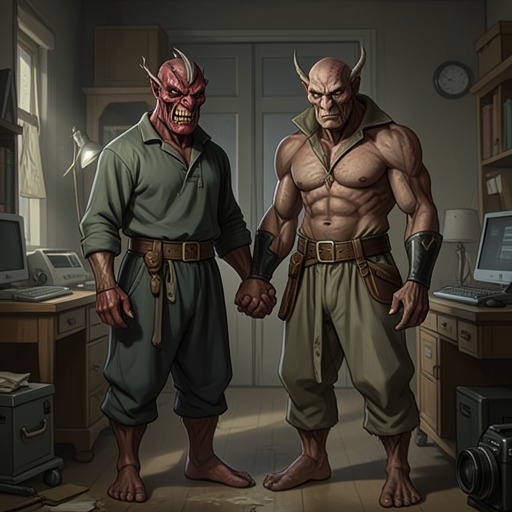
Croissant is the older brother of Chocolatine. He is described as rough around the edges, especially when Gevaudan is mentioned, and the narrative marks that subject as perilous for him. Chocolatine, by contrast, is cheerful and disarming, even when discussing lethal behavior. Their sibling relationship gives the werewolves a domestic structure that contrasts with Vainqueur’s language of minions, food, and treasure.
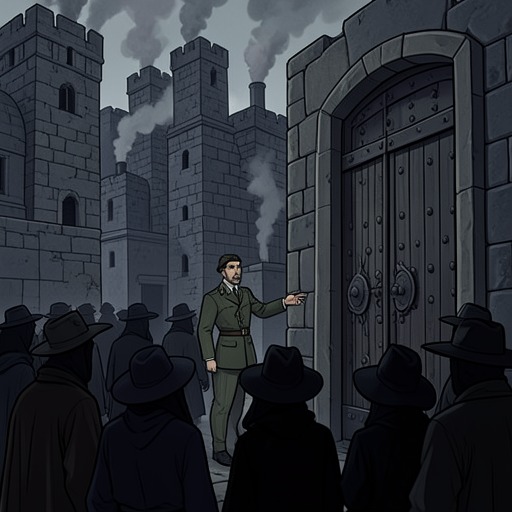
Their settlement is a secret monster community concealed behind human appearances. Croissant explains that its inhabitants disguise themselves to avoid inquisitors and adventurers who regularly travel through the region and would otherwise try to wipe them out. The concealment is therefore not presented as a predatory conspiracy but as a survival practice imposed by persecution. Chocolatine states that the community sometimes kills hostile outsiders in their sleep first, revealing the violent logic produced by that persecution: the villagers are both threatened prey and capable defenders.
The settlement is also a place of instruction. Croissant describes a school for mimics and other shapeshifters where students learn to blend into human society in a safe, family-friendly environment. Werewolf life is consequently connected to education, performance, and collective protection. Their ability to pass as human is not merely an individual trick; it is a communal skill taught to younger or less experienced monsters.
Recruitment by Vainqueur Knightsbane
Vainqueur’s encounter with the werewolves turns their survival into a debt. He argues that if the werewolves had not survived, he would have gained more treasure, so their continued existence has cost him. His proposed compensation is that they become his minions. Survival is presented as the reward for obedience, and Vainqueur frames himself as unusually merciful because another dragon might simply have eaten them rather than accepting werewolves into service.
This bargain reveals the species’ precarious position in Vainqueur’s food-chain worldview. Croissant is not first recognized as a political equal or protected community member; he is assessed as a potential source of treasure, labor, and food. Vainqueur even threatens to eat him when the werewolf resists the demand. The recruitment therefore combines protection with coercion. Joining Vainqueur’s hierarchy may spare the villagers from immediate destruction, but it also subjects them to a master who insists that every creature has the fundamental right to be eaten by him.
The werewolves nevertheless become useful participants in the wider monster polity. Vainqueur later orders Croissant to send inhabitants with class levels above twenty to an applicant pool for the coming war against Furibon. The recruitment is not limited to werewolves: the assembled candidates include one hundred kobolds, as well as a troll, a dryad, and a golem. This broad call shows how Croissant functions as an intermediary between the hidden settlement and Vainqueur’s expanding military organization, while also making the werewolves part of a multi-species force rather than an isolated tribe.
Social Hierarchy, Reproduction, and Labor
Werewolves are repeatedly caught in systems that classify living beings according to usefulness and value. Vainqueur tells Victor that Victor stands directly below the dragon in the preciousness hierarchy and even above princesses, while minions may be eaten as emergency rations if hunger leaves no other food. Werewolves belong to this same hierarchy: intelligence and service can improve their position, but neither removes their status as possible provisions under Vainqueur’s dragon-centered logic.
The species is also discussed through reproduction. Vainqueur teaches that a creature seeking a mate should display the size of its hoard before asking to breed, and warns against allowing paupers to raise its offspring. He then distinguishes dragons from creatures such as werewolves, arguing that dragons need not reproduce because they do not die as often, whereas short-lived creatures must perpetuate their species before extinction. The speech is comic and reductive, but it places werewolves within a recognizable biological community whose continuation is treated as a practical necessity rather than a romantic ideal.
Their labor position is equally ambivalent. The wider monster civilization turns corpses, monster parts, and discarded bodies into commodities, and Victor is compelled to arrange their sale for necromantic transformation under a church contract. Werewolves are not specifically identified as the corpses’ owners or victims in that transaction, but the episode establishes the economic environment into which they are recruited: bodies, loyalty, survival, and service can all be converted into value. Their admission to Vainqueur’s service therefore offers protection while exposing them to the same exploitative economy that governs his other minions.
Werewolves in the Wider Monster Order
The werewolf community sits alongside many other nonhuman populations that refuse a simple human-versus-monster division. Its villagers include werewolves and shapeshifters, while the broader settlement contains ghouls, a squid-human hybrid, a steel golem, and many other creatures. At Murmurin, gnolls who once served Furibon are eventually accepted by Vainqueur after he condemns their former allegiance and forgives them, although he later eats twenty troublemakers to enforce discipline. Werewolves thus belong to a growing, unstable monster society governed simultaneously by fear, recruitment, labor, spectacle, and appetite.
Their hidden-community identity also intersects with religion. Victor Dalton mentions having met a god and being made that god’s prophet, which leads the Moon Man cult to seek his genes. The resulting crowd consists mostly of werewolves in human form, but also includes gnolls, kobolds, mimics, and other creatures. Werewolves are therefore represented not only as a persecuted population but as participants in fervent and sometimes absurd religious networks. Their presence in the crowd demonstrates how quickly secrecy can become exposure when prophecy, reproduction, and monster identity are linked.
The novel repeatedly contrasts werewolf survival with the ideological extremes of other beings. A fairy proposes exterminating mortal races and promises Vainqueur fairy gold and mortal flesh as a reward. Vainqueur rejects the plan because mortals are his favorite food and because eliminating them would deprive him of coins and princesses. His refusal does not amount to universal compassion; he still preserves a hierarchy in which sentient beings can be consumed. Yet it prevents total extermination, leaving space for mixed communities such as the werewolf settlement and for commercial institutions open to monsters and mortals alike.
Narrative Significance
Werewolves expose the incompleteness of Vainqueur’s supposedly universal principles. He claims not to discriminate because all creatures are equally inferior to him and insists that everyone should have the right to become his emergency food. The claim erases distinctions by imposing one dragon-centered standard on every species. Against it, the werewolf village supplies a different model of collective life: concealment for safety, mutual defense, family continuity, education in shapeshifting, and negotiation with outside powers.
Their portrayal also unsettles the boundary between human and nonhuman identity. Human appearance is a learned disguise, not proof of humanity; the village school teaches monsters to perform normality, and Victor Dalton himself is a dragon monster in disguise. Werewolves consequently belong to a world where identity is relational and constructed through bodies, masks, alliances, and recognition. They are not merely creatures that transform into wolves. They are a people forced to transform socially in order to remain alive.
At the same time, the narrative refuses to idealize them. Croissant can lose control under the full moon, Chocolatine speaks lightly of killing outsiders, and the community’s defensive violence mirrors the dangers it fears. The werewolves are neither innocent victims nor uncomplicated villains. Their central significance lies in that tension: they are hunted, organized, capable of brutality, capable of loyalty, and sufficiently valuable to be incorporated into Vainqueur’s empire without ever escaping its predatory logic.