1986 Chernobyl Nuclear Accident
Voices from ChernobylThe 1986 Chernobyl Nuclear Accident began with the destruction of a reactor and became an unfolding human and environmental catastrophe. Its immediate violence was followed by an invisible, persistent danger: contamination that crossed borders, unsettled daily life, and made decisions about home, food, health, and family into decisions under uncertainty. The accounts present the accident not as a single night that ended when the flames were controlled, but as a rupture whose consequences kept arriving—in evacuation columns, abandoned villages, illness, and the changed prospects of children.
The explosion and its reach
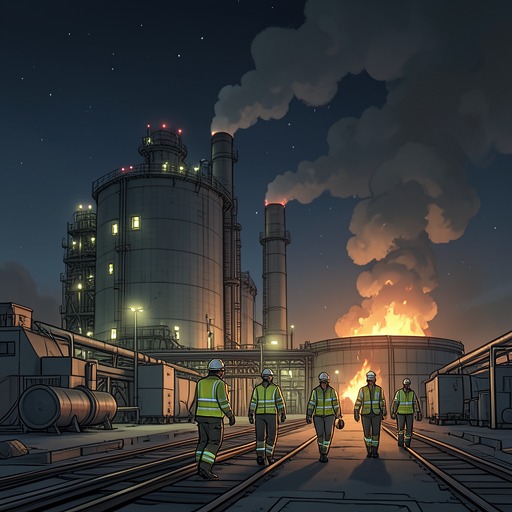
A historical note places Chernobyl among the old Soviet-designed RBMK stations nearest to Belarus, alongside Ignalinsk to the north and Smolensk to the east. At 1:23:58 on April 26, 1986, a series of explosions destroyed the reactor in the building housing Energy Block 4 of the Chernobyl Nuclear Power Station. The book identifies the resulting catastrophe as the largest technological disaster of the twentieth century. The precision of the recorded time stands in stark contrast to the scale of what followed: a clearly timed blast whose consequences could not be confined to the site or to the first hours after it.
The account of the fire makes that gap between an emergency response and the actual danger concrete. Smoke rose from burning bitumen covering the roof; those sent to fight the flames later described the surface as like walking on tar. They kicked at burning graphite with their feet, in shirt sleeves and without their canvas protective gear. They had been called to a fire and had not been told what they were facing. The workers’ actions were immediate and physical, but the danger was not an ordinary blaze: the radioactive material would remain a threat after the visible flames and smoke had drawn attention away from it.
The release was not local. An estimated 50 million curies of radionuclides entered the atmosphere, and 70 percent descended on Belarus. The source records cesium-137 contamination above one curie per square kilometer across 23 percent of Belarusian territory, compared with 4.8 percent of Ukraine and 0.5 percent of Russia. More than 18 million hectares of arable land had contamination above that threshold, while 2,400 hectares were removed from agricultural use. Forests and marshes were also part of the affected landscape: 26 percent of Belarus’s forests, along with extensive marshland near the Pripyat, Dnieper, and Sozh rivers, were considered part of the radioactive zone.
Within days, instruments registered elevated radiation far beyond the reactor’s surroundings. Readings were recorded in Poland, Germany, Austria, and Romania on April 29; Switzerland and northern Italy on April 30; and, on May 1 and 2, France, Belgium, the Netherlands, Great Britain, and northern Greece. By May 3, readings had been recorded in Israel, Kuwait, and Turkey. Airborne particles were detected in Japan on May 2, in India on May 5, and in the United States and Canada on May 5 and 6. The chronology makes the accident’s expanding scale legible: in less than a week, a reactor destroyed in the Soviet Union had become a problem for the entire world.
Evacuation, exposure, and lost homes
The explosion’s consequences were measured not only in radiation readings but in forced departures and the lives those departures divided. During the evacuation, one elderly woman remained on her knees before her house with an icon, refusing to leave the graves of her two sons, who had been killed in the war. The apple trees were in bloom and the sky held white clouds; there had been no attack and no gunfire. Yet officials could offer no answer to her question of whether this was a war. Her protest exposes the mismatch between the familiar appearance of the village and the danger that required its abandonment.
Another recollection makes the evacuation a scene of coercion and confusion. Aircraft flew low overhead toward the reactor as soldiers went from house to house. Livestock moaned and children cried; some people hid, while elderly women begged in front of their homes and soldiers lifted them into vehicles. One resident stayed inside her hut and challenged the soldiers to tie her hands and feet if they meant to take her. The first day passed from shouting into an unnerving quiet. She later heard that people had walked in one column and livestock in another. The operation removed residents from danger, but its force and wartime appearance also marked the loss of home as an imposed, bewildering event.
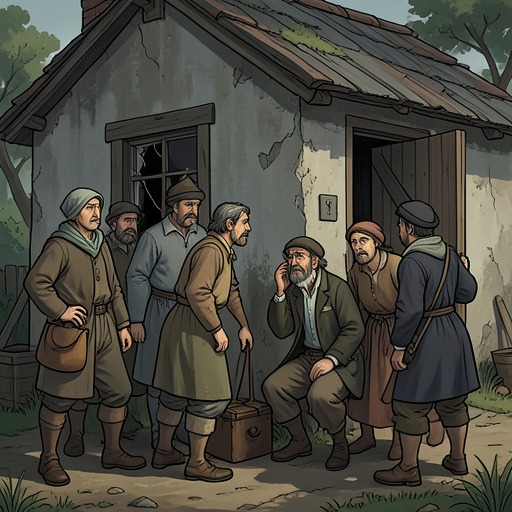
Evacuation did not guarantee a secure new life. One account describes a woman walking for two weeks with her cow, unable to get into a house and sleeping in the forest. Others experienced suspicion in their new surroundings: displaced people were treated as if they were infectious. Compensation could also fail to protect them. In one family’s account, money paid for a house and cow helped buy furniture and a car, but the daughter-in-law followed the older woman through the apartment wiping door handles and chairs. The money was spent, while the stigma and dependence remained. The testimonies thus distinguish removal from recovery: a person could be taken away from contaminated land and still lose shelter, acceptance, and control over the next stage of life.
For Belarus, the scale of displacement became a national loss. The historical account compares the 485 villages and settlements lost as a result of Chernobyl with the 619 Belarusian villages destroyed with their inhabitants by the Nazis during World War II; 70 of the post-accident settlements were permanently buried underground. The comparison does not make the two catastrophes identical. It shows how the destruction of inhabited places called up a history of wartime devastation, even when the landscape offered no visible battlefield. The same account estimates that one in five Belarusians lived on contaminated land—2.1 million people, including 700,000 children—and reports that mortality in the hardest-hit Gomel Region and Mogilev Region exceeded births by 20 percent.
The danger that could not be seen
Radiation’s invisibility made ordinary senses unreliable, while official explanations and available guidance failed to give residents a stable basis for action. In the first days, books about radiation, Hiroshima, Nagasaki, and even X-rays disappeared from a local library. Some residents believed this had been ordered to prevent panic. Medical bulletins and other information were absent. Potassium iodide was difficult to obtain; people who managed to get it sometimes took large amounts with liquor and later needed their stomachs pumped. In that vacuum, residents adopted a crude sign of safety: if sparrows and pigeons remained in town, they assumed people could remain too. One witness recalled birds crashing into a taxi window as if blinded, an observation that unsettled the human rule of thumb without supplying a dependable replacement.
A villager’s description of cesium reveals how the unseen hazard could briefly seem visible. After being told radiation lay on the ground and entered the soil, she found pieces in her yard and nearby gardens: one black and dripping after rain, another blue, and another red. She and neighboring women searched roughly two hectares and found about four large pieces, each around the size of her headscarf. Rain had washed them away by the next day, leaving nothing for the police to inspect. Once the material was visible, she said, it seemed less frightening; yet its disappearance did not mean the danger had disappeared. The episode captures the instability of evidence in a disaster where what people could point to might vanish before authorities arrived.
Instructions and restrictions arrived into lives already shaped by land and subsistence. Signs posted by police and soldiers gave readings of 60 or 70 curies; residents were advised to work in masks and rubber gloves, wash yards, and launder sheets, blankets, and curtains. The same people who had relied on their potatoes were suddenly told not to eat them. The scale of the requested precautions could seem absurd when residents believed contamination lay in forests and fields, not behind closet doors or glass. In another recollection, a family returned to a moonlit road bordered by fields where poisoned topsoil had been stripped and buried and white dolomite sand put in its place. The transformed ground looked like something other than earth. Such measures made contamination visible through signs and altered landscapes, but they could not make its extent or future consequences easy to comprehend.
Long aftermath and contested memory
The book’s accounts emphasize that the accident continued after the evacuation and the first emergency response. A four-year-old child had spent much of her life in hospital, where she knew her friends and growth; at home for a month or two, she asked when they would return to the hospital. Her mother described multiple operations to construct anatomy and continuing urinary complications that required manual care every half hour. After years of being told the condition was a congenital handicap, the parents finally obtained a medical document acknowledging a connection to ionizing radiation in small doses. They could not afford the tens of thousands of dollars that treatment abroad might require. The mother wrote to hospitals, even accepting the possibility that her daughter might become an experimental subject if that offered a chance to keep her alive. Here, contamination’s aftermath enters the most intimate scale: the child’s daily care, her parents’ finances, and the future she might be able to imagine.
The costs also reshaped childhood and family ties in less clinical ways. A girl who was barred from her grandmother’s burial because soldiers would not let children enter the restricted area understood that she would never visit the grave. At the cemetery, a dosimeter clicked over the grass and flowers, and soldiers threw out the food and vodka laid out for the wake. Her grandmother’s last expressed wish had been for sorrel, a plant the family was not allowed to eat for years because it absorbed radiation. In another account, children learned of their own sins while sheltering in a cellar during hard rain and a black cloud: a broken jar of raspberry jam and a torn dress hidden in a closet. The grandmother had knelt to pray, telling them it was the end of the world and punishment for sin. For children, the accident’s language arrived as fear, prohibition, separation, and the effort to make sense of danger through familiar moral ideas.
War became a recurring frame for experiences that had no gunfire. One witness, recalling childhood during World War II, named that war as the most frightening event of his early life. Decades later, people measured the years since Chernobyl against the four years of war, describing a decade after the accident as if two wars had passed. An evacuated woman saw the departure of residents and livestock as a wartime scene; another witness recalled soldiers and an evacuation overseen by officials before blooming apple trees. The comparison gave people a language for loss and compulsion, but it also registered a difference: there was no attacker in sight, and no visible weapon to confront. The danger’s invisibility made it possible for a blue sky and ordinary weather to coexist with an evacuation.
Ten years on, people voiced sharply different ways of living with the unresolved disaster: some insisted that everything had passed or would turn out all right; others feared imminent death, wanted to leave the country, demanded help, or concluded that life had to continue regardless. A witness described Belarus as a huge laboratory, with two million people living on poisoned land while researchers from Moscow, Petersburg, Japan, Germany, and Austria came to study them. The claim makes a distinction between being studied and being protected: the people exposed to the consequences could become material for knowledge while still facing uncertainty about what the exposure meant for their lives.
That uncertainty altered the meaning of return and of the abandoned countryside. Years after residents left, people from other wars arrived at abandoned houses that had not been destroyed and buried by special squads. Refugees from Armenia, Georgia, Abkhazia, Tajikistan, and Chechnya came to this land because they had nowhere else to go. For people fleeing armed conflict, the threat from contaminated land and water could sound like a fairy tale beside the immediate, familiar danger of people killing one another with guns. The accident therefore produced not one settled aftermath but overlapping experiences: evacuation, isolation, continued residence, and later resettlement, each shaped by what people could bear and what alternatives they had.
The accident’s significance in the book lies in this extended collision between a technological disaster and the forms through which people try to understand danger. A fire could be seen; radionuclides could not. A dosimeter could click over grass, a sign could name a reading, and stripped soil could be replaced by pale sand, but none of these fully resolved what was safe, what could be eaten, or what the future would hold. By placing national statistics beside the refusal of an old woman to leave her house, the missing information beside improvised rules about birds, and distant scientific attention beside a child’s daily medical care, the accounts show how one reactor’s destruction entered homes, memories, bodies, and plans for generations.