Bely Bereg
Voices from ChernobylBely Bereg is a village in the Narovlyansk region of Gomel Region, remembered in Voices from Chernobyl through the testimony of people who were evacuated and later returned. The village’s story is not simply one of departure and homecoming: soldiers forced residents out, belongings and familiar routines were lost, and return meant entering a place that had been damaged and stripped. Against that rupture, the residents’ attachment to the village persisted—in its beauty, its graves, its animals, and the work of making homes habitable again.
Setting and Evacuation
The testimony introduces Bely Bereg as a village whose landscape is itself part of what residents believe they lost. One returnee challenges the compensation offered for their homes by asking who could pay for the beauty of the place, which had been turned into what officials called a resort zone. The contrast makes the removal more than a transfer of property: what was taken could not be measured by the price assigned to a house.
The evacuation arrived with force and confusion. Soldiers chased residents out as large military vehicles entered the village; another account recalls aircraft, helicopters, trucks with trailers, and soldiers, sounds that made the departure seem like the beginning of a war. For one household, the announcement that evacuation would begin the next day collided with the unfinished harvest: the potatoes had not yet been dug. The residents’ anger at the collective-farm chairman and their refusal to leave show how official orders met the practical ties of village life—crops, homes, and the conviction that they had already endured hardship before radiation came.
Leaving Home and Its Traces
Departure did not erase the residents’ connection to the village. One person took earth from a mother’s grave in a small sack, knelt to ask forgiveness for leaving, and went to the grave at night without fear. The gesture carries the village beyond its houses: leaving also meant separating from the dead, whose resting place remained behind.
The houses, meanwhile, became surfaces for farewell. Residents wrote their names on wood, fences, and asphalt. These marks recorded who had lived there and made departure visible in the very places people were abandoning. In the testimony, a village is not only a collection of buildings to be evacuated; it is a network of personal histories that people try to leave legible to others.
Animals also register the human cost of evacuation. One account says that soldiers shot the dogs; the speaker remembered the sound and could no longer listen to a living creature scream. Later, some residents returned with cats and dogs, carrying their household bonds back across the boundary despite the soldiers who tried to stop them. They entered at night through the forest, like partisans. The return thus reverses the forced departure, but not by permission: people and animals come back together through a route that evades armed control.
Return and Repair
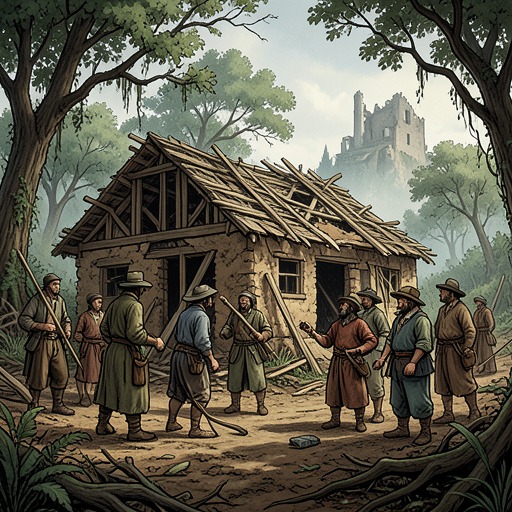
The returnees describe a homecoming without the comforts of restored normality. Three families came back together to find looted houses: stoves smashed, windows broken, doors removed, and lamps, switches, and outlets taken. One resident rebuilt what could be rebuilt with their own hands. The concrete inventory of damage gives the return its measure: coming home did not mean recovering an intact home; it meant facing the work of making one again.
The residents’ demands are correspondingly modest and firm. They say they do not need a government store or a bus, and are willing to walk twenty kilometers for bread; what they ask is to be left alone. In another returnee’s account, the land offers room to plow a hundred hectares, while the absence of bosses and government interference is treated as a form of freedom. The return is neither an uncomplicated pastoral refuge nor a simple rejection of hardship. It is a claim to live on familiar ground by one’s own labor and terms.
Narrative Significance
Bely Bereg’s testimony places environmental disaster within ordinary, material attachments: potatoes still in the ground, earth taken from a grave, dogs shot during evacuation, and the doors and fittings needed to make a house work. Those details resist the abstraction of displacement. They show why a village cannot be compensated for by assigning a price to its buildings, and why return is more than crossing back into an evacuated place.
The village also holds together two forms of persistence. Residents leave marks and carry a little of the homeland with them; later, they return through the forest and rebuild what looting has undone. Their accounts do not claim that the damage has vanished. Instead, Bely Bereg emerges as a home continually asserted through memory, kinship with the land, and the strenuous work of staying or coming back.