Bereavement
Voices from ChernobylBereavement in Valentina Timofeevna Panasevich’s testimony is not a passage from grief to recovery but a life reorganized around an absence that keeps returning. Her husband’s death after he was sent to Chernobyl makes ordinary gestures—reaching across a bed, hearing a bird, answering a child—carry the force of loss. She says she has begun living again, yet her account does not resolve the question of how to live without him. It follows instead the difficult coexistence of memory, obligation, silence, and a continuing wish to understand.
Loss and the life before it
Panasevich remembers her husband as a companion in a marriage shaped by repeated departures and reunions. He worked in construction and traveled across the Soviet Union; she waited for him, and their years together felt, in her description, like the life of two lovebirds. His departure for Chernobyl came on her birthday, October 19, 1986. Guests were at the table when he apologized and kissed her; a car was already waiting outside. The occasion that should have belonged to her became the beginning of his absence.
A notice bearing a red banner arrived that same day, making his call-up resemble a summons to war. Panasevich later wondered why she and her husband had not felt the fear that had come over their mothers. She knew where he was going, but says she could have looked in a neighbor boy’s tenth-grade physics textbook and did not. The retrospect brings knowledge to the threshold of the departure without making it possible to undo it. In the brigade of seven men sent with him, all eventually died. The first death came after three years; at first, the survivors treated it as coincidence, then watched the others die one after another. Her grief is therefore intimate and cumulative: the loss of her husband belongs to a pattern whose scale became visible only over time.
Absence in ordinary time
The testimony gives grief a bodily routine. On waking, Panasevich’s hand feels across the bed for her husband, finding his pillow and smell rather than his presence. A small bird runs along the windowsill and makes a little bell ring; the sound awakens her to a voice she says she had never heard before. The ordinary morning has not stopped, but its details arrive changed: sensation both recalls the dead and makes the present newly audible.
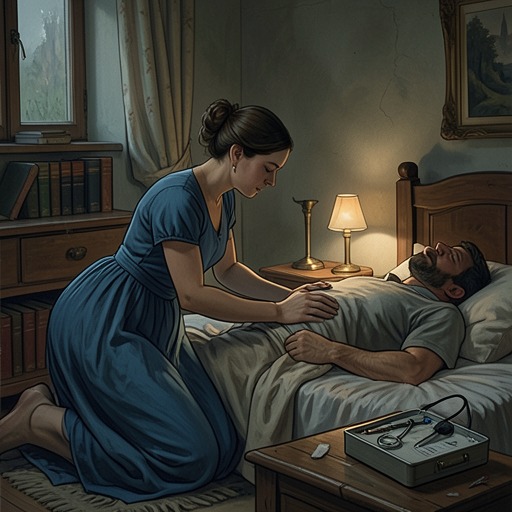
At night she closes her eyes and thinks of him until sleep comes. He appears in dreams only in brief flashes, and then disappears; she can hear his footsteps but cannot follow where he goes. In the last year of his life, she placed one pillow under him, then another, then a third, raising him as he looked out the window at the sky. She describes his dying as lasting a whole year and says they could not part. The care expressed by the pillows persists in memory as a concrete measure of that prolonged separation: she could tend to him, but could not keep him.
Her account moves between the claim that she is living again and the repeated question of where he is. At first, she says, she was heartbroken and paralyzed, wanting to speak with someone but not with anyone human. She went to church for its quiet, where she could forget her life for a while; morning brought the bed and the search for him back. This return is not presented as a neatly completed stage of mourning. Even the statement that she no longer cries is immediately joined to her wish to talk, as if speech offers a different way to remain with what cannot be changed.
Silence, memory, and survival
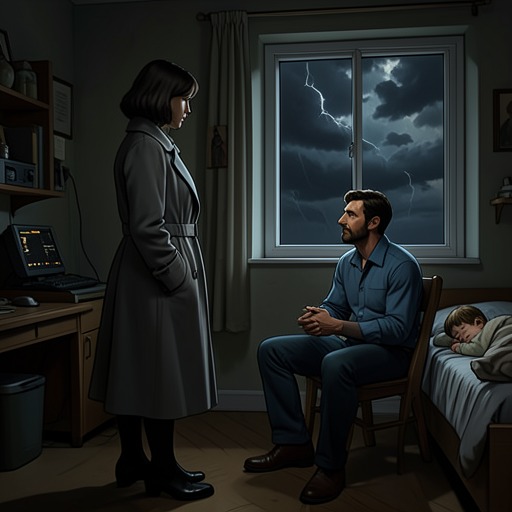
Panasevich is careful about the limits of what she can tell. She says she cannot speak about all of it and does not understand how she stayed alive. The interruptions of family life do not erase that difficulty: her daughter comes to say that her homework is finished or that a button has fallen off and needs sewing. These requests locate the bereaved woman in present responsibilities, while the question of how to follow her husband remains unanswered. The movement between a child’s practical need and the absent husband’s irretrievability is part of the testimony’s form: grief does not replace daily life; it inhabits it.
She distinguishes her own remembrance from her friend’s choice to plan another marriage. Their husbands died in the same year after being together in Chernobyl, but Panasevich does not condemn her friend. The friend has children and needs to survive, she says. This comparison refuses a single acceptable timetable for bereavement. Panasevich cannot imagine forgetting, while acknowledging that another widow may continue by making a different future. Her testimony allows both realities to stand without turning one woman’s response into a judgment on the other.
The interview itself becomes a struggle over whether private suffering should be named. Panasevich hesitates over having her name written, invoking secrets and people who pray in a whisper; then she changes her mind and asks that her name be recorded, so that God will know. Public testimony does not mean that everything can be said. Rather, the decision to speak coexists with her insistence that some of the story remains unfinished and with her questions about why people must suffer.
A future organized around her son
Panasevich identifies her son as what pushed her back out into life. He has been ill for a long time and, although grown, sees the world with the eyes of a five-year-old. Doctors have ordered that he live at Novinki Mental Hospital if he is to live; she visits him on weekends and hopes to exchange her apartment for one closer to the hospital. These details make survival an obligation with a place, a journey, and a practical plan attached to it—not an abstract triumph over grief.
At the visits, her son asks where Papa Misha is and when he will come. The question gives the absent husband a continuing place in their family life, while exposing the limits of what the mother can explain or repair. Panasevich says they will wait for him together and that she will read her Chernobyl prayer in a whisper. The ending does not promise that waiting will become acceptance. It joins the son’s childlike understanding, the mother’s private prayer, and the father’s enduring absence in a shared act of remembrance. Her bereavement remains open, but speaking, visiting, and caring for her son give that openness a lived form.