Birds
Voices from ChernobylBirds in Voices From Chernobyl are neither scenery nor a dependable warning system. Sparrows and pigeons become an informal test of whether a town is still habitable; elsewhere, birds strike a taxi window as if blinded, and testimony describes them among the living things frightened by radiation. Their presence makes environmental damage visible, but never fully legible. When people imagine evacuating every creature, Birds also expose a harder question: who can be saved when human plans cannot even communicate with the lives they mean to protect?
Signs of Habitation and Danger
In one account, residents make a practical rule from what they can see: while sparrows and pigeons remain in town, people can live there too. The rule offers a bodily, everyday substitute for information that residents lack. Yet it is not a measurement of radiation, and the narrative immediately unsettles its reassuring simplicity. A taxi driver, unable to understand what was happening, sees birds repeatedly crash into his window. The witness compares their behavior to blindness or suicide. Birds are thus both signs by which people judge the environment and creatures whose distress exceeds the meaning people assign to them.
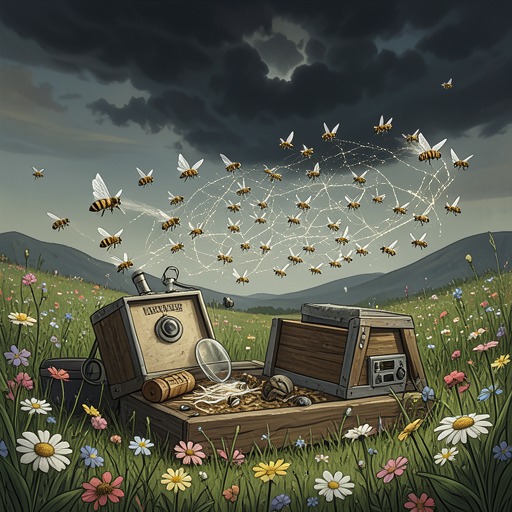
Another testimony places Birds within a wider disturbance of animal life. A speaker says radiation frightens animals and birds, while trees remain silent. The contrast gives nonhuman life a presence without pretending it can explain itself: birds can visibly react, but their behavior does not tell residents what the radiation is, where it lies, or what will happen next. The account of bees staying inside their nests for two days before emerging on the third, while official radio and newspapers said nothing, sharpens that contrast between animal response and human uncertainty. The bees are not birds, but their story forms part of the book’s recurring comparison between human knowledge and other creatures’ ways of registering change.
Witnesses to a Changed Landscape
A returning traveler remembers birds in their nests on arriving in a contaminated landscape; by the time the traveler leaves, apples lie on the snow. The account does not turn that sequence into a claim about what happened to the birds. Instead, it preserves fragments of a place whose ordinary life has become difficult to read. The witness describes the burial of earth, bugs, spiders, and leeches, and calls the place a separate world. Birds belong to this record not as a complete population count but as one detail among many that resists a clean division between human disaster and the fate of other living things.
A different speaker imagines the future while looking at fields where poisoned topsoil has been removed and replaced with white dolomite sand. The transformed ground prompts a nightmare vision of a creature moving on all fours; in that imagined world, ants alone remain, while everything else in heaven and earth has died. This is speculation, not a prediction about Birds. Its force lies in how it makes the loss of familiar life imaginable: the landscape seems to have become so alien that even the continued presence of birds can no longer be assumed.
The Limits of Rescue
The question of what can be done for animals becomes explicit in an account by a filmmaker. After encountering an old woman who refuses to leave her cat and an apple tree without its smell, he turns to filming animals. When he shows his Chernobyl films to children, one boy asks why nobody could help the animals. The question stays with the filmmaker because it exposes an omission in art and public concern: human suffering and love receive attention, while the lives of other species are often left outside the frame.
The filmmaker has heard that, in the first months after the accident, someone proposed evacuating animals along with people. The proposal immediately opens onto practical and ethical obstacles. Moving creatures above ground would not solve the problem of insects and worms below it, or birds in the sky. How could a pigeon or sparrow be evacuated, and how could anyone give them the information needed to leave? The account does not resolve the dilemma. It shows instead that human rescue plans encounter lives that cannot be organized by the same instructions, routes, or assumptions as a human population.
Human Knowledge and Nonhuman Life
A hunter’s reflection draws a distinction between people, who understand, and animals and birds, which simply live. The phrasing is revealing in the context of the book: human beings possess concepts and instruments, yet those resources do not guarantee comprehension of an invisible hazard. Birds appear through actions that witnesses can observe—remaining in a town, striking glass, or being named as possible evacuees—but those observations cannot be translated into a complete account of what the creatures experience.
Across these testimonies, Birds shift the scale of disaster. They test a reassuring local rule, embody a visible disturbance, and challenge the assumption that evacuation and care can be designed around people alone. The book does not give them a speaking voice or claim to know their inner lives. Instead, it records the limits of human interpretation: birds can be seen, their behavior can trouble witnesses, and their fate can prompt a child’s moral question, even while the means to answer that question remain beyond the human account.