Cancer among Chernobyl liquidators
Voices from ChernobylCancer among Chernobyl cleanup workers is presented through separate testimonies rather than as one uniform medical history. The accounts follow illness from hazardous assignments into homes, workplaces, and hospitals, where bodily changes could be unmistakable even when their cause remained disputed or concealed. Their force lies in that gap: people describe what happened to them and their families while also confronting the difficulty of having those experiences officially recognized.
Exposure and the sealed record
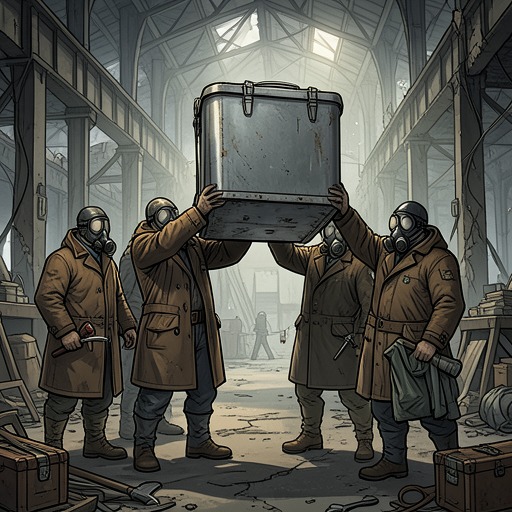
One former soldier describes returning from Chernobyl at twenty-two and becoming a second-group invalid immediately after his military service. His unit carried buckets of graphite from the reactor, shoveling it with ordinary tools; he estimates the exposure at ten thousand roentgen and says the men changed their masks as many as thirty times in a shift. They also worked on the sarcophagus, which he remembers as a monumental grave for Valery Khodemchuk, trapped beneath the ruins in the first minutes after the explosion. The unit still had three months of service remaining. When it returned, its members were not even given clean clothes: they continued wearing the same trousers and boots they had worn at the reactor until demobilization.
The danger was accompanied by an order not to speak. The soldiers signed nondisclosure forms, and before returning were warned that, in the interests of the State, they should not tell people what they had seen. The speaker says that the relevant documents were still hidden or had been destroyed because they were classified. His account makes secrecy more than a matter of withheld information: without records of exposure, he asks, how could doctors help him establish what had happened?
He also describes trying to claim recognition at a factory after his health had deteriorated. When his supervisor threatened to reduce his work because he kept being sick, the former soldier protested that he was a Chernobylite who had saved and protected others. The director answered that the factory had not sent him there. The exchange leaves the worker caught between an official past that cannot be documented and an ordinary workplace that treats his illness as a personal inconvenience. His account does not name a specific cancer diagnosis, but his disability, fear of his own uncertain death, and the deaths of former fellow workers place the cancer testimonies within a wider record of severe post-exposure illness.
Illness enters the family
A pediatrician recounts her husband’s leukemia after he was sent from a factory to work in the Chernobyl exclusion zone. His assignment included raking straw and gathering beets and potatoes in the fifteen-kilometer zone. He became ill two months after returning. While spackling a wall with his father, he collapsed; at the hospital, his condition was described as a fatal dose of leukocytes. He returned home convinced that he was dying. His wife tried to drive away that certainty and remembers giving birth to a daughter in the hope that he would believe there was still a future. Doctors had warned her that her husband would die, and she recalls wishing she had physically barred him from leaving for the assignment.
A child’s testimony shows how a father’s service could first be understood as heroic and only later as a source of fear. The boy’s father was taken to Chernobyl during the night; in the morning, his mother was crying. When the father returned, he went back to factory work and said nothing about the assignment. At school, the boy proudly told classmates that his father was a liquidator who had helped clean up after the accident. The boys were jealous. A year later, the father became ill. After a second operation, he told his son about working near the reactor: the gardens were blooming, although the villagers had left, and cleanup did not stop the dosimeters from clicking again the next day.
The child himself, at twelve, was an invalid with blood cancer. He says doctors connected his illness to his father’s work at Chernobyl and to his own birth afterward. The distinction between the boy’s early pride and his later diagnosis is sharpened by the social consequences: classmates who learned that he had cancer were afraid to sit beside him or touch him. Two pension checks arrived at the family home, one for the boy and one for his grandfather. The testimony makes illness visible not only in the hospital but in the classroom, where the child’s diagnosis changes how others approach him.
Treatment and the altered body
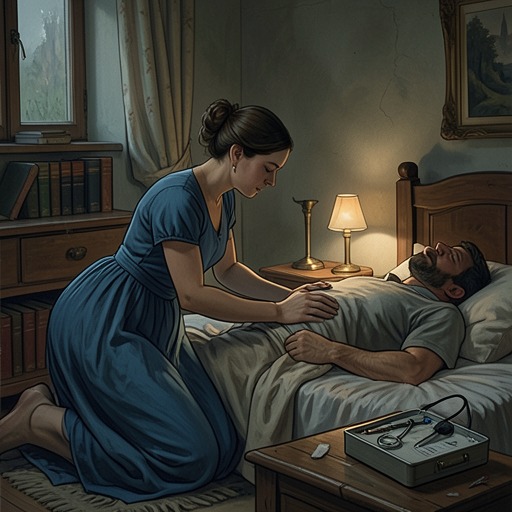
Another wife recounts her husband’s cancer through the care required to keep him alive at home. He resisted seeing a doctor because he could neither hear nor feel pain, although his lymph nodes had already grown to the size of eggs. At the clinic, a doctor recognized him as another Chernobylite. A week later, surgeons removed his thyroid gland and larynx and replaced them with tubes. The intervention began a demanding routine rather than a return to ordinary life: after he was sent home, his wife was taught to feed him through a needle inserted into a tube leading to his stomach.
She prepared fresh food four times each day, ground it in a meat grinder, and passed it through the feeding apparatus. By then he had lost his sense of smell and could not tell her how the food tasted. They still went to the movies a few times and kissed there, trying to find a way back into life. At the same time, she kept the subject of Chernobyl from him and intercepted telephone calls because his friends were dying one by one. The effort to protect him from those deaths coexisted with the knowledge that his own condition was worsening.
After he could no longer speak, the couple communicated with a notebook and pencil. His wife describes how his changed face became part of the illness she had to witness: after the removal of his lymph nodes disrupted his circulation, his nose grew several times larger, his eyes shifted in appearance, and eventually one eye closed. He asked for a mirror. For two days, she evaded the request by pretending not to hear or by making noise in the kitchen. On the third day, he wrote the demand in large letters, with three exclamation points. The scene turns a small household object into the limit of her protection: she can delay his seeing the change, but she cannot make the request disappear. They had one year left together, during which he grew worse each day.
Diagnosis, causation, and recognition
The testimonies distinguish bodily experience from the explanations institutions are willing to record. A pediatrician says that children know their diagnoses, medicines, and procedures, often better than their mothers, but do not necessarily understand cancer as a sentence of death. When they die, she says, their faces look surprised. Her observation places childhood knowledge beside childhood vulnerability: a child may master the language of treatment without grasping what the adults around them fear.
The book also presents the wider difficulty of connecting disease to radiation exposure. In one account, a mother spends four years pressing doctors and officials to recognize a link between low-dose ionizing radiation and her daughter’s complex congenital conditions. The doctors initially classified the condition as a congenital handicap; she eventually obtained a medical paper confirming a connection. This is not a cancer case, but it clarifies the contested ground on which families sought recognition for radiation-related harm. The account describes official instructions to classify such incidents as general sicknesses until a Chernobyl database could be built, perhaps in twenty or thirty years. For the family, that timetable was impossible: the child’s treatment and future were already unfolding.
A separate report of village examinations records children with readings of fifteen hundred, two thousand, and three thousand or more micro-roentgen, alongside a claim that girls had genetic mutations and could not give birth. When the speaker asks whether a tractor driver working nearby wears a gas mask, the Party worker answers that the workers do not. The passage does not identify these readings as cancer diagnoses. Instead, it shows how exposure, health fears, and inadequate protection continued to meet in ordinary work and in the effort to interpret what measurements meant.
Private loss and public consequence
Across these accounts, cancer is not only a diagnosis but a rupture in expected lives. A father’s work that once made a son proud becomes entangled with the son’s own illness; a couple’s shared routines narrow to operations, feeding, silence, and care. At the same time, claims of injury encounter nondisclosure, missing records, disputed causation, and the social distance imposed on patients. The book does not collapse every illness into one proven mechanism. It preserves the speakers’ different kinds of evidence—the remembered assignment, the hospital encounter, the family’s daily labor, the medical classification, and the missing paperwork—and shows why, for those living with the consequences, uncertainty did not make the suffering less real.