Chernobyl as a war
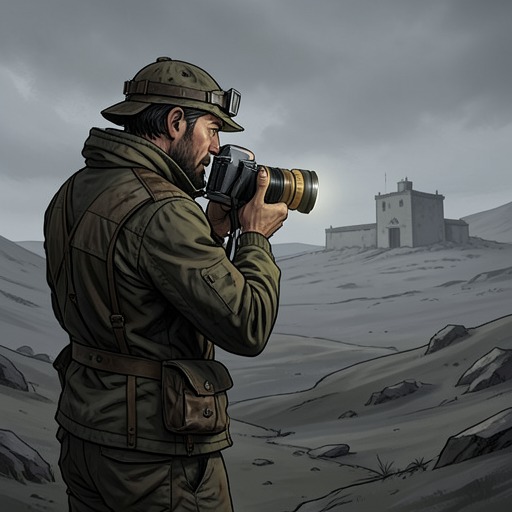
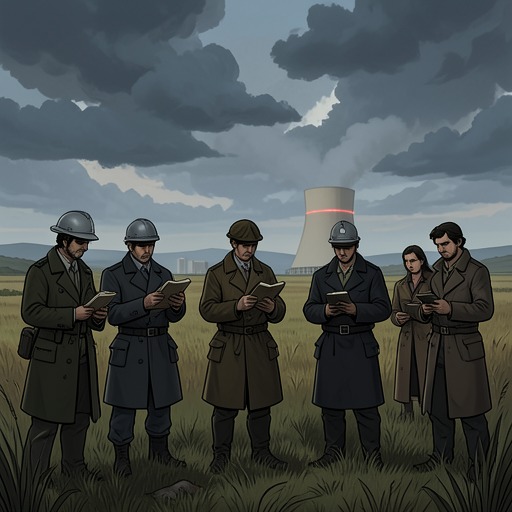
Voices from ChernobylChernobyl as a war is a recurring frame through which survivors describe a disaster without a visible battlefield, a recognizable attacker, or a safe place to retreat. The analogy draws on lived memories of earlier wars and on the Soviet language of mobilization and sacrifice, but it also breaks down: radiation cannot be seen or contained by ordinary military boundaries, and the apparent peace of blue skies and blooming orchards can conceal danger. Across the testimonies in Voices from Chernobyl, war is at once a means of understanding the catastrophe and a measure of how unprecedented it was.
War as an inherited measure
For people whose childhoods or family histories were shaped by war, Chernobyl enters a vocabulary already formed by bombardment, occupation, loss, and survival. One speaker remembers the war as the scariest thing in childhood; another describes grandparents whose childhood had been the war, while Chernobyl became the defining event of the next generation. That inheritance makes the comparison intimate, not merely rhetorical: people reach for a familiar history to describe what has changed their lives, even when the new disaster refuses to fit it.
The recurrence of the comparison also records a change in scale. Ten years after the accident, one speaker observes that people measure time against the four-year war and feel as if they have lived through two wars. Their responses range from confidence that everything has passed to terror that everyone will soon die, from wanting to leave the country to insisting that life must continue. The variety matters: calling Chernobyl a war does not produce a shared conclusion about what to do. It gives people a common measure for an experience that otherwise remains difficult to grasp.
Yet the analogy has a sharp boundary. A witness insists that there is nowhere to hide from Chernobyl—not underground, underwater, or in the air. The old strategies of war, including shelter and flight, cannot reliably place a person beyond the threat. The phrase war of all wars conveys not a conventional victory but the failure of familiar defenses.
Evacuation without a visible battle
The evacuation scene described by a historian makes that mismatch concrete. An old woman kneels before an icon at her house and refuses to leave. Officials have offered compensation for her house and cow, but she asks who can pay for her life. Her two sons, killed in an earlier war, are buried nearby. Now she sees white clouds and apple trees in bloom; there has been no attack and no shooting. The colonel directing the evacuation and the local officials cannot answer her question about whether this is a war. In her account, the danger is real, but the signs by which she once recognized war are absent.
The experience of evacuation could likewise resemble a journey to safety while feeling nothing like the wars people knew from books. A young witness recalls leaving Pripyat beneath a clear blue sky with Easter cakes and colored eggs packed in bags and baskets. Buses moved slowly among livestock as people chased cows and horses down the roads; drivers and shepherds argued over radioactive dust and the risk of trampling crops. The scene mingled ordinary possessions and seasonal food with an emergency whose permanence no one yet understood. The young people cried; her mother cried; many older women did not. No one thought the departure meant they would never return.
For children, the catastrophe could arrive in frightening colors and indirect explanations. One child remembers a black cloud and hard rain, with puddles yellow and green, while adults called the substance dust from flowers. The grandmother took the children into the cellar, knelt to pray, and taught them that the disaster was divine punishment. When soldiers came in cars, the child thought war had begun. Their talk of deactivation and isotopes was unfamiliar, while a soldier chasing a cat with a dosimeter clicking near it made the threat visible only through the animal’s contamination and the instrument’s sound. War was recognizable as an emergency, but not as an explanation.
Mobilization, obedience, and dangerous labor
The military form of the response gave the comparison a practical force. One conscript recalls that his regiment was put on alert and that the men were not told their destination until they reached Belorusskaya train station in Moscow. A soldier who protested was threatened with a military tribunal; the commander told the troops they could go to prison or be shot. The speaker, by contrast, wanted to do something heroic. Men from across the Soviet Union went together, frightened but also exhilarated by the prospect of action.
At the station, that martial expectation turned into labor in protective clothing. The men received white robes, caps, and gauze masks, then cleaned the grounds and the reactor roof with shovels. Those sent onto the roof were called storks. Robots could not manage the work because their systems malfunctioned, so people took their place. The men were proud of what they did, but the pride sits beside the coercion and the danger: the operation used soldiers and military discipline for a task whose hazard could not be judged by sight.
Another account describes people called up for military training living in tents in the forest, twenty kilometers from the reactor. They were between twenty-five and forty, with some holding university or vocational-technical degrees; one was a history teacher. Instead of machine guns they were given shovels. They buried garbage heaps and gardens, pulled up garlic and cabbage that looked ordinary, and appeared in villagers’ yards in gloves, respirators, and surgical robes. The women crossed themselves at the sight. The landscape looked like home, yet the crews were ordered to treat its crops and soil as dangerous waste.
The unevenness of the invisible front sharpened the fear. Units had one dosimeter among them, while exposure could vary from two roentgen in one place to ten in another. A responder recalls feeling as though the men had no rights, like prisoners, even while he watched the work from the side. Other cleanup accounts describe sealed houses, abandoned farm machinery, photographs, identity papers, and awards left behind by absent residents. On the roads, dogs and cats no longer seemed to recognize people; the crews were ordered to shoot them. The emptied homes and the animals’ behavior made the territory feel occupied by death, although no human enemy was present.
The invisible front and the collapse of certainty
The war metaphor also describes a conflict over what could be known. Measurements exposed dangers that ordinary appearances concealed: in one survey, forest background radiation was five or six times higher than on roads or fields, while thyroid activity among adults and children in some villages reached one hundred to three hundred times the allowable level. Breast milk was radioactive; food displayed beside clothes in village shops proved contaminated when tested. These findings made familiar places and necessities—fields, shops, milk, and gardens—part of the danger zone. The frontline could run through a kitchen or a child’s sandbox rather than along a visible boundary.
Professional knowledge did not automatically translate into protection. A nuclear engineer recalls asking supervisors what to do and being told to take measurements and watch television. On television, Mikhail Gorbachev said immediate measures had been taken. The engineer believed the assurances, despite knowing enough about physics to understand that living things should leave the area, at least temporarily. Reports and explanatory notes were compiled, but Party discipline and faith in the political order kept the scientists silent and at work. The account connects that obedience to a belief that society was fair and placed human beings first; when that faith later collapsed, some people suffered heart attacks or died by suicide.
The suppression of warning gave this war a further, political dimension. A senior scientist, calling from Moscow over a government line to reach the Belarusian Party leadership, found that the connection went dead as soon as he began discussing the accident. After finally reaching Nikolai Slyunkov, he warned that the radioactive cloud was moving toward Belarus and urged iodine prophylaxis and evacuation within one hundred kilometers. The reply minimized the crisis as a fire that had already been put out. In this account, the danger was not only radiation: access to information and the ability to act on scientific knowledge were also contested.
Aftermath, memory, and a war without an ending
For those who had grown up with war, the comparison could make the social and emotional consequences legible, but it could not make them familiar. A child remembers that soldiers guarded the old village cemetery with machine guns and barbed wire when her grandmother was buried there. Adults were allowed through; she was not. At the graveside, soldiers tested the grass and food laid out for the wake with a dosimeter and threw it away because it clicked. The child understood that she would never be able to visit her grandmother. Burial, mourning, and family visits—practices that war might interrupt but did not necessarily render radioactive—were transformed by the exclusion zone.
Nor did the disaster end when the immediate evacuation passed. One witness compares the people living on poisoned land to raw material for a scientific experiment, noting that two million of Belarus’s ten million people lived on contaminated territory. Researchers arrived from Moscow, Petersburg, Japan, Germany, and Austria to collect data and write dissertations; residents experienced themselves as subjects in an international laboratory preparing for an uncertain future. Their daily reactions varied, but the repeated alternatives—everything has passed, everyone will die, help is needed, or life must go on—show how little the passage of time settled the question.
The book’s form preserves this unresolved quality through memories that return in fragments, scenes, and reflections rather than as a single authoritative account. One narrator says that memory is fragile, more like a person’s emotions than exact knowledge. Another recalls stopping in the forest after leaving the Zone and noticing ants moving along a birch branch, apparently untouched by the soldiers, hardware, and destruction nearby. The image does not explain the catastrophe; it marks the limit of human scale and attention. The war comparison gives witnesses a language for mobilization, loss, and fear, while the ants and the continuing contamination suggest a world that does not arrange itself around human battle lines. Chernobyl is called a war because it invades ordinary life; it exceeds the metaphor because no armistice makes the invisible threat disappear.