Chernobyl exclusion-zone entry ban and return restrictions
Voices from ChernobylChernobyl exclusion-zone entry ban and return restrictions governed who could go back to the villages emptied after the disaster, separating former residents from their homes even as work and agricultural activity continued inside the restricted territory. Enforced through soldiers, roadblocks, observation posts, and police, the restrictions were not a simple closure of the contaminated landscape: people were kept out while state-directed operations went on within it. The testimonies reveal the rule not only as a security measure but as an intimate rupture, imposed on people who still understood their houses, land, animals, and graves as home.
Evacuation and the guarded boundary
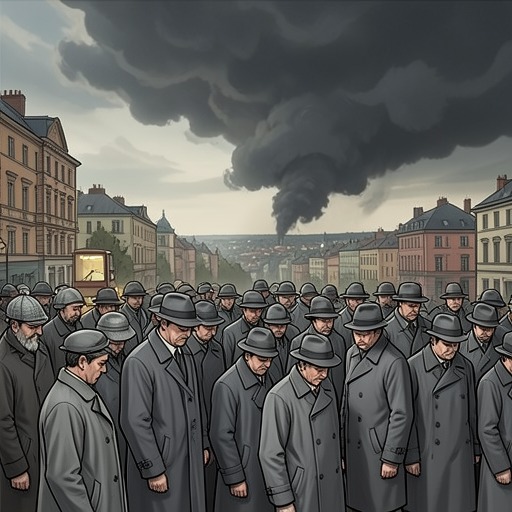
After the explosion, residents were moved out of villages in the evacuation zone. One older woman remembers aircraft passing low overhead toward the reactor while soldiers went house to house. Livestock moaned, children cried, and people hid or covered themselves as the evacuation unfolded. Soldiers asked whether she had packed; she refused to leave her hut, and the young men departed without taking her that day. She later heard that people had been marched out in one column and livestock alongside them. Her account makes the boundary’s human meaning plain: evacuation was not simply a change of address, but a forced departure from an inhabited world.
The boundary was subsequently guarded. A soldier assigned to prevent former residents from returning describes roadblocks and observation posts established around evacuated villages. In peacetime, he and his comrades stood in military fatigues between residents and their property. The older villagers asked to enter for a bucket, pitcher, saw, or axe, or to harvest crops; they brought eggs, bacon, and homemade vodka as they pleaded. Their request was not abstract access to a dangerous area: they wanted their own belongings and the use of land they still considered theirs.
Enforcement and the contradictions of access
The soldier’s account describes a landscape in which exclusion was selective. On one side of the road, soldiers barred residents; nearby, cows grazed, harvesters worked, and grain was transported. A woman could milk a cow only for a soldier to require her to pour the milk onto the ground. Eggs carried in a basket had to be buried. Farmers raised potatoes and harvested them, though the produce was not to be kept. The rule therefore did not mean that the land was unused or inaccessible to everyone. It withheld ordinary access from former inhabitants while authorized activity continued around them, making the division between permitted work and forbidden return difficult for residents—and even for the soldiers—to reconcile.
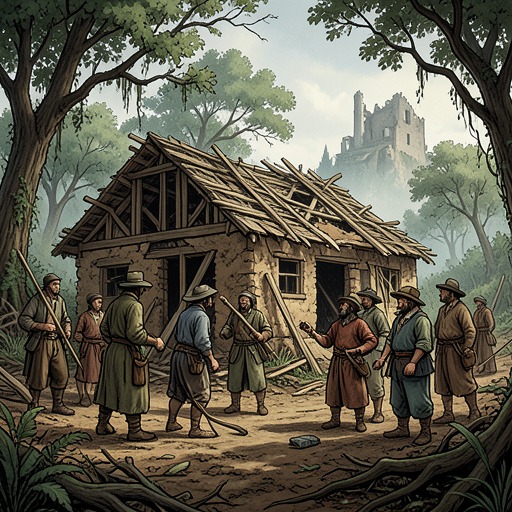
Police enforcement could also reach people who had gone back. One woman recalls that police came twice and broke her stove, then took her away on a tractor; she returned afterward. Others came back secretly, slipping through the forest at night. In her account, the dead could return openly to the place where they belonged, while living people had to approach under cover of darkness. That contrast captures the rule’s sharpest consequence: a home remained physically present, but its living owners could be treated as trespassers.
Unequal permission and the costs of return
The restrictions shaped return through lists and eligibility limits. One testimony says that the police had lists of people they would allow back, while children under eighteen could not return. Those eager to come home wanted, at minimum, to stand in their own yard beside the apple tree. They might first visit the cemetery, then go to the house, leaving candles on fences, a white towel at the gate, or even a wreath. The return described here is not a general reopening of the villages. It is a controlled, conditional visit, loaded with rituals of mourning and attachment.
For people who did not receive permission, separation could mean losing not only a house but also the means to live independently. One displaced resident says that she walked for two weeks with her cow and slept in the forest after she was refused entry to a house. Another recalls that compensation for a home and cow was spent by relatives and consumed by inflation; in town, a daughter-in-law followed her around wiping down the door handle and chair. The restriction thus intersected with dependence, poverty, and stigma: relocation did not guarantee that a person would be welcomed or secure in the new place.
A rule that could not end attachment
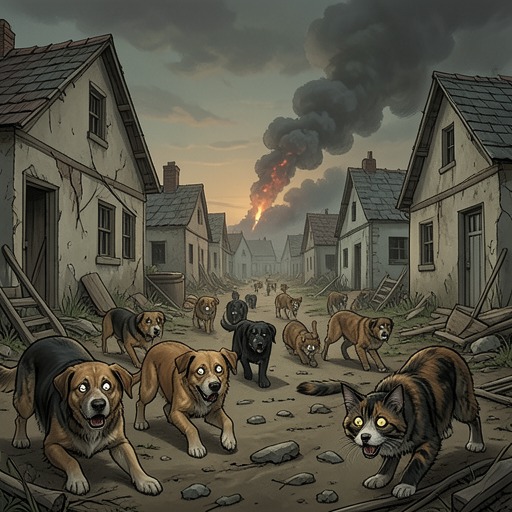
The accounts also show why bans and enforcement did not erase the desire to return. Residents spoke of coming back for the harvest, reclaiming what was theirs, or simply standing in a familiar yard. Some described the village as empty but still alive with birds and animals; for one woman, her husband’s grave was a reason to stay rather than leave. Others crossed the boundary despite police intervention. The physical landscape could be guarded, and particular objects or crops could be forbidden, but neither measure made the former inhabitants cease to recognize it as home.
The restriction existed alongside a wider emergency in which workers, soldiers, and specialists continued entering the contaminated area. A liquidator recalls carrying buckets of reactor graphite, shoveling it with ordinary tools, and helping pour the sarcophagus over the ruins where Valery Khodemchuk had been trapped. Another account describes soldiers on the reactor roof as the most reliable workers when radiation disrupted remote-controlled machines. These accounts do not establish a single formal access code, but they make the operational distinction clear: entry could be required for state work while ordinary residents were kept away from their own villages.
The resulting order placed people under control without restoring the security of ordinary life. An engineer describes measuring radiation in villages where children played, food was exposed, and residents continued daily routines, while supervisors told the team to take measurements and watch television. A director of a nuclear-energy institute says that his government telephone calls about the accident were blocked. Against this background of danger, limited information, and administrative command, the return restrictions appear not as an isolated border measure but as part of a larger system that decided who could move, work, know, and remain. Their enduring force lies in the unresolved divide they created: the land was restricted, but its former residents’ sense of belonging was not.