Chernobyl reactor roof cleanup
Voices from ChernobylChernobyl reactor roof cleanup was the dangerous manual operation in which soldiers cleared radioactive debris from the roof of the ruined reactor after the disaster. Radio-controlled machines failed in the intense radiation, so human workers became the most dependable cleanup equipment: in rubber suits and masks, they rushed to collect fuel, graphite, concrete, and metal and throw it from the roof. The soldiers were called the “green robots,” a name that captured both their uniforms and the unsettling substitution of people for machinery. Their work was presented through the language of duty and sacrifice, but the testimony also records coercion, improvised protection, disputed exposure limits, and consequences that continued long after the men left the site.
Why soldiers were sent onto the roof
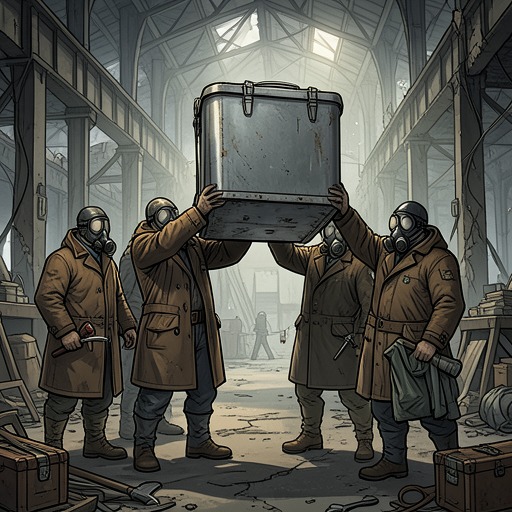
The cleanup belonged to a much larger military mobilization. One account estimates that 210 military units, amounting to about 340,000 personnel, were committed to dealing with the catastrophe’s fallout. The roof detail faced especially severe exposure: lead vests offered little protection against radiation coming from below, and the workers wore ordinary, cheap imitation-leather boots. Remote-controlled equipment could not reliably do the work. Machines might fail to obey commands or carry them out in reverse because radiation disrupted their electronics; one account describes the robots as dying at the reactor. Soldiers, by contrast, could still be ordered forward.
A six-month posting could begin with evacuation duties and end at the reactor. One soldier recalled that after five months of evacuating people, his unit was sent to the site. The men had already heard jokes and serious talk about being assigned to the roof in their last month, and about how long they might live afterward. Five years was the figure most often repeated. The expectation of danger did not stop the assignment; it became part of the way the soldiers spoke about it, quietly and without panic.
The work and its improvised machinery
The task was brutally compressed into short turns. In one description, soldiers spent about a minute and a half or two minutes on the roof each day. Another account says instructions allowed only forty or fifty seconds, a limit the actual work could not meet: men had to get to the debris, load or move it, run to the hole, and throw it down. One soldier remembered being shown the roof on a monitor, where pieces of graphite and melted bitumen marked the places to clear and the area where a hole had to be made. Workers were told not to look down, though some did.
The equipment made the labor heavier, not safer. A special wheelbarrow weighed forty kilograms before it was loaded. Even in the fast roof routine described by another witness, roughly twenty to thirty seconds went into filling a barrow and another thirty into throwing the debris off the roof. Lead vests, masks, and the burden of the barrow had to be managed at a speed that left little room to pause. A museum mold of graphite, shaped like a soldier’s cap, conveys the density involved: if real, the piece would weigh sixteen kilograms.
The nickname “green robots” made the soldiers’ function plain. Three thousand six hundred men worked on the roof of the ruined reactor. Unlike the malfunctioning machines, they could respond to the immediate demands of the task, but that reliability came from their bodies being exposed where the electronics failed. Soldiers slept on the ground in tents; they remembered throwing straw down to make bedding, straw taken from stacks near the reactor. The machinery’s failure did not remove the danger. It transferred the work, and its risk, to people.
Orders, volunteering, and rewards
The language of volunteering sits uneasily beside the chain of command. Before one unit went up, its commander announced that only volunteers would climb and that those who stepped aside would have a discussion with the military prosecutor. Some men protested that they had already gone and should have been sent home. They eventually agreed to go, with one soldier reasoning that an oath required obedience. He did not doubt that insubordination could bring a prison sentence of two or three years. The decision was framed as voluntary, but refusal carried an explicit threat.
Exposure figures were also shaped by institutional incentives. The testimony says that if a soldier received more than twenty-five roentgen, his superiors could be jailed for poisoning their men. The speaker’s conclusion was that nobody was recorded as exceeding that limit. Dosimeters did not dispel the contradiction between official accounting and the hazard as the men experienced it: on the roof, one soldier’s five-roentgen instrument immediately reached its maximum, as did a larger dosimeter rated to two hundred roentgen. Workers read newspaper assurances that the air around the reactor was clean and laughed at them.
The men who continued working could receive cash awards. One soldier who had already been on the roof that day volunteered to go again and received 500 rubles. Another kept making a hole in the roof after his fellow soldiers waved for him to come down; he did not stop until the opening was ready. He received 1,000 rubles, enough at the time to buy two motorcycles. He later became a first-group invalid. The account remembers their commitment and the respect it brought, while making the cost of continuing unmistakable.
The larger danger and the ethic of sacrifice
The roof work was part of an emergency in which the stakes extended beyond the workers and the reactor. In a separate account of the danger under the reactor, men were sought to open a safety valve so that water would not combine with uranium and graphite to form a critical mass. The feared explosion was estimated at three to five megatons, with the potential to render Kyiv, Minsk, and a large part of Europe uninhabitable. Volunteers were promised cars, apartments, a dacha, and continuing support for their families; the men who went received 7,000 rubles, while the promised material benefits were forgotten. The testimony insists that they did not dive for the material rewards. The episode places the roof crews’ sacrifice within a broader culture that could ask people to accept mortal danger in the name of preventing a still greater catastrophe.
That culture is not presented as a simple celebration. One speaker rejects the explanation that self-sacrifice reflects a low valuation of life or a fatalistic disposition, yet describes people raised to be soldiers and repeatedly mobilized to do what seemed impossible. The tension remains: the work could be understood as meaningful service, while the institutions directing it treated soldiers as replaceable labor. The failed robots and the men who took their place make that contradiction physical.
After the roof
The cleanup did not end when a soldier’s shift or deployment ended. One former worker recalled being made to sign a nondisclosure form and saying nothing afterward. He had become a second-group invalid immediately after army service, at twenty-two. His unit returned without being given clean clothes and continued wearing the same trousers and boots worn at the reactor until demobilization. He had carried buckets of graphite and helped pour the sarcophagus, the structure he described as a giant grave for Valery Khodemchuk, trapped beneath the ruins in the first minutes after the explosion.
Silence also shaped what came after service. The former soldier found that even at his factory job he could not make the experience intelligible to others. When his boss told him to stop being sick or face a cut in his work, he appealed to the director as a Chernobylite who had protected others; the director answered that the factory had not sent him there. His claim to recognition met institutional distance rather than acknowledgment. The account of the roof thus reaches beyond exposure itself, into a life in which the work was kept secret, illness impaired employment, and the meaning of service was contested.
A witness returning from the site recalled being warned that, in the interests of the State, it would be better not to tell people what the men had seen. They had not understood everything, he said, but they had seen it all. That divide between seeing and being permitted to speak completes the operation’s record: the soldiers were sent where machines could not function, ordered to work at the edge of what bodies could endure, and then discouraged from describing the conditions. “Green robots” names not only their role in the cleanup, but the process by which human beings could be made to stand in for failed technology and then disappear into silence.