Chernobylite identity
Voices from ChernobylChernobylite identity names the collective belonging that emerged among people displaced or marked by the Chernobyl disaster. It began as a label that made ordinary people seem dangerous and alien to others; in time, some survivors reclaimed it as the name of a community bound by shared memories, fear, and loss. The testimonies present this identity not as a simple replacement for nationality, but as a new social boundary created through evacuation and sustained by the reactions that followed.
From ordinary life to marked identity
Before the disaster, one witness describes a life of routine: work, a return home, an average salary, and an annual vacation. The sudden transformation into a Chernobyl person made that ordinary identity impossible to resume. Other people looked differently at those from the affected area and questioned them about the burning station, whether they had been afraid, and whether they could have children. In the witness’s account, they were treated like animals: objects of intense curiosity, yet people about whom others knew little. The place-name itself became a signal that made heads turn.
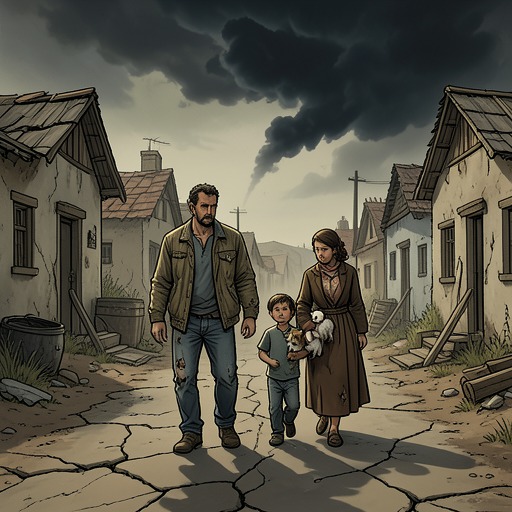
Displacement sharpened that break. Residents of Pripyat left on the third day, with the reactor burning, and lost not only their town but, as one testimony puts it, their whole lives. The evacuation was experienced amid radically mismatched explanations: the public account turned Chernobyl into a house of horrors, while the witness insists on telling only what was personally theirs. The family door, marked with the speaker’s growth from first grade through seventh, carried a different kind of truth. The speaker’s father had lain on it after death, following a family custom, and the door had become a family relic. Wanting to take it during evacuation shows how identity remained attached to the intimate objects and memories that official accounts and hurried departure could not carry for them.
Stigma in ordinary encounters
The new identity acquired force through small, concrete acts of avoidance. After reaching Minsk, one family had to pay triple the usual price for train seats. A conductor brought tea to the other passengers but asked the family for their cups; only afterward did they understand that she feared them because they were from Chernobyl. When the parents later returned to their apartment, they retrieved a warm blanket, a fall coat, and a collection of Chekhov’s letters. A stain on the blanket would not wash out or yield to vacuuming. At the dry-cleaner’s it was found to be radioactive, and the contaminated patch was cut away. The belongings remained recognizably the same, but the speaker could no longer sleep beneath the blanket or wear the coat, and felt hatred toward objects that might have killed them.
Fear also entered intimate relationships. One young woman, already formally engaged, worried that her Chernobyl family background would make marriage and childbearing unacceptable. Her fiancé’s mother asked whether she could have children; the question turned the possibility of love into a perceived moral danger. The speaker compared the situation to the survivors of Hiroshima, describing the Chernobyl Hibakusha as people who existed but were not discussed. Here, Chernobylite identity was not only a shared description: it was a mark that could reach into a couple’s future and make a survivor feel that even loving someone might be forbidden.
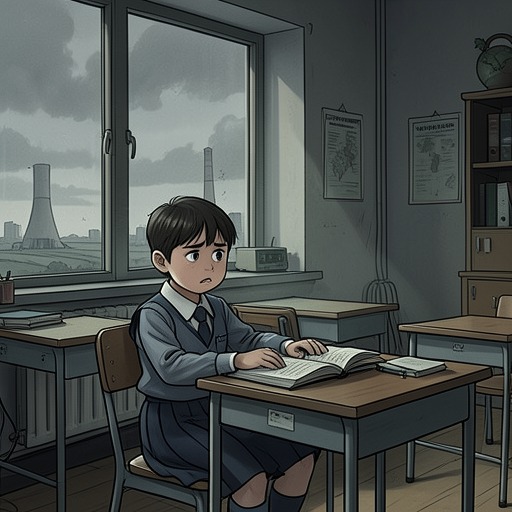
Children encountered the same stigma without the means to explain it. A family arriving in a village found one woman willing to give them a place to sleep, while her friend tried to pull her away because the newcomers were contaminated. After settling in Mogilev, the family’s fourth-grade son returned from school in tears. He was the only child from Chernobyl in his class; his classmates called him Shiny and feared sitting beside him because they believed he was radioactive. In another account, a girl at pioneer camp was called a Chernobyl rabbit and sent outside at night so the other children could check whether she glowed. Such episodes made the disaster’s invisible contamination into a social fantasy imposed on children’s bodies, and one testimony says the boy’s childhood ended too early.
A boundary that becomes a community
The testimonies also show survivors claiming the name that had separated them from others. One speaker says that people in the affected community often remain silent because they do not yet have words for an experience that is not ordinary and raises questions without ordinary answers. Yet the speaker identifies a dividing line: on one side are the Chernobylites, on the other everyone else. People who might otherwise have named themselves as Russian, Belarusian, or Ukrainian instead say they are from Chernobyl or call themselves Chernobylites, as if they belonged to a separate people, a new nation. The identity begins in shared exposure, but becomes a language for recognizing one another.
For one family, that recognition was a reason not to leave. The parents considered going elsewhere but were afraid to do so. Among other Chernobylites, they were not afraid of one another: if someone offered an apple or cucumber from a garden, they could accept and eat it rather than hide it and throw it away. Common memories and a common fate made daily trust possible. Outside that circle, they expected to be treated as foreign or leprous. The mother’s experience in the first days of evacuation showed that this rejection could come even from kin: when she fled with her daughter to her sister in Minsk, the sister refused to let them into the home because she had a baby she was breastfeeding, and mother and daughter slept at the train station.
Inherited fear and the meaning of Chernobyl
The shared identity carries apprehension into the next generation. One mother reports that her daughter, then in tenth grade, was already imagining whether she could love a child born with a disability. The mother describes young people as fearful not only for their children but for grandchildren who do not yet exist. She contrasts this with the war generation, which, in her view, had the confidence of people who had won a war and wanted to live, learn, and have children. After Chernobyl, people smile and sing less, she says; the returning forest and the altered national character accompany a broader feeling of doom. The disaster has changed both everyday life and thought.
Another testimony gives the identity a starkly paradoxical meaning. After the Soviet empire crumbled, the speaker says, the survivors found themselves alone; at the same time, Chernobyl had become the meaning of their lives and of their suffering. The world learned that they existed through the disaster, which the speaker calls both a source of victimhood and a window to Europe. This is not a claim that suffering has become welcome or uncomplicated. It describes how an imposed mark can become the central ground on which a community recognizes itself, even as fear, isolation, and uncertainty remain. Chernobylite identity is thus both the consequence of being treated as other and a collective name for people who know that they share a fate.