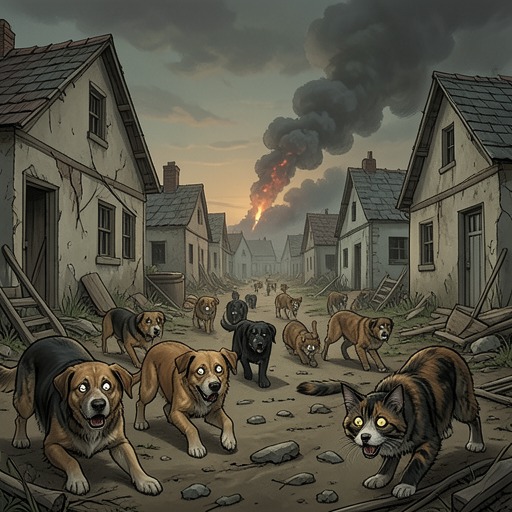
Culling of abandoned animals in the Chernobyl exclusion zone
Voices from ChernobylThe culling of abandoned animals in the Chernobyl exclusion zone turned the aftermath of evacuation into a second, deliberately administered violence. Officials ordered hunters to kill household animals left behind, citing the danger that radiation-contaminated animals might carry beyond the restricted area. In the hunters’ recollections, the operation’s procedures cannot contain its human cost: animals still waited for their owners, ran toward familiar voices, and looked at their killers.
Order and Preparation
A few months after the explosion, regional Party officials summoned Viktor Iosifovich Verzhikovskiy, chairman of the Khoyniki Society of Volunteer Hunters and Fishermen. The evacuated area, described as the Zone of Exclusion, still held dogs and cats. Officials said the animals had absorbed heavy doses of radiation in their fur and might wander out of the Zone; the hunters were ordered to exterminate them to prevent an epidemic.
Verzhikovskiy gathered the hunters, but they did not want to enter without protective equipment. Civil defense had no respirators to provide. He eventually obtained masks from a cement factory: thin film intended to protect against cement dust, not proper respirators. The contrast with the soldiers they encountered made the disparity plain. Soldiers had masks, gloves, and armored personnel carriers; the hunters wore shirts and covered their noses with handkerchiefs, then returned to their families in the same shirts and boots. The assignment had exposed them to danger without equipping them for it.
The Operation Across the Villages
Verzhikovskiy assembled two brigades of twenty men each. Every brigade included a veterinarian and a representative of the epidemic center, and the hunters had a tractor with a scoop and a dump truck for removing the animals. They were paid thirty rubles apiece, but the money did nothing to remedy the lack of protective equipment. For two months they traveled through the Chernobyl exclusion zone, crossing dozens of evacuated villages—half the villages in their region, including Babchin and Tulgovichi.
The dogs had remained beside the houses they once guarded. When the hunters first arrived, the animals ran toward their voices, apparently expecting people to return; the men shot them in houses, barns, and yards, dragged them into the street, and loaded them onto the truck. The dogs did not know why people were killing them, and they were unafraid of guns. During the evacuation, dogs had also run after buses, while soldiers pushed and kicked them away. The account makes the order’s blunt logic collide with the animals’ ordinary attachment to people and place: abandoned pets greeted the hunters as familiar human visitors, and were killed for doing so.
Killing and Burial
At Masaly, six kilometers from the reactor, one hunter remembered an iodine smell mixed with a sourness in the air. A dog lying with her puppies leapt toward him; he shot her, then had to shoot the puppies at close range as they licked their paws and played. The hunters filled a dump truck with animals, including a small black poodle whose memory still troubled the speaker. The work’s procedure—shoot, collect, transport—could not make the killing impersonal: the animals’ dependence and lack of fear brought them toward the people who had come to kill them.
The burial ground made the operation’s disregard for safety visible as well. Instructions called for a raised site, insulated with cellophane and chosen to keep contamination from reaching groundwater. In practice, the hunters dug a deep hole without cellophane and without taking time to find the proper location. Some animals were still alive when the truck was emptied. With no bullets left, the men pushed a wounded poodle back into the hole and buried it. The hunter recalled that moment alongside the dog’s attempt to climb out, an unfinished consequence of an operation meant to remove a hazard but carried out without the equipment or care its own rules required.
There were fewer cats than dogs, the hunters observed; they could only guess that cats had left after the people or found places to hide. One hunter concluded that it was easier to kill from far away, so that the animal’s eyes did not meet the shooter’s. The recollection turns the gaze into the operation’s measure of distance: not a technical distance from radiation, but the human distance needed to carry out the order.
The Lives the Order Could Not Contain
The hunters’ memories place the culling against an earlier intimacy with animals that the assignment could not erase. One recalled killing a fox as a child and later shooting a doe, then swearing never to kill another because of the animal’s expressive eyes. In the Zone, by contrast, the dogs ran toward human voices and met the hunters’ gaze; the administrative category of household pet could not make them behave like a removable hazard. Their trust was precisely what made them easy to kill, and what made the work difficult to remember as mere procedure.
Other testimony widens the frame beyond the animals the hunters were ordered to shoot. In an abandoned house, a cat had survived by eating geraniums; elsewhere, rabbits ran loose, and hunters released otters near water. A filmmaker who later showed children his films of Chernobyl animals recalled a boy asking why nobody had helped them, a question he could not answer. The proposed evacuation of animals raised a problem the order to exterminate them had settled by omission: how to account for life in the earth and sky as well as in houses and yards. In these recollections, the culling remains not only a response to radioactive danger but a record of how completely human emergency measures placed other lives outside the circle of rescue.