Foxes
Voices from ChernobylFoxes recur in Voices from Chernobyl as both survivors of human abandonment and targets of human action. They slip into gardens and deserted houses, live among domestic animals, and become part of hunting and animal-culling accounts; their presence exposes how the disaster rearranged the boundary between village and wilderness without removing human power over the animals left behind.
Encounters in Abandoned Villages
A resident describing life in an isolated village says that Wild boars and Foxes sometimes come into the garden, while people are rare and the police are the main human visitors. The detail makes the changed population of the village tangible: animal visits have taken the place of ordinary contact with neighbors. Foxes are not merely distant signs of wild nature; they enter the domestic space people still inhabit.
Another account describes a Fox believed to be rabid, seen in spring. The speaker says that such foxes become unusually tame and claims that placing a bucket of water in the yard will make one flee because it cannot look at water. The book presents this as the resident’s practical knowledge, not as an independently verified explanation. In a landscape where daily life is shaped by animals’ unpredictable appearances, folk observation becomes a way of interpreting danger and deciding how to respond.
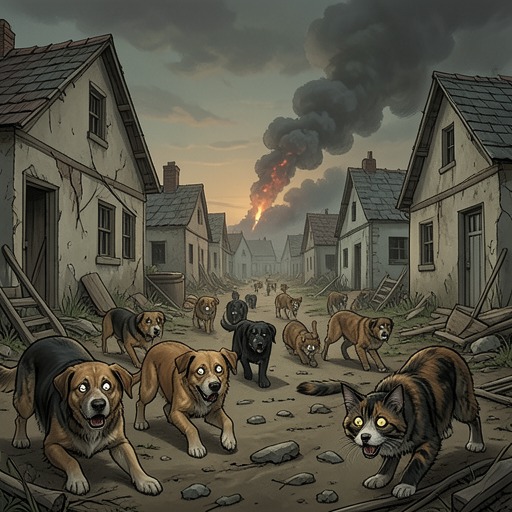
The animal’s presence is also bound up with the collapse of village life. In a hunter’s recollection of deserted settlements, Foxes were already living in the villages alongside Dogs and eating the remaining Chickens. As the chickens disappeared, Dogs began eating Cats. This sequence records a food chain reshaped by abandonment: domestic animals left behind, and wildlife moving into inhabited structures, became entangled in the same depleted environment.
Hunting and Human Uses
One hunter remembers killing a Fox as a child. In the same recollection, he describes killing a doe later and swearing not to kill another one because of the animal’s expressive eyes. The distinction matters: the stated vow follows the killing of the doe, not explicitly the Fox. Elsewhere, a hunter contrasts human claims to understanding with animals’ unreflective way of living, while describing the Fox as clever. The animal is thus presented through more than one human judgment—as prey, as an alert creature, and as a life whose behavior resists easy human interpretation.
In another account, a hunter says that two Foxes, along with two Rabbits and two wild goats, were shot for science. The animals were considered sick, but the group tenderized and ate them; the speaker says that initial fear gave way to familiarity and that people still had to eat. The episode joins observation to consumption rather than separating scientific interest from necessity. It also shows how exposure to danger could become normalized in practice, even when the hunters recognized the animals as sick.
The broader accounts of shooting in the abandoned villages describe a more coercive relationship with animals. A hunter characterizes the work as a military operation: people surrounded villages, and Dogs fled into the forest at the first shot. Foxes are described as already sharing the villages and feeding on chickens, but the specific shooting and burial details in this account concern Dogs and Cats. Keeping that distinction clear prevents the Fox from becoming an interchangeable figure for every animal killed in the zone.
Abandonment, Exposure, and Uncertainty
The book repeatedly sets animal life against the human systems meant to manage the disaster. A filmmaker recalls an abandoned house where a Cat had survived inside, eating the geraniums, and remembers notes left on doors about departing families and pets. That episode concerns a cat, not a Fox, but it clarifies the conditions in which Foxes appear elsewhere: homes emptied by evacuation, domestic routines broken, and animals left to find food or shelter without their former caretakers.
A separate account of contaminated food and agricultural work describes radiation measurements in villages, including radioactive milk and food sold in stores. Those observations do not establish the dose received by any particular Fox. The hunters’ description of sick game and their shooting of Foxes for scientific purposes provide the more direct evidence of animal illness, while the book leaves the individual animals’ exposure and fate largely unmeasured. The gap between a broad, measurable contamination and the uncertain condition of any one animal is part of the account’s larger record of what could not be fully known.
The Animals’ Place in the Record
A filmmaker says that an encounter with an old woman unwilling to leave her Cat, together with the sight of an apple tree without its usual smell, led him to make films only about animals. After showing the films to children, he is asked why no one could help the animals; he says he cannot answer. The question challenges a cultural habit of centering human suffering while leaving animals, plants, and other life outside the account of loss. Foxes’ appearances in gardens and villages make that exclusion harder to sustain: they are present in the same changed world, though the record often reaches them through human observation or a gun sight.
The filmmaker also recalls being told that someone proposed evacuating animals along with people in the first months after the accident. The proposal immediately raises practical limits: how could people relocate animals living underground, or those in the sky? Foxes are not individually identified as subjects of this plan, but as terrestrial animals they belong to the unresolved question of which lives could be moved, protected, or simply left behind. Their recurring presence therefore carries a double significance: they demonstrate the return of wildlife to emptied human spaces, while exposing how little the evacuation and rescue system could offer nonhuman life.