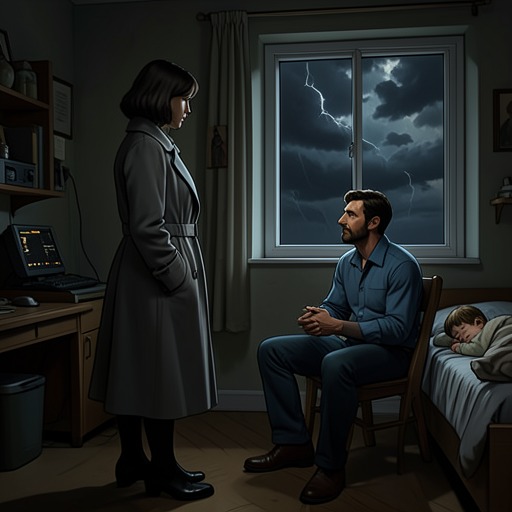
Hospital No. 6
Voices from ChernobylHospital No. 6 is the Moscow radiology hospital where firefighter Vasily Ignatenko and other men from his shift were treated after the Chernobyl disaster. In Lyudmilla Ignatenko’s testimony, the hospital is at once a controlled medical site and an intimate, improvised world: access depends on passes and pleading, while the severity of the men’s injuries draws their families into daily acts of care. The contamination eventually reaches beyond the patients themselves, into the walls and floor of the building.
Location and Restricted Access
The hospital was identified to Lyudmilla by a police officer in Moscow, who directed her to Hospital No. 6 at the Shchukinskaya stop. Although people had warned her that the firemen’s location was top secret, the officer gave her the address. The hospital was a special institution for radiology, and entry required a pass. Lyudmilla paid the woman at the door to get inside; once in, she still had to ask and beg before she reached the office of the head radiologist, Angelina Vasilyevna Guskova.
Guskova’s first question was whether Lyudmilla had children. Lyudmilla understood that her pregnancy could keep her from seeing her husband, so she concealed it; at six months pregnant, she was thin enough that it did not show. Other wives who came to the hospital were not allowed in. Lyudmilla’s ability to remain near Vasily therefore appears in her account as an exception, not an ordinary privilege of visiting relatives.
After three days staying with friends in Moscow, Lyudmilla was permitted to lodge in a dormitory for medical workers on the hospital grounds. The arrangement gave her a place to stay near the patients, but it was not a domestic space with the facilities she expected: there was no kitchen, and staff told her that the men could no longer digest food. Her early efforts to bring soup and juice were soon overtaken by the physical damage of radiation poisoning.
Isolation and Treatment
The day after the men were separated into individual rooms, they were forbidden to enter the hallway or speak to one another. They communicated by knocking on the walls in a dash-and-dot pattern. Staff explained that radiation affected each body differently, and measured the radiation in the walls around the patients. Sick people were moved from the floors above and below; in Lyudmilla’s recollection, the surrounding spaces were left empty. The hospital’s arrangement thus registered the danger as something extending beyond the men’s bodies into the building itself.
Vasily’s condition changed rapidly. Burns appeared inside his mouth, on his tongue and cheeks, first as small lesions and then in larger layers. Lyudmilla describes changes in the color of his face and body as she watched him become a different person from one day to the next. The hospital staff told her that the men could no longer digest food; Vasily could not swallow even a raw egg. The account gives the hospital a stark measure of time as well: it was for people with severe radiation poisoning, and Lyudmilla recalls being told that a person died within fourteen days.
As the illness progressed, Vasily was placed in a bio-chamber behind a transparent curtain. Medical instruments allowed staff to give injections and place a catheter without going through the curtain. Lyudmilla learned to undo its Velcro fastenings and went inside to remain beside him. When his condition became so severe that she could not leave him, she stayed on a small chair by the bed. She changed the thin sheet covering him; the sheets were bloodied by evening, and pieces of his skin adhered to her hands. She cut her nails until they bled so she would not accidentally wound him. Nurses who could not approach him called on her when something was needed.
Families, Care, and Loss
The hospital’s strict boundaries did not eliminate family involvement; instead, care was carried out through negotiated access and improvised help. Lyudmilla’s friends supplied cooking utensils and provisions while she tried to prepare food for six firefighters from Vasily’s shift. A janitor offered her counsel about illnesses that could not be cured. Later, when Lyudmilla was staying in the hospital dormitory, her own clothes and belongings tested as radioactive on a dosimeter and were taken away. She received an oversized hospital robe and slippers, and continued visiting Vasily in them. Because she could not go to the market dressed that way, other people brought her vegetables; someone lent her a pot and another person a cutting board.
The hospital was also the setting for an attempt to save Vasily through a bone-marrow operation. Guskova remained important to Lyudmilla, who said she would be grateful to her for the rest of her life. An American professor, Dr. Gale, performed the operation and offered a small measure of hope. Vasily’s younger sister, Natasha Ignatenko, was judged the best match, but Vasily resisted the idea of exposing his younger sister to the procedure. His older sister offered to undergo it. Lyudmilla watched the operation through a large window; afterward the sister had eighteen punctures in her chest and struggled to recover from the anesthesia. The family’s ordeal extended beyond Vasily’s room: Lyudmilla ran between the two patients, while Vasily was confined behind the chamber curtain.
Other patients from the firefighters’ shift were also treated in bio-chambers. Orderlies refused to care for them without protective clothing, so soldiers carried sanitary vessels, cleaned floors, and changed bedding. Lyudmilla heard news of the men’s deaths one by one, including Vladimir Pravik and Viktor Kibenok, friends of Vasily whose families had also been close. The hospital brought the men into separate rooms, but their deaths accumulated in the same testimony, like repeated blows.
Contamination and the Hospital’s Aftermath
The building itself became part of the aftermath. A nurse told Lyudmilla that Vasily had received 1,600 roentgen, while 400 was a lethal dose, and described her as sitting beside a nuclear reactor. After the patients died, the hospital underwent renovation: workers scraped down the walls and dug up the parquet. These measures give concrete form to the account’s earlier description of radiation being measured not only in patients but in the walls, floors, and neighboring rooms.
Lyudmilla also recalled that Vasily was photographed naked while she was away from his room. The explanation given was that the images were for science; she experienced the photography as an invasion of what she regarded as intimate and wholly personal. Her testimony places scientific observation alongside the hospital’s clinical procedures, but does not treat them as emotionally equivalent: injections and treatment were part of the effort to care for him, whereas the photographs became a source of anger and helplessness.
Narrative Significance
Hospital No. 6 is remembered through the details that formal medical description cannot contain: a pass at the entrance, a borrowed pot, knocks through a wall, a transparent curtain, and blood on a sheet. Those objects and routines show how the hospital’s clinical order met a crisis in which ordinary visiting, feeding, and nursing no longer worked as expected. Lyudmilla’s presence does not undo the separation imposed on the patients; it makes visible the labor required to cross it.
The hospital also concentrates the testimony’s changing scale of danger. Radiation is first encountered as a diagnosis and a bodily injury, then as a hazard measured in rooms and on personal belongings, and finally as contamination that requires the stripping of walls and floors. Its significance in the account lies not simply in being where Vasily died, but in how it gathers treatment, family devotion, scientific scrutiny, and the material cleanup of a contaminated space into one setting.