Kaluigin home
Voices from ChernobylNikolai Fomich Kalugin’s family door carries a life that evacuation could not make him leave behind. Its surface records his and his children’s growth; it had served as the place where his father lay before burial, and later became the bier for his young daughter. Kalugin’s effort to recover it from an emptied, looted apartment turns an ordinary part of a home into a family relic and, finally, a witness to the death he attributes to Chernobyl.
A Household Record
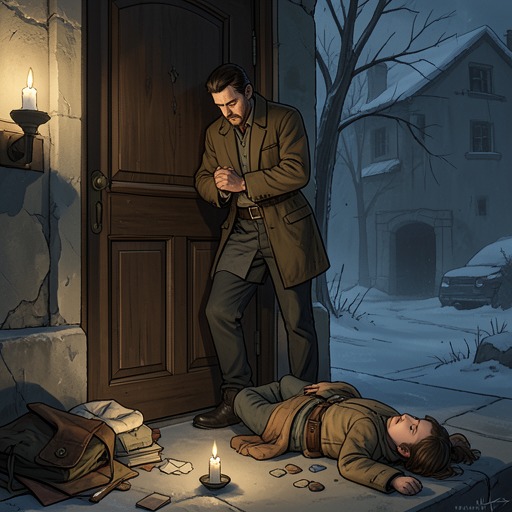
The door is not precious because of its material or use alone. Kalugin describes it as a talisman and family relic: his mother had told him that the deceased should be laid on the door of their home while the coffin was brought. His father had lain there, and Kalugin had sat beside him through the night while the house remained open. The door thus held a place in the family’s practice of mourning before it became the object of a later act of forced departure.
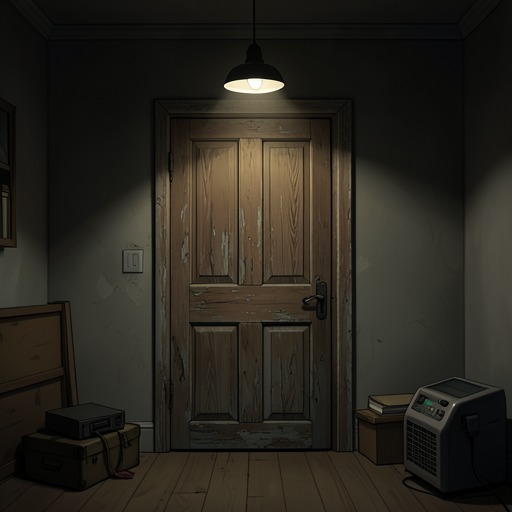
Its small etch-marks preserve another kind of passage through time. Kalugin’s height is marked from first grade through seventh grade, and beside those marks are the records of his son and daughter growing up. The door contains, in his words, his whole life: not an abstract memory of home but a surface on which childhood and parenthood have accumulated in visible traces. Leaving it behind would mean abandoning a family record along with the apartment.
Evacuation and Retrieval
When authorities announced over the radio that people could not take their cats, Kalugin’s family tried to put their cat in a suitcase. She climbed out and scratched at everyone. He contrasts that failed attempt to take a living companion with his insistence on taking one belonging: the door. Rather than remove all his possessions, he would take this single object and cover the apartment entrance with boards.
Kalugin first asked a neighbor who had a car for help. The neighbor gestured toward his head, implying that Kalugin was not thinking clearly. The door was not recovered then. Two years later, after the apartment had already been looted and emptied, Kalugin took it at night on a motorcycle, through the woods. Police pursued him and threatened to shoot, mistaking him for a thief. The episode reverses the ordinary meaning of possession: he was trying to retrieve the door from his own home, yet the act made him look like someone stealing from it. The object’s value was legible to him through its family history, not to the authorities through its ownership.
The Door at His Daughter’s Death
The door’s association with death returned when Kalugin’s daughter became ill. He took his wife and daughter to the hospital after black spots appeared on their bodies, each about the size of a five-kopeck coin. The spots came and went; tests were performed, but when Kalugin asked for the results, he was told they were not for him. His account places the family’s fear alongside this refusal of information, without offering a medical explanation for the spots.
His daughter was six. Kalugin recalls putting her to bed as she whispered that she wanted to live because she was still little. Later, when she died, the family laid her on the same door on which his father had lain, and kept her there until a small coffin arrived. The coffin was so small that he compared it to a box for a large doll. The familiar object links two deaths across generations, but the repetition does not make the second loss bearable: the door that had carried the memory of a child growing up now held her after her death.
A Material Witness
Kalugin’s account makes the door an alternative to the public transformation of Chernobyl into a spectacle. He says he wants to tell only what is truly his, and describes how people began to regard those from the disaster area as strange, asking them what they had seen and whether they could have children. Against that distant curiosity, the door retains marks, family customs, and specific acts of care that cannot be reduced to an image of a ruined town.
At the end of the account, Kalugin states that his daughter died from Chernobyl and that people want them to forget. The door gives that testimony a physical history: his father’s body, the children’s growth marks, its recovery from the emptied apartment, and his daughter’s small body before burial. It does not establish a medical finding about her death; it carries Kalugin’s witness to it. In the monologue, preserving the door and recounting its use become inseparable from refusing erasure.