Leukemia
Voices from ChernobylLeukemia appears in Voices from Chernobyl not as an abstract diagnosis but as a disruption that enters the home, the classroom, and the future a family had imagined. A twelve-year-old calls himself an invalid and says doctors attributed his blood cancer to his father’s work at Chernobyl; elsewhere, a pediatrician describes her husband’s leukemia after he was sent to work in the contaminated area. Their accounts make illness both bodily and social: families organize themselves around care and uncertainty, while institutions dispute or withhold the explanations they seek.
Diagnosis and Attribution
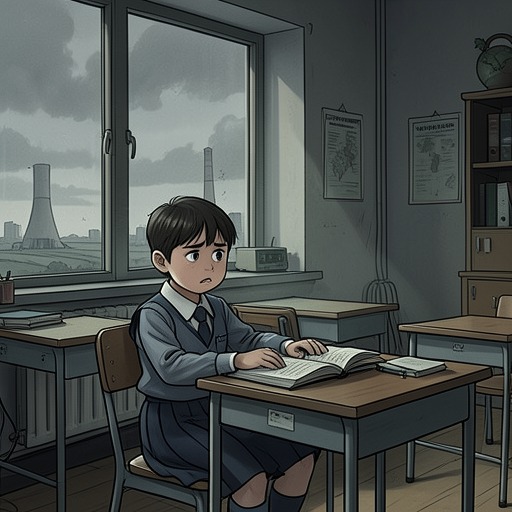
The testimonies give leukemia more than one setting. In one, a twelve-year-old receives pension checks alongside his grandfather and has cancer of the blood. His classmates become afraid to sit beside him or touch him. The doctors connect his illness to his father’s work at Chernobyl before the child was born. He responds by affirming his love for his father, while remembering that his father was taken away at night and that the family waited for him as if he were at war. Diagnosis thus names the child’s condition but does not settle what responsibility means inside the family.
A pediatrician recounts a different history: doctors warned her that her husband would die of leukemia. He had been sent from his factory to work on a collective farm in the fifteen-kilometer zone, where workers raked straw, collected beets, and dug potatoes. Two months after he returned, he collapsed while spackling a wall with his father. The family called an ambulance, and in hospital he was described as having received a fatal dose of leukocytes. The account places a clinical warning, a work assignment, and a sudden collapse in the same sequence, without turning that sequence into a general medical explanation for every case.
Illness Inside the Family
The husband returned convinced that he was dying. His wife tried to persuade him otherwise and describes giving birth to a daughter in the hope that he would believe life remained possible. She recalls imagining that, had she known he would become ill, she would have shut every door and locked him in. The image turns care into an impossible counterfactual: the danger had already crossed the threshold before she understood what she might have needed to keep out.
The couple continued to seek ordinary life even as his condition worsened. She learned to feed him through a tube, preparing fresh food four times a day, grinding it in a meat grinder, and pushing it through a needle into the tube leading to his stomach. He had lost his sense of smell and could not tell her how the food tasted. They still went to the movies and kissed there, trying to resume a life together while keeping Chernobyl out of their conversations. She intercepted telephone calls because his friends were dying one by one, and the subject had become forbidden at home.
After he could no longer rise or speak, their remaining year became, in her account, a year of dying. His body changed: after his lymph nodes were removed and his circulation was disrupted, his nose enlarged and shifted, his eyes changed direction, and one eventually closed. When he could no longer whisper, they communicated with a notebook, pen, and pencil. He repeatedly wrote that he wanted a mirror. For two days she evaded the request; on the third, faced with the words written in large letters and marked with exclamation points, she still ran to the kitchen and made noise with the pots and pans rather than answer him. The scene makes the disease’s physical changes inseparable from the strain of witnessing them together.
Childhood, Stigma, and a Future Interrupted
The twelve-year-old’s account shows how a diagnosis travels beyond the patient. His classmates’ fear turns his illness into a reason for physical avoidance, while his father’s work becomes part of the explanation the doctors give him. His love for his father does not erase the connection he has been told about; instead, the testimony holds affection and the consequences of exposure in the same family history.
The pediatrician’s observations extend the account of childhood illness without identifying every sick child as a leukemia patient. She says children often do not understand cancer as a sign of approaching death, even though they know their diagnoses, medicines, and procedures in detail. When children die, she sees surprise on their faces. In the hospitals, little girls play with dolls, close their eyes, and make the dolls die. The contrast between precise medical knowledge and a child’s incomplete understanding gives the diagnosis a lived texture that a clinical label alone cannot convey.
The family’s life after the husband’s decline also remains organized around illness and care. The woman describes another son as having grown up while seeing the world with the understanding of a five-year-old; he lives in a mental hospital, where she visits on weekends, and asks when his father will come. She hopes to exchange her apartment for one nearer Novinki Mental Hospital. The testimony does not identify this son’s condition as leukemia, but it shows how the household’s future remains shaped by sickness, separation, and the work of continuing to be present for a child.
Records, Uncertainty, and the Limits of the Label
Across the book’s testimonies, a reported link between radiation and illness does not automatically become an accepted medical or administrative explanation. One mother spends four years pressing doctors and officials for a document connecting her daughter’s severe congenital conditions with small doses of ionized radiation. Doctors initially classify the condition as a congenital handicap and say that science lacks the information to make such connections; eventually she obtains a paper confirming the link. This is not a leukemia case, but it clarifies the larger conflict surrounding attribution: families seek an account of what happened, while official categories and evidentiary standards can delay recognition.
The same tension appears in accounts of exposure and documentation. A former soldier says his unit was made to sign a nondisclosure form; he reports carrying buckets of graphite from the reactor with ordinary shovels, changing masks repeatedly, and later becoming a second-group invalid at twenty-two. He says he had no document showing what dose he received. His testimony does not name leukemia as his diagnosis, but it shows why illness could be difficult to connect to an exposure history when records were classified or unavailable. Separately, a speaker describes checking children in villages whose measured levels reached fifteen hundred, two thousand, or three thousand micro-roentgen and reports genetic mutations among girls; that account, too, concerns radiation harm rather than a stated leukemia diagnosis.
The book also sets blood cancer within a wider record of radiation illness without collapsing distinct conditions into one. Another spouse describes severe radiation poisoning, rapidly changing burns, and a hospital where patients with serious poisoning were expected to die within fourteen days. That account is not identified as leukemia. Its place beside the leukemia testimonies underscores the range of bodily suffering represented in the book, while the differing diagnoses remain distinct. Leukemia’s significance lies in this double pressure: it names an illness, but the testimony keeps asking what can be known about its cause, who will recognize that cause, and how a family is to live while those answers remain unsettled.