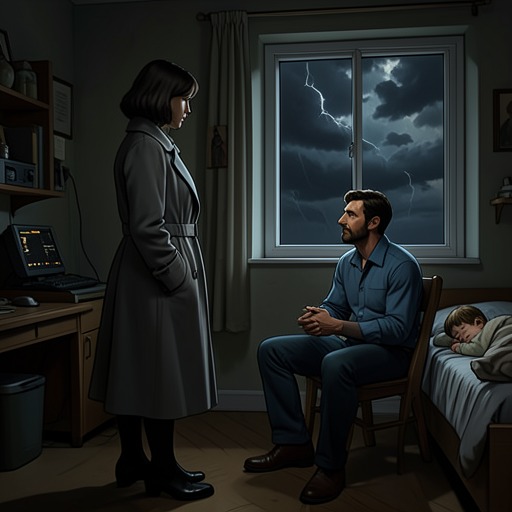
Lyudmilla Ignatenko
Voices from ChernobylLyudmilla Ignatenko was the newly married wife of firefighter Vasily Ignatenko and was six months pregnant when he was sent to the fire at the reactor. Her account follows the movement from ordinary married life to a hospital vigil, where she cared for Vasily through catastrophic radiation injuries, and then to a double bereavement: his death and the loss of their unborn daughter. Recounted through broken memories, silences, and repeated acts of care, her testimony makes intimate love inseparable from the physical consequences of the disaster.
Identity and Married Life
Lyudmilla and Vasily lived in the dormitory of the fire station where he worked. Their rooms were on the second floor; three other young couples shared the kitchen, and the fire engines were kept below. They were so newly married that they still held hands on trips as ordinary as going to the store. Lyudmilla says she told him she loved him without yet understanding how much that love would demand of her. She was accustomed to knowing where he was and what he was doing, a familiarity that made his sudden absence all the more terrifying.
Vasily had chosen firefighting deliberately. After being drafted into the army, he served in a fire brigade in Moscow, and afterward wanted to be a fireman and nothing else. His parents had hoped he would remain in the countryside and had even built him a new house. He loved the work of sowing and plowing, and the couple expected to visit his parents in Sperizhye to plant potatoes on the morning after the fire. The trip, about forty kilometers from Pripyat, belonged to the future they still assumed they had.
The Fire and the Hospital
During the night, Lyudmilla heard a noise and looked out the window. Vasily told her there was a fire at the reactor and that he would return soon. She did not see the explosion itself; she saw flames, a bright sky, smoke, and felt the heat. As the hours passed, the promised return gave way to waiting. At seven in the morning she learned that Vasily was in the hospital and ran there, only to find police surrounding it and barring visitors. The officers warned that the ambulances were radioactive. Other wives whose husbands had gone to the reactor that night had gathered outside as well.
Lyudmilla found a friend who worked as a doctor at the hospital and held on to her white coat, pleading to be admitted. The doctor warned that Vasily and the others were gravely ill, but eventually let Lyudmilla see him briefly. His body was swollen so severely that his eyes were barely visible. The doctors urged the wives to bring milk, saying the men should drink several liters, although Vasily disliked it. At the time, the families did not know that doctors, nurses, and orderlies at the hospital would themselves become ill and die.
Care in the Bio-Chamber
As Vasily’s condition worsened, Lyudmilla stayed close even after he was moved to a special bio-chamber. His sister Natasha Ignatenko was brought from Belarus and proved to be the best match for a bone-marrow operation. Vasily refused at first because he did not want his younger sister harmed. His older sister agreed to undergo the procedure, and Lyudmilla watched the operation through a large window. The sister suffered greatly afterward and later became an invalid. Lyudmilla moved between the sisters’ rooms and Vasily’s chamber, where a transparent curtain separated him from visitors.
She learned how to open the curtain and went in despite the restrictions. Vasily called for her repeatedly, and she could not bear to leave him. The hospital’s instruments allowed staff to give injections and place a catheter without entering the chamber. In other chambers, soldiers took over basic care after orderlies refused to work without protective clothing. Lyudmilla heard that men who had been at the reactor were dying one after another; the repeated reports became a blow she could not escape.
She also describes the daily physical work of caring for Vasily. His skin came away onto her hands, and the sheet she changed each day was covered in blood by evening. Even small folds or knots in the bedding could wound him, so she smoothed it carefully and clipped her nails until they bled to avoid cutting him. Nurses called on her when they needed to approach him. While she was away, staff photographed his naked body for scientific purposes. She experienced this as an invasion of the intimacy she was trying to protect, even as the hospital treated his body as an object of study.
Lyudmilla did not tell the doctors she was pregnant, and she continued to stay in the chamber at night with the nurses’ permission. They warned her that Vasily’s body was dangerously radioactive and that she would be harmed by remaining beside him. She persisted. In the mornings, before doctors made their rounds, nurses hurried her out; she would return on her visitor’s pass from nine in the morning until nine at night. Her legs became blue and swollen from exhaustion. At six months pregnant, she believed the child inside her was protected and says she could not even feel the small movement beneath her heart.
Death and Burial
A doctor told Lyudmilla that Vasily had received 1,600 roentgen, while 400 was a lethal dose. After the patients died, the hospital scraped down its walls and dug up the parquet. In the final days, Vasily’s body was profoundly damaged. Lyudmilla helped him when his lungs and liver were coming through his mouth, and she remembered the effort to keep him comfortable even as his body failed.
On the night before his death, she left the chamber for a short walk and went back to the dormitory, where she lay on the floor. A cleaner soon urged her to return because Vasily was calling for her. That morning, she accompanied another wife to the cemetery for the burial of firefighters Viktor Kibenok and Vladimir Pravik, friends of Vasily and of their family. Lyudmilla remembered a photograph of the couples taken in their building the day before the explosion: their husbands looked handsome and happy, and she later understood it as an image of the last day of their former life.
When she returned from the cemetery, a nurse told her Vasily had died fifteen minutes earlier. She had been away for three hours. She ran back to the bio-chamber; his last words had been calls for her, and the nurse had told him she would be back. Lyudmilla stayed with him afterward and accompanied him to the grave. At the morgue, his service clothes had to be cut because his body was swollen and wounded, and no shoes would fit. He was buried barefoot. His body was placed in a transparent plastic bag, then a wooden coffin that was itself enclosed in another bag, and finally a zinc coffin. Even his service cap barely fit.
Their Daughter and the Aftermath
The child Lyudmilla carried did not survive. After the baby was cremated, Lyudmilla asked that the ashes be placed at Vasily’s feet. At the cemetery, the grave bears only his name: the little girl had not yet been named. Lyudmilla says she visits with two bouquets, one for Vasily and one for the corner where her daughter lies, and that she crawls around the grave on her knees. She blames herself, while also describing her belief that the baby absorbed the radioactive shock and saved her. The account presents this as the bereaved mother’s anguish and interpretation, not as a medical finding; she insists that she loved both of them and cannot reconcile love with death.
Lyudmilla later received an apartment in Kyiv, in a large building where people from the atomic station were housed. It was the kind of two-room apartment she and Vasily had wanted, but she says she was going mad in it. She connects her private loss to the larger group of station workers and families living on Chernobylskaya Street. Many remained tied to work at the station despite serious illness and disability, and some died suddenly. She observes that no one seemed to ask what they had endured or what they had seen.
Testimony and Narrative Role
Lyudmilla’s recollection is organized less as a continuous report than as a return to moments she cannot put in order: hours of waiting, the daily sheet, the calls from the bio-chamber, and the plastic bag at the graveside. She says she could not speak about the hospital operation for ten years, and elsewhere describes the final memories as broken flashes. Her pauses and repetitions register the difficulty of telling, while the concrete details of nursing and burial make the disaster legible at the scale of one family.
Her testimony also complicates any clean separation between private devotion and public catastrophe. The hospital’s warning about radiation, the scientific photographs, the soldiers caring for patients, the sealed burial, and the erased hospital surfaces all enter the account through the experience of a wife trying to remain beside her husband. Lyudmilla’s story is therefore not only a record of Vasily’s death: it preserves the labor of care, the loss of their daughter, and the unanswered need of survivors to have their experience heard.