Nikolai Fomich Kalugin
Voices from ChernobylNikolai Fomich Kalugin is a re-settler and father whose testimony turns an ordinary household door into a record of family life, displacement, and death. He describes taking the door from his looted home and later laying his daughter on it while they waited for a coffin. His account culminates in an explicit act of witness: he says that his daughter died from Chernobyl, and that people want the family to forget.
Identity and Setting
Kalugin’s testimony appears in the section devoted to monologues by people who returned, and he is identified as a father. The account is attributed to Bely Bereg, in the Gomel Region. These brief identifiers place his family’s loss within the experience of people returning to an affected place, without supplying a fuller biography or naming his wife and children.
His account moves between the family’s life before displacement and its aftermath. He recalls the years before his military service and the growth of his son and daughter as part of what the door preserves. The family’s history is not presented as an abstract recollection: it is attached to an object that belonged to their home, carried their memories, and became part of the circumstances surrounding his daughter’s death.
The Door as Family Record
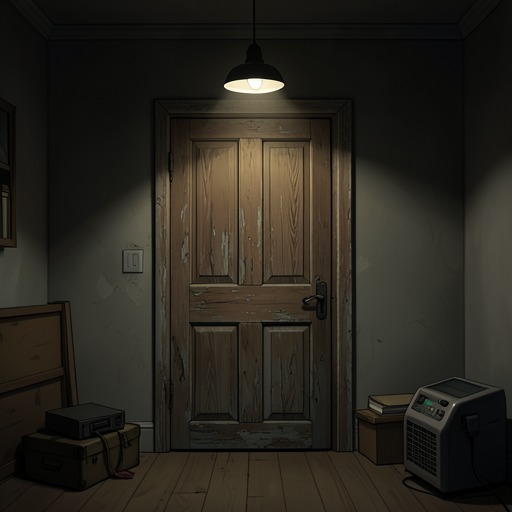
Kalugin explains that his whole life was written on the door. It held the remembered sequence of his life before the army and his children growing up. Leaving it behind would therefore mean abandoning more than a piece of furniture: he understood it as leaving behind a material record of his family.
When he asked a neighbor with a car for help, the neighbor gestured toward his head, as if questioning his judgment. Kalugin took the door anyway. Two years later, after their apartment had been looted and emptied, he carried it away at night on a motorcycle, traveling through the woods. Police chased him and shouted, “We’ll shoot! We’ll shoot!” They mistook him for a thief. The episode reverses the apparent meaning of the act: Kalugin was taking the door from his own home, yet had to retrieve his own family’s object as if stealing it.
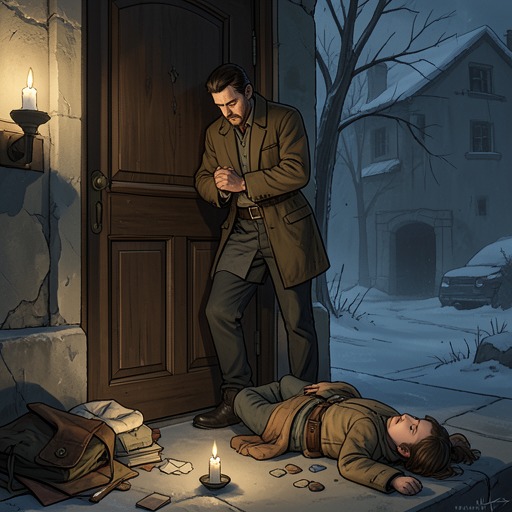
The door’s significance changes again in the account of his daughter’s death. Kalugin says that the family put her on the same door on which his father had lain, until a small coffin arrived. The object thus connects generations within the family, but the association is not a comforting symbol: it carries the weight of successive bodies and makes the daughter’s death inseparable from the household’s physical past.
Illness and the Limits of Explanation
Kalugin recounts taking his wife and daughter to the hospital after black spots appeared across their bodies. The spots, about the size of a five-kopeck coin, came and went, and he says they did not hurt. Medical tests were performed, but when he asked for the results, he was told they were not for him. His response—asking who they were for, if not him—expresses a father’s exclusion from information about his own family’s health. The testimony reports symptoms and withheld results; it does not provide a diagnosis from the hospital.
Fear also entered the home through predictions about the future. Kalugin remembers people saying that they would die and that no Belarusians would remain by the year 2000. His daughter was six. As he put her to bed, she whispered, “Daddy, I want to live, I’m still little.” He had thought she understood nothing; her words revealed that she had absorbed the surrounding fear. The scene makes the threat intimate and specific: it is no longer only a public prediction, but a child’s plea spoken at bedtime.
At the hospital, Kalugin recalls seven little girls, all shaved bald, in one room. His wife returned home unable to bear what she had seen. She said that it would be better for their daughter to die than to suffer, or for her herself to die rather than continue watching. Kalugin’s recollection breaks off in protest. He says that describing the scene as though he were a stranger feels like betraying the people involved, and repeatedly insists that he cannot go on. The interruption records a limit within the testimony itself: the events are being recounted, but not made emotionally distant or fully manageable by narration.
Death and the Work of Witness
Kalugin says plainly that his daughter died from Chernobyl. The statement is his testimony about the cause of her death; the hospital’s refusal to share the test results leaves the medical explanation unresolved within the account. He places that assertion beside the small coffin and the makeshift bier, giving the claim a domestic and bodily setting rather than leaving it as a general accusation.
The monologue is framed by his wish to bear witness and his insistence that the past is present again. He says the events happened ten years earlier and happen to him again every day. In that recurrence, telling is neither detached reporting nor a completed act of remembrance. The door, the daughter’s words, the hospital room, and the coffin return together as details that cannot be separated from the family’s continuing grief.
His testimony also confronts the demand to forget. Kalugin says that people want the family to forget his daughter’s death, while his narration names it and assigns it to Chernobyl. The door’s journey from family record to contested possession and then to a place on which his daughter lay gives that witness a physical form. It preserves not only a life remembered in the household, but the intimate cost that Kalugin refuses to let disappear.