Pripyat
Voices from ChernobylPripyat is remembered as a lived-in town at the edge of the Chernobyl Nuclear Power Station, where domestic routines and youthful curiosity continued even as the reactor burned. In the testimonies, its decisive transformation is not only the evacuation: the town’s inhabitants lose a home they expected to return to, and carry its radioactive aftermath into new places, relationships, and memories.
A town beside the station
Pripyat was home in the plainest, most intimate sense. One family lived in a large prefabricated apartment building on the fifth floor, its windows facing the station; another young couple shared a fire-station dormitory kitchen with three other couples, above the garage where the red trucks were kept. The fire station tied the town’s domestic life directly to the emergency: the newly married Lyudmilla Ignatenko knew where her husband, Vasily Ignatenko, was and what he was doing because the firehouse was part of their everyday world. Their ordinary habit of holding hands on trips to the store makes the coming separation legible as a rupture in a shared life, not an abstract historical event.
The town’s pre-disaster landscape also included familiar public and private routines: children rode bicycles, people fished in the river, neighbors sat on balconies, and families tended gardens and stored belongings. Residents could see the station from home, but proximity had not taught them what its danger meant. In one recollection, a neighbor watched the fire through binoculars while children raced toward it on bicycles. No parent or teacher stopped them. The town’s closeness to the reactor made the catastrophe visible without making it understandable.
Fire in the familiar landscape
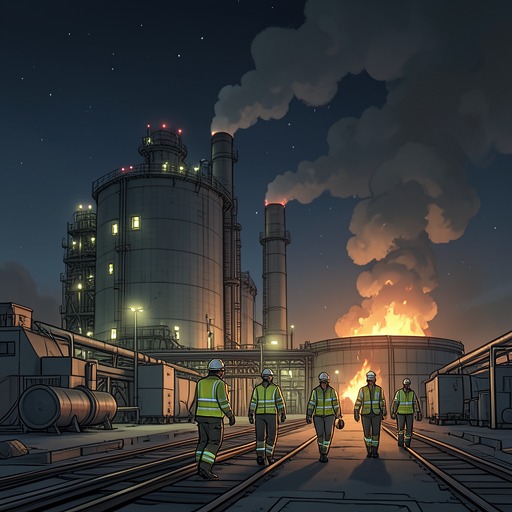
On the night of the accident, a fireman saw his wife at the window and told her to close it and return to sleep, saying there was a fire at the reactor and he would be back soon. She did not see the explosion itself. What she saw was a tall flame, smoke, and a radiant sky; she remembered the heat and the fact that he did not return. Elsewhere, a young resident recalled the smoke as blue rather than black or yellow. People at the river came back deeply blackened, an alarming change that was still interpreted through ordinary comparisons rather than a settled understanding of radiation.
The town’s first response was shaped by familiar assumptions. The fire seemed to be an ordinary blaze being fought by ordinary firemen, and some boys joked about who would die first. A speaker recalled that people were accustomed to military danger and explosions, but this was not the kind of war described in books. The contrast between the visible emergency and its invisible reach left residents without a usable measure of risk. They watched, speculated, and continued familiar routines while the danger was already present in the air and landscape.
Evacuation and the severing of home
As evacuation preparations began, the town became a scene of opposing movements: hundreds of buses stood ready on one side of a street, while fire trucks from across the region occupied the other. White foam covered the roadway. The radio told residents that the departure might last three to five days and advised them to take warm clothing for a stay in the forest. Some treated the announcement as a temporary excursion, packing guitars, radios, and food for an imagined break from routine; the wives of the firemen who had been at the reactor understood the departure differently and cried.
Another family remembers the evacuation as a hurried, partial departure. Residents were told they could not take cats or other belongings. One woman put her cat in a suitcase, but it climbed out and scratched people; she also wanted to take the apartment door, a family talisman marked with the years of her childhood. The door held a particular history: her father had lain on it after his death while the family waited for a coffin. Leaving it behind meant abandoning an object that joined the family’s present home to its earlier losses. Even belongings that did travel could not restore the household: one father ran back for two new shirts and returned with them still on their hangers.
The bus journey out did not look like the wartime departure residents had imagined. The sky remained blue; people carried Easter cakes and colored eggs. Livestock slowed the buses as cows and horses were driven along the roads, and drivers and shepherds argued over dust, animals, and the crops that would be trampled if the herds left the road. The evacuation was real, but its finality was not yet clear to those leaving. One account says the family departed on the third day and did not understand that they would never come back to their town.
Displacement beyond the town
Leaving Pripyat did not end exposure to the disaster. After the train journey to Minsk, one family found that their origin changed how strangers treated them: a conductor who served tea to others asked them for their cups after learning they came from Chernobyl. When the family retrieved belongings from their apartment a month later, a mark on a blanket continued to register radiation after washing and cleaning. The dry cleaners cut out the glowing spot, but the blanket was no longer usable to the speaker, nor was the coat that had come back with it. These objects remained materially recognizable and emotionally altered: the same possessions, now associated with a danger that could not be seen.
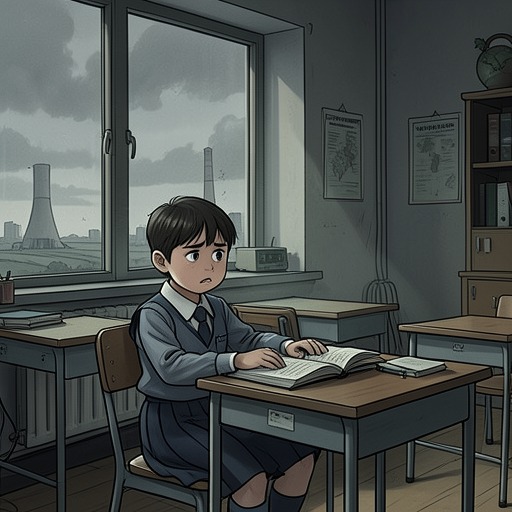
Other accounts describe the stigma extending into new homes. After settling in Mogilev, a boy from Pripyat returned from his first day of school in tears: a classmate did not want to sit beside him because he was radioactive. He was the only child from the town in his class, and the other children called him Shiny. For his mother, this experience confirmed an identity formed through separation, a sense that the displaced had become a distinct people. The name attached to their former home followed them into schoolrooms and ordinary social encounters.
Even burial and mourning were reshaped by the town’s geography. A family’s grandmother was buried in her old village inside the restricted area, where barbed wire and armed soldiers controlled access. Children were not allowed through. At the cemetery, a dosimeter registered the grass and flowers, and food laid out for the wake had to be thrown away. The bereaved family could bury the grandmother in her old village, but a child could not visit her there again. The surrounding landscape remained home, yet its paths and customs had become subject to barriers and measurement.
A remembered and vanished Pripyat
The loss of Pripyat is described as more than the loss of buildings. One former resident says that the town is no longer there and that what remains is not their town; leaving meant losing an entire life. Memories return with specific, ordinary details: blue sky, a garden, roses, a balcony, the route past familiar houses. Nadezhda Petrovna Vygovskaya recalls dreaming that she rides through sunny Pripyat with her son, looking at the large rose bushes. In the dream she is young and he is little, and the fears have fallen away. The dream restores a shared passage through the town without undoing its disappearance.
The testimonies resist turning Pripyat into a spectacle detached from its inhabitants. A former resident objects to the way accounts of Chernobyl turned the town into a house of horrors or a cartoon, and insists on telling what was personally experienced. That insistence gives the place its double character: Pripyat is the site of an industrial catastrophe, but also the setting of childhood marks on a door, a family’s garden, crowded apartments, and daily journeys. Its disappearance remains inseparable from the lives that had made it a town, and from the continuing estrangement of those who were forced to leave.