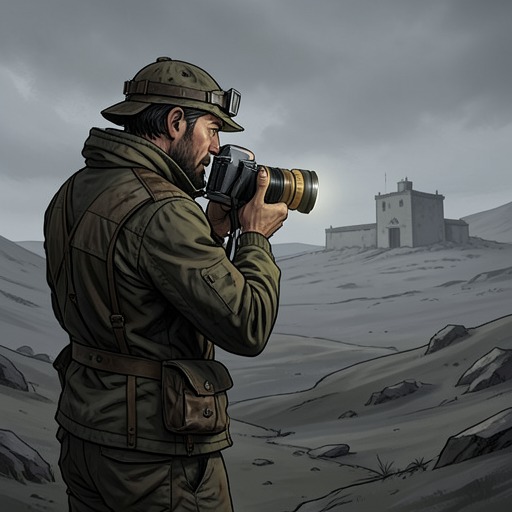
Proposal to evacuate animals from the contaminated zone
Voices from ChernobylThe proposal to evacuate animals from the contaminated zone turns a logistical question into a test of who is included in the idea of rescue. Recalled by cameraman Sergei Gurin, the project would have moved animals along with people after the accident; its unanswered questions—how to relocate creatures of the earth and sky, and how to communicate danger to them—make visible the human limits of evacuation and the lives its plans left outside their frame.
The proposal and its practical limits
Gurin says that, after searching and asking around, he was told that someone had proposed evacuating animals together with people in the first months after the accident. The recollection gives no name for the proposer, formal plan, or account of implementation. Instead, it preserves the problem as a series of questions. Animals above ground might perhaps be moved, but what about bugs and worms living in the earth? Pigeons and sparrows lived in the sky: how could they be evacuated, and what information could humans give them about what was happening?
These questions undo the apparent simplicity of treating animals as another population to transport. An evacuation plan can move people by bus, but it cannot readily explain a radioactive danger to a bird or collect the innumerable forms of life beneath the ground. Gurin calls the problem both practical and philosophical. The proposal is remembered less as a completed operation than as a point where the limits of human planning become impossible to ignore.
The household bond and the boundary of rescue
The stakes of animal evacuation also appear in the refusal of an old woman to leave her cat behind. Her family tells her that the cat cannot come because its fur is radioactive; she answers that she will not leave him alone and calls him family. The exchange makes the policy boundary intimate: a rule about contaminated animals is also a demand that a person abandon a member of her household. The proposed evacuation asks how animals might be moved with people, while this scene shows that even a beloved companion could be excluded from the journey.
Gurin later recalls finding a real cat in an apparently abandoned house. It had eaten the geraniums inside, and he could not tell how it had got in or whether it had been left there. Notes on doors and in children’s handwriting ask that cats not be beaten or killed, because they protect houses from rats. These small traces record practical dependence and attachment at once: animals were not merely present in the emptied settlements but entangled in the routines and affections that evacuation disrupted.
The lives beyond the human account
Gurin’s memory of the Zone includes birds in their nests when he arrived and apples lying on snow when he left. He says that not all the apples were buried, and remembers burying earth with bugs, spiders, and leeches. The animals and other organisms in this account are not a decorative backdrop to human displacement. Their presence makes the disaster’s scale harder to contain within human measures: moving residents does not remove the living world from contaminated land, nor can a plan for visible animals encompass every creature in soil, air, and abandoned homes.
His account also recalls a hunter who, after killing a fox as a child and later a doe, swore never to kill another because of the animals’ expressive eyes. That testimony offers a different response to nonhuman life from the evacuation proposal’s managerial questions: it recognizes an animal as more than a problem to be moved or controlled. Together, these recollections place the proposal within a wider reckoning over whether animals are treated as beings with lives of their own or only as part of a human emergency.
From unanswered question to artistic purpose
When Gurin showed his Chernobyl films to children, the theater filled despite his expectation that only a handful would attend. One boy, stammering and blushing, asked, “Why couldn’t anyone help the animals?” Gurin says he could not answer. The question gives the proposal its lasting force: it shifts attention from whether animal evacuation was technically possible to why the lives at stake were so readily left without an adequate response.
Gurin connects that silence to an artistic tradition centered on human suffering and love, which, in his view, does not descend to the level of animals, plants, and other life. He says that after encountering an old woman and an apple tree without a smell, he began making films about animals; he now describes animals, trees, and birds as closer to him than before. He wants to make a film called “Hostages” about animals and to see events through an animal’s eyes. The evacuation proposal remains unresolved in his account, but its questions continue in this change of perspective: the disaster demands attention not only to the people who left, but also to the beings who could neither understand the danger nor direct the terms of their own rescue.